
Amber Aniston • July 31, 2026

Why Todd Bowles Refuses to Let Contract Drama Define the Buccaneers' Season

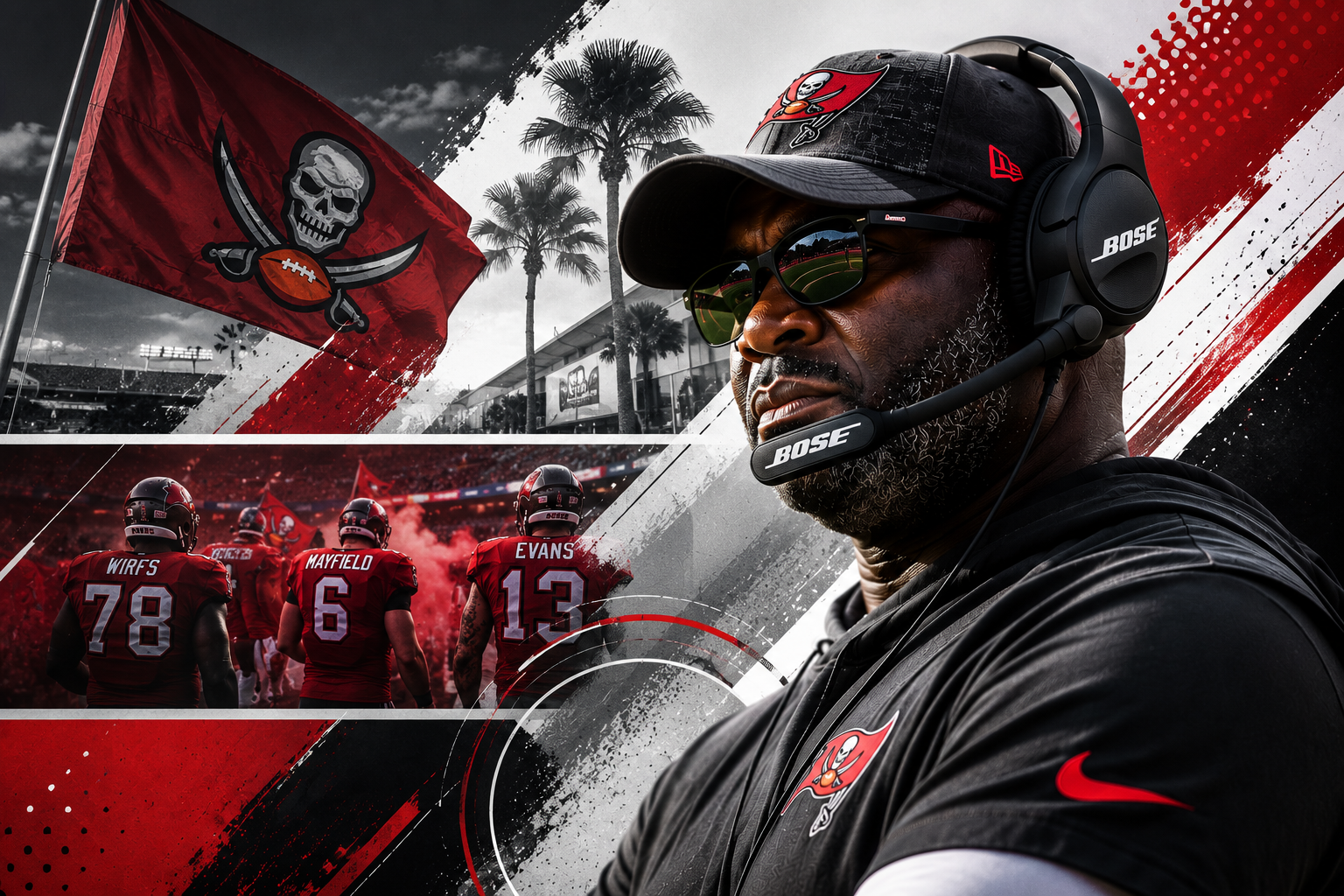
NFL training camps are often filled with contract negotiations, trade rumors, and questions about the future. Few teams have entered camp this year carrying as many high-profile storylines as the Tampa Bay Buccaneers. Yet despite a franchise quarterback expressing frustration over his contract, a Pro Bowl defensive lineman requesting a trade, and an offseason that included the departure of Mike Evans and the retirement of Lavonte David, head coach Todd Bowles has remained remarkably consistent in his message. 


For Bowles, the priority isn't contract talks or speculation about the future. It's preparing the Buccaneers for Week 1. 


That approach has become the defining theme of Tampa Bay's training camp as the organization attempts to keep its attention on football instead of headlines. 


Bowles Is Drawing a Clear Line Between Business and Football 


The Buccaneers entered camp with two significant contract situations hanging over the organization. 


Quarterback Baker Mayfield acknowledged his disappointment after extension negotiations failed to produce a new agreement before his self-imposed deadline. Meanwhile, defensive tackle Vita Vea publicly requested a trade while seeking a new contract, adding another layer of uncertainty to Tampa Bay's preseason preparations. 


Rather than allowing either situation to dominate training camp, Bowles has consistently emphasized that contract negotiations belong outside the practice field. 


His message has remained simple: the team understands the business side of the NFL, but once players step between the lines, the focus shifts entirely to football. 
Leadership Starts With the Locker Room 


Contract disputes can quickly divide an NFL locker room if players begin questioning one another's commitment. Tampa Bay's veterans, however, have consistently rejected that idea. 


Mayfield has continued participating fully in training camp despite contract negotiations ending until after the season. He has also made it clear to teammates that his focus remains on helping the Buccaneers win games rather than allowing outside issues to become distractions. 


Wide receiver Chris Godwin echoed that sentiment by emphasizing that teammates understand the business side of professional football and have no reason to question the commitment of players handling contract negotiations. From inside the locker room, the expectation remains that everyone will continue preparing the same way regardless of unresolved financial matters. 


That unity is exactly what Bowles hopes will prevent outside headlines from influencing the team's daily work. 


Tampa Bay Has Faced More Than Contract Questions 


The Buccaneers' offseason has included far more than negotiations with Mayfield and Vea. 


Longtime franchise cornerstone Mike Evans departed in free agency, ending one of the most successful player-team relationships in club history. Shortly afterward, veteran linebacker Lavonte David retired after serving as one of the organization's most respected leaders for more than a decade. 


Those changes alone would have created questions about Tampa Bay's leadership entering the new season. 


Instead, they have been joined by uncertainty surrounding two of the team's most important remaining players. 


For many organizations, that combination could easily create tension throughout training camp. Bowles appears determined to keep those developments from defining the atmosphere around the team. 


The Buccaneers Are Betting on Professionalism 


One reason Bowles has remained confident is the experience within Tampa Bay's locker room. 


Mayfield continues to practice, Vea remains engaged with teammates despite his trade request, and veteran leaders have publicly stressed that business negotiations do not change their approach once football activities begin. 


Bowles has repeatedly described the roster as mature enough to separate contract discussions from on-field preparation. That confidence reflects his belief that veteran leadership can prevent temporary business issues from affecting the team's long-term goals. 


It is a philosophy NFL coaches frequently preach, but one that becomes far more difficult to maintain when multiple star players are involved simultaneously. 


The Real Test Will Come During the Season 


Keeping distractions out of training camp is one challenge. 


Maintaining that focus throughout a full NFL season may prove much more difficult. 


Mayfield is expected to play the final year of his current contract before free agency becomes a possibility, while Vea's future with the organization remains uncertain after requesting a trade. Neither storyline is likely to disappear once the regular season begins. 


At the same time, Tampa Bay is attempting to rebound after missing the playoffs last season, placing additional pressure on both the coaching staff and the roster. 


Winning games has a way of quieting distractions. Losing, however, often magnifies every unresolved issue surrounding an organization. 


Bowles Knows Headlines Don't Win Games 


Training camp headlines often create the impression that a franchise is either unraveling or thriving long before meaningful football begins. 


Bowles has consistently refused to embrace either narrative. 


His comments throughout camp suggest he views contract disputes as part of the NFL's business landscape rather than signs of a fractured locker room. By encouraging players to separate negotiations from preparation, he is attempting to create stability during one of the franchise's most eventful offseasons in recent memory. 


Whether that approach ultimately leads Tampa Bay back to the postseason will not be determined by contract negotiations or trade speculation. 


It will be determined by what happens once the Buccaneers take the field. 


For now, Bowles appears determined to ensure that every conversation inside the building returns to the same subject: football. 
FOOTBALL
By Amber Aniston July 31, 2026
FIFA's World Cup investment proposal has sparked opposition from major football confederations, with governance and transparency emerging as the central issues.
football player
By Amber Aniston July 30, 2026
Build a stronger 2026 fantasy football roster by understanding why drafting running backs early can create flexibility and long-term value in half-PPR leagues.
By Amber Aniston July 30, 2026
One of the most significant pieces of legislation in the history of college athletics is facing an uncertain future. The proposed Protect College Sports Act (PCSA) was designed to create a nationwide framework for regulating name, image and likeness (NIL), transfer rules, revenue sharing, and athlete eligibility. However, with the Big Ten and SEC withholding their formal support, lawmakers are running out of time to move the bipartisan bill through Congress before the Senate's August recess. The legislation has been viewed by many athletic directors and conference commissioners as the best opportunity to restore stability to an increasingly fragmented college sports landscape. But ongoing disagreements over several key provisions have placed its future in jeopardy. Why the Protect College Sports Act Matters College athletics has undergone dramatic changes over the past several years. NIL compensation, the transfer portal, athlete revenue sharing, and repeated court rulings have fundamentally altered how schools recruit, retain, and compensate student-athletes. The Protect College Sports Act was introduced to establish consistent national standards rather than leaving schools to navigate a patchwork of state laws and ongoing legal challenges. Among its major goals are: Creating uniform NIL regulations nationwide Standardizing transfer portal rules Establishing revenue-sharing guidelines Providing five years of athlete eligibility Giving conferences greater authority to enforce regulations Offering additional legal protections related to antitrust challenges Supporters believe the legislation could bring much-needed structure to college athletics after years of uncertainty. Why the Big Ten and SEC Have Not Signed Off Despite generally supporting federal legislation, the two most powerful conferences remain unwilling to endorse the current version of the bill. Conference leaders say several important issues remain unresolved, particularly language involving so-called "associated entities." These include corporate sponsors, multimedia rights partners, and outside organizations that could potentially direct additional compensation to athletes outside the proposed revenue-sharing cap. Big Ten and SEC officials argue that unless those loopholes are addressed, schools could effectively bypass spending limits, undermining the legislation's purpose.  Ohio State Athletic Director Ross Bjork summarized the conferences' position simply: "We need a ceiling." Revenue-Sharing Cap Remains the Biggest Obstacle Much of the debate centers on how athlete compensation would be limited. Current negotiations include a structure featuring: $21.3 million base revenue-sharing cap Approximately $20–22.5 million additional retention pool Up to $5 million designated for women's athletics Conference leaders support increasing athlete compensation but insist those figures must be paired with a truly enforceable hard cap. Without stronger safeguards, administrators worry schools could continue funneling money through outside partnerships while technically remaining under the cap. Time Is Becoming the Biggest Challenge Even if negotiators reach an agreement, Congress faces a rapidly approaching deadline. The Senate is scheduled to begin its month-long recess on August 7 , leaving only a narrow window for lawmakers to advance the legislation. Senate staff members have publicly acknowledged that every passing day reduces the likelihood of securing a floor vote before lawmakers leave Washington. Conference representatives and congressional staff have continued negotiating revised language, but formal approval from the Big Ten and SEC has yet to arrive. Lawmakers Say Major Concessions Have Already Been Made Congressional leaders argue they have significantly revised the proposal in response to conference concerns. According to reports included in the source material, lawmakers agreed to numerous requested changes, including: Stronger recruiting and tampering provisions Modified revenue-sharing language Changes involving conference governance Adjustments affecting NIL oversight Additional flexibility regarding institutional NIL agreements Despite those revisions, conference officials maintain they still need to review final legal language before committing their support. Conference Leaders Say They Need More Certainty Big Ten Commissioner Tony Petitti has repeatedly emphasized that conference officials cannot endorse language they have not fully reviewed. Rather than rejecting the legislation outright, Petitti has described the negotiations as an effort to ensure the final bill accomplishes its intended purpose. Conference officials also continue seeking broader antitrust protections and greater certainty regarding how future enforcement would work under the proposed law. SEC Commissioner Greg Sankey has similarly stated in recent weeks that congressional legislation remains the preferred outcome but acknowledged the conference has discussed alternative governance models if federal action ultimately fails. Alternative Plans Already Being Discussed If Congress cannot pass the Protect College Sports Act, college athletics may move toward alternative solutions. Among the possibilities currently under discussion are: Plan B Revising the current College Sports Commission structure Negotiating updated revenue-sharing rules among the Power Four conferences Creating stronger conference-led enforcement mechanisms Plan C A self-governance model led by the major conferences Independent enforcement of recruiting, NIL, and compensation rules Greater conference autonomy outside the existing NCAA structure Neither option is considered ideal by conference leaders, who continue describing federal legislation as the preferred long-term solution. Industry Remains Divided Not every stakeholder agrees with the conferences' position. Executives representing multimedia rights companies argue that legitimate endorsement agreements should not automatically count against athlete compensation limits. Others believe an overly restrictive cap could unintentionally reduce genuine commercial opportunities for student-athletes who have built valuable personal brands. That disagreement highlights the broader challenge facing lawmakers: balancing competitive fairness with athletes' growing opportunities to profit from their name, image, and likeness. What's Next? Negotiations between congressional leaders, the White House, and conference representatives remain ongoing. According to the latest reports, lawmakers submitted what has been described as a "best and final" revised version of the legislation to the Big Ten and SEC while asking both conferences to make their decision quickly. Whether that will be enough to secure their support remains unclear. For now, the Protect College Sports Act remains alive—but time is quickly becoming its biggest opponent. If an agreement cannot be reached before Congress begins its August recess, the effort to establish national standards for college athletics could be delayed for months, leaving schools, athletes, conferences, and fans to continue navigating one of the most uncertain periods in the history of collegiate sports.
By Angelie Te July 30, 2026
This article is a practical guide to sports sponsorship activation for brands, schools, athletic programs, and event organizers working around live sports coverage. Whether you run a booster club, manage athletic marketing for a district, or represent a company looking at sponsorship opportunities, the strategies here focus on live and streamed sports events rather than generic sponsorship theory. Target readers: brand marketers, athletic directors, booster clubs, school communications teams, and event organizers planning sponsor integration around streamed or televised games.
By Angelie Te July 30, 2026
1. Why High School Sports Live Streaming Matters Before the Next Big Game Friday night football under the lights, winter basketball tournaments packed into a single gym, spring baseball doubleheaders that stretch past sundown - none of these moments stay local anymore. Parents watching from a work trip, grandparents three states away, and college recruiters scanning for their next recruit all expect to watch high school games the moment they happen. High school sports live streaming has shifted from a nice-to-have experiment to a baseline expectation for 2026 athletic programs.
USC Trojans football head coach
By Amber Aniston July 29, 2026
One of college football's most iconic rivalries remains on pause, and USC head coach Lincoln Riley continues to believe the series could have continued if negotiations had unfolded differently. Speaking during Big Ten Media Days , Riley reiterated that he wants the annual matchup between USC and Notre Dame to remain on the schedule. However, he also suggested the Fighting Irish bear responsibility for the current hiatus after the two schools failed to reach an agreement on extending the series beyond its previous contract. The rivalry, which has been played nearly every year for almost a century, will not be contested this season for just the fifth time since World War II, ending one of the longest continuous traditions in college football. Lincoln Riley Says USC Wanted to Keep Playing Riley made it clear that USC's desire to continue the rivalry has not changed. When asked about the status of future games, the Trojans coach said his position remains the same and expressed hope that the two programs can eventually return the matchup to the college football calendar. According to Riley, the game would still be taking place had previous discussions resulted in the agreement USC expected. "Nothing's changed from my vantage point," Riley said. "We want to play the game. I want to play the game." While Riley stopped short of directly criticizing Notre Dame by name, his comments reinforced USC's longstanding position regarding the stalled negotiations. Why the Rivalry Was Paused The disagreement centered largely on scheduling. USC reportedly wanted to move the annual rivalry from its traditional late-season date to Week 0 , believing an early-season matchup would reduce the potential impact a late loss could have on the Trojans' College Football Playoff hopes. Notre Dame declined that proposal. Head coach Marcus Freeman previously explained that while he is willing to play USC "anytime, anywhere," moving a game that had historically been scheduled near the end of the regular season to the opening week was not in the best interest of the Irish program. Without an agreement on scheduling, the rivalry was placed on hold. A Rivalry Unlike Almost Any Other Few games in college football carry the historical significance of Notre Dame versus USC. The programs have met: 96 times entering the hiatus 78 of the last 79 seasons Every year except the COVID-affected 2020 season during that stretch Before the 2020 interruption, the only extended pause came during World War II , when the rivalry was not played for three consecutive seasons. The annual matchup has featured numerous Hall of Fame players, Heisman Trophy winners, national championship teams, and unforgettable finishes that helped shape college football's national popularity. Why Scheduling Became More Complicated The changing landscape of college football has made scheduling marquee nonconference games increasingly difficult. USC now competes in the Big Ten , where annual conference schedules already include several nationally ranked opponents. Combined with expanded College Football Playoff discussions, many programs are carefully evaluating how difficult nonconference schedules could affect postseason opportunities. Some observers believe that concern influenced USC's request to move the rivalry earlier in the season, allowing the Trojans additional opportunities to recover from a loss before playoff selections are made. Notre Dame, meanwhile, maintained that preserving the rivalry's traditional place on the calendar remained important. Notre Dame Quickly Filled the Opening Following the breakdown in negotiations, Notre Dame moved quickly to adjust its future schedule. The Irish announced a home-and-home series with BYU , a decision USC supporters have pointed to as evidence that Notre Dame was prepared to move on from the rivalry rather than continue negotiations. Notre Dame officials have not publicly blamed USC for the hiatus, instead emphasizing that scheduling decisions must reflect what is best for the football program as a whole. Freeman has consistently stated that he understands USC must also make decisions based on its own competitive priorities. Could the Rivalry Return? Despite the current break, neither school appears ready to end the rivalry permanently. Reports referenced in the source material indicate both programs remain interested in renewing the series, with 2030 viewed as the earliest realistic opportunity for games to resume. Several factors could make future negotiations easier. Among them are: Potential expansion of the College Football Playoff Changes to conference scheduling models Greater flexibility in nonconference scheduling Long-term television agreements that accommodate marquee rivalry games If those developments occur, both schools may find it easier to restore one of college football's premier annual matchups. Fans Continue Hoping for a Resolution The pause has disappointed fans on both sides. For generations, Notre Dame and USC have represented one of the sport's defining intersectional rivalries, regularly matching national powers from opposite coasts in games that often carried championship implications. The series has also produced some of college football's most memorable moments while featuring legendary coaches and countless future NFL stars. Its absence leaves a noticeable gap on the national schedule. The Tradition Isn't Gone—Just Waiting While Lincoln Riley continues to suggest Notre Dame deserves much of the blame for the current hiatus, both programs have consistently expressed a desire to eventually bring the rivalry back. Whether that happens in 2030 or later remains uncertain, but there appears to be mutual recognition that college football is better when Notre Dame and USC share the field. Until an agreement is reached, one of the sport's greatest traditions will remain on hold, with fans left hoping the rivalry returns before another generation misses the opportunity to experience one of college football's most celebrated annual games.
Caitlin Clark
By Amber Aniston July 29, 2026
Indiana Fever star Caitlin Clark will have to carefully manage her emotions for the remainder of the regular season after the WNBA denied the team's appeal to rescind her seventh technical foul. The league's decision leaves Clark just one technical foul away from an automatic one-game suspension , creating an added storyline as the Fever continue one of the WNBA's hottest stretches heading toward the playoffs. While Clark remains one of the league's top performers, another technical foul would not only trigger a suspension but also carry an additional financial penalty under league rules. The ruling comes as Indiana has won four consecutive games and continues climbing the standings behind Clark's outstanding play. Why Clark Received the Technical Foul Clark's latest technical foul occurred during Indiana's 123-88 victory over the Connecticut Sun before the WNBA All-Star break. The Fever guard became involved in a verbal exchange with Connecticut rookie Saniya Rivers during the third quarter. Officials assessed technical fouls to both players after the confrontation. Following the game, Clark explained that Rivers had told her she was "locking her up." Clark responded by pointing to the scoreboard, noting Indiana held a commanding 95-67 lead at the time of the exchange. Although many observers viewed the interaction as routine competitive trash talk, the officials determined both players deserved technical fouls. Fever Appeal Is Unsuccessful Believing the technical foul was unwarranted, the Fever submitted an appeal to the WNBA. Indiana argued that the exchange did not rise to the level of conduct typically resulting in a technical foul, especially given that similar on-court conversations occur throughout the league. However, league officials upheld the original ruling, meaning Clark's seventh technical foul remains on her record. The decision leaves the Fever without further avenues to challenge the call. WNBA Technical Foul Rules Clark now finds herself in dangerous territory under the WNBA's disciplinary system. Current WNBA Technical Foul Penalties First through third technical fouls: $500 fine each Fourth through seventh technical fouls: $1,000 fine each Eighth technical foul: Automatic one-game suspension and $1,500 fine Every two additional technical fouls (10th, 12th, 14th, etc.): Additional one-game suspension With seven technical fouls already assessed this season, Clark must avoid another infraction if she hopes to remain available for every remaining regular-season game. Clark Continues Playing at an MVP Level Despite the disciplinary concern, Clark's production has remained among the league's best. During the game against Connecticut that resulted in her seventh technical foul, she finished with: 27 points 11 assists Five three-pointers She followed that performance with another spectacular outing Tuesday night against the Seattle Storm. Clark vs. Seattle 32 points 7 assists 4 rebounds 9-for-14 shooting Four three-pointers Her recent performances have helped Indiana continue one of its strongest stretches of the season. Fever Building Momentum Indiana has become one of the WNBA's hottest teams entering the final months of the regular season. After opening the year with a 5-5 record , the Fever have found another gear, winning four straight games to improve to 18-10 . The team's balanced offense has played a major role in that turnaround. Alongside Clark, veterans Kelsey Mitchell and Aliyah Boston have consistently delivered strong performances, giving Indiana one of the league's most productive offensive trios. With the playoffs approaching, every remaining regular-season game carries increased importance for postseason positioning. Stephanie White Faces New Challenge The league's decision may also influence how head coach Stephanie White manages Clark moving forward. Clark has always played with visible emotion and competitive intensity, traits that have become part of her identity since entering the WNBA. While that passion fuels many of her performances, White and the coaching staff will likely emphasize avoiding unnecessary confrontations that could result in another technical foul. Maintaining Clark's availability will be essential if Indiana hopes to continue its climb in the standings. Next Test Comes Against Portland The Fever return to action Friday with a road game against the Portland Fire . Indiana will attempt to extend its winning streak while Clark enters the contest knowing every interaction with officials and opposing players could carry additional significance. Although the focus remains on winning basketball games, the suspension watch will now accompany Clark throughout every remaining contest until either the regular season concludes or she reaches the technical foul threshold. Balancing Passion With Discipline Clark's competitive fire has become one of the defining characteristics of her game. That emotion has helped establish her as one of the WNBA's biggest stars and a driving force behind Indiana's resurgence. At the same time, it now places her in a delicate position. With the WNBA declining to overturn her seventh technical foul, Clark must strike a careful balance between playing with the intensity that has made her successful and avoiding the next technical that would automatically sideline her for a game. For a Fever team with championship aspirations, keeping its franchise player on the court may be just as important as extending its current winning streak.
basketball staff assisting injured player
July 29, 2026
The Indiana Fever extended their winning streak Tuesday night, but the celebration was tempered by an injury scare involving one of the franchise's biggest stars. All-Star center Aliyah Boston exited Indiana's 105-95 victory over the Seattle Storm after suffering an apparent right leg injury during the second quarter. While Boston did not return to the game, the Fever expressed optimism afterward, with head coach Stephanie White indicating the decision to hold her out for the remainder of the contest was largely precautionary. The injury comes at a critical point in the season as Indiana continues climbing the WNBA standings and positioning itself for a playoff push. Boston Injured During Second Quarter The injury occurred midway through the second quarter at Climate Pledge Arena. Boston set a screen before rolling toward the basket to receive a pass from Caitlin Clark . As she attempted to move into the lane, she became tangled with Seattle's Flau'jae Johnson , causing her to fall awkwardly to the court. Boston landed directly on her right knee and immediately grabbed her leg in visible pain. Medical personnel quickly rushed onto the floor while players from both teams gathered around the Fever star. After remaining down for several moments, Boston was helped to her feet and slowly made her way to the locker room with assistance from the training staff. The images from the arena immediately raised concerns for one of the WNBA's premier frontcourt players. Fever Take a Conservative Approach Indiana later announced that Boston was questionable to return because of a right lower leg injury . Although she returned to the bench to watch the second half, Boston never re-entered the game. Coach Stephanie White explained afterward that the Fever chose not to risk making the injury worse. "We just want to be very conservative and make sure that she's good to go," White said following the victory. White did not provide a timetable for Boston's return, and the team has not yet released additional details regarding the severity of the injury. Boston Was Off to Another Strong Performance Before leaving the game, Boston continued the productive season that has helped make Indiana one of the WNBA's top teams. She finished with: 11 points 2 rebounds 1 assist 1 steal 10 minutes, 38 seconds played Entering Tuesday night's contest, Boston was averaging: 17.3 points per game 8.5 rebounds per game Her consistent production has earned another All-Star selection and remains one of the biggest reasons for Indiana's success this season. Caitlin Clark Takes Over After Boston exited, Caitlin Clark delivered another standout performance to help secure the victory. Clark scored 32 points while adding seven assists , including an explosive third quarter in which she accounted for 16 of Indiana's 18 points . She finished 9-for-14 from the field , leading the Fever to their fourth consecutive victory. The win also marked another milestone for Indiana's offense. The Fever have now scored 100 or more points in 12 games this season , establishing a new WNBA single-season record. Teammates Step Up in Boston's Absence Indiana's supporting cast helped absorb Boston's absence during the second half. Several players made important contributions, including: Monique Billings: 14 points, 11 rebounds Makayla Timpson: 4 points, 4 rebounds, 1 block Myisha Hines-Allen: 5 points, 4 rebounds White praised the team's response after Boston went down, saying the players rallied around one another and remained focused despite the emotional moment. "Our communication in huddles has been really, really good," White said. "Everybody has to do a little bit more, and our team did that." Sophie Cunningham Expresses Confidence During a halftime interview, teammate Sophie Cunningham spoke about Boston's importance to the team. Cunningham described Boston as a unique player whose value extends beyond statistics, calling her an All-Star and future Hall of Famer while expressing confidence that both Boston and the Fever would be okay. Her comments reflected the confidence teammates have in Boston's recovery while acknowledging the challenge of replacing one of the league's best centers. Fans Find Encouragement After the Game Although Boston never returned to action, postgame scenes gave many Fever supporters reason for optimism. Video shared after the game showed Boston walking without noticeable assistance while celebrating with teammates. She even performed her signature "Bow, Bow, Bow" celebration, prompting encouraging reactions from fans across social media. Many supporters pointed to her ability to walk comfortably as a positive sign, though the Fever have not yet announced whether she will be available for Friday's matchup against the Portland Fire . Fever Continue Climbing the Standings Indiana's victory improved the team's record to 18-10 , extending its winning streak to four games and moving the Fever within striking distance of the upper half of the WNBA standings. The team's balanced offense and improved depth have fueled one of the league's strongest stretches, but Boston's health could become a significant storyline as the regular season enters its final months. For now, the Fever appear encouraged that the injury may not be as serious as initially feared. Still, until additional evaluations are completed, Indiana—and its fans—will be closely monitoring one of the team's most valuable players ahead of another important stretch in the playoff race.
More Posts