
EAST COAST SPORTS LIVE
Men's Basketball
Men's basketball news

March Madness is heading back to Wichita. The NCAA has officially selected Wichita, Kansas , to host Opening Round games for the 2027 and 2028 NCAA Division I Men's Basketball Championship , marking a significant milestone as the men's tournament expands from 68 to 76 teams beginning in 2027. Wichita will join longtime host Dayton, Ohio , in welcoming teams during the opening days of college basketball's biggest event. The decision reinforces Wichita's reputation as one of the nation's premier college basketball destinations while introducing a new format that accommodates the expanded NCAA Tournament field. NCAA Tournament Expansion Creates New Opportunity The addition of eight teams to the NCAA Tournament required changes to the tournament's opening schedule. Beginning in 2027, both Wichita and Dayton will host three Opening Round games on Tuesday and Wednesday following Selection Sunday . The expanded format will feature 12 automatic qualifiers and 12 at-large teams competing for spots in the traditional 64-team bracket. The NCAA approved tournament expansion earlier this year, prompting a nationwide search for an additional Opening Round host city. Wichita Earns the Bid After reviewing proposals from multiple interested cities, the NCAA Division I Men's Basketball Committee selected Wichita as the newest Opening Round site. The recommendation was later approved by the Division I Men's Basketball Oversight Committee, officially awarding Wichita hosting duties for both the 2027 and 2028 tournaments . Wichita State University will serve as the official host in partnership with Visit Wichita , Sedgwick County , and the City of Wichita . Committee Chair Keith Gill cited Wichita's passionate basketball culture and central location as major reasons behind the selection, noting that the city is well-positioned to welcome teams from across the country on short notice after Selection Sunday. INTRUST Bank Arena Returns to the National Stage All Opening Round games will be played at INTRUST Bank Arena , a venue already familiar with NCAA Tournament basketball. The downtown arena previously hosted first- and second-round NCAA Tournament games in 2018 and 2025 , while Wichita's history as an NCAA Tournament host dates back to 1956 . Over the decades, the city has welcomed numerous March Madness contests at Levitt Arena, the Kansas Coliseum, and INTRUST Bank Arena. The NCAA's decision continues Wichita's long tradition as one of college basketball's most respected host cities. Wichita's Basketball Tradition Basketball has been deeply woven into Wichita's identity for generations. The success of Wichita State University , combined with consistently strong attendance at NCAA Tournament events, has helped establish the city as one of the country's premier basketball markets. The Shockers reached the 2013 Final Four , earned a No. 1 seed in the 2014 NCAA Tournament , and built one of the nation's most passionate fan bases. That tradition played a significant role in convincing the NCAA that Wichita could successfully launch the expanded tournament. Local Leaders Celebrate the Announcement The announcement was welcomed by both university and community leaders. Wichita State Director of Athletics Kevin Saal called the selection an honor, emphasizing the city's reputation for supporting college basketball while highlighting the economic impact the tournament will have on Wichita and the surrounding region. INTRUST Bank Arena Regional General Manager A.J. Boleski also expressed excitement about bringing another national championship event to the venue and providing a first-class experience for participating teams and fans. NCAA Senior Vice President of Basketball Dan Gavitt added that Wichita's central location makes it an ideal destination, allowing many participating schools and fan bases to travel efficiently during the tournament's opening days. How the Expanded Opening Round Will Work The new Opening Round format reflects the NCAA's expansion to 76 teams. The six automatic-qualifier games will feature the tournament's lowest-seeded conference champions, while the six at-large matchups will involve the final at-large teams selected to the bracket. The NCAA also plans to consider travel logistics when assigning teams to Opening Round sites, helping reduce unnecessary travel before the first round begins. The first expanded Opening Round will be held March 16–17, 2027 , with Wichita again hosting games March 14–15, 2028 . Economic and National Impact Hosting the Opening Round is expected to bring significant benefits beyond basketball. Thousands of visiting fans, student-athletes, coaches, media members, and NCAA officials will travel to Wichita over consecutive years, creating a substantial economic boost for local hotels, restaurants, transportation providers, and businesses. The announcement also strengthens Wichita's national profile as a destination capable of hosting major sporting events, continuing a trend that recently earned the city recognition as one of America's leading sports-event hosts. Looking Ahead to March Madness The expanded NCAA Tournament begins a new era for college basketball. With Wichita joining Dayton as an Opening Round host, the first days of March Madness will now feature games in two basketball-rich communities capable of welcoming teams from across the country. The additional host site provides greater flexibility for the NCAA while creating new opportunities for fans to experience the excitement of the tournament's opening games. As the sport prepares for its first 76-team bracket, Wichita is set to become one of the most important stops on the road to the Final Four. Final Takeaway The NCAA's decision to award Wichita the 2027 and 2028 NCAA Men's Basketball Championship Opening Rounds represents a major milestone for both the city and the tournament itself. Driven by the expansion to a 76-team field, Wichita's rich basketball history, central location, and proven ability to host championship events made it a natural choice to join Dayton in launching March Madness. When the expanded tournament tips off in March 2027, Wichita will once again find itself at the center of college basketball, welcoming teams and fans as the pursuit of a national championship officially begins.
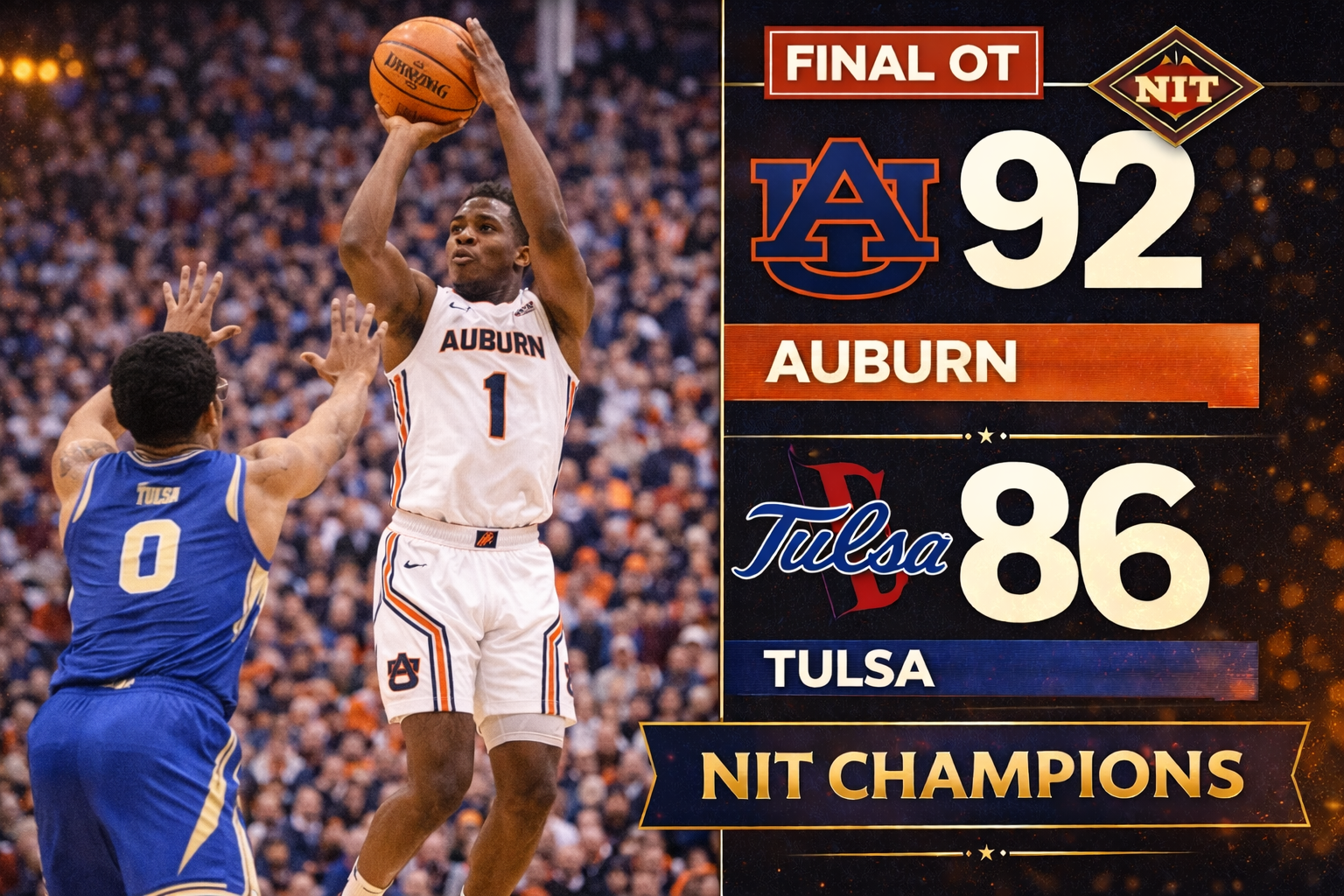
INDIANAPOLIS — Auburn completed a dramatic postseason run Sunday night, defeating Tulsa 92–86 in overtime at Gainbridge Fieldhouse to claim the program’s first National Invitation Tournament championship. The Tigers overcame a massive second-half collapse, regained composure in the final seconds of regulation, and controlled overtime to finish a five-game NIT run with a title. Auburn improved to 22–16 on the season, while Tulsa ended its year at 30–8 after one of the most resilient tournament runs in the country. Fast Start Gives Auburn Early Control Auburn set the tone early with one of its most dominant stretches of the postseason. The Tigers opened the game shooting efficiently and applying defensive pressure that disrupted Tulsa’s offense from the outset. Auburn quickly built a double-digit lead, fueled by balanced scoring and strong perimeter shooting. Tahaad Pettiford and Kevin Overton led the charge early, combining for multiple three-pointers while pushing the pace in transition. The Tigers extended their lead to 34–13 during the first half, capitalizing on Tulsa’s struggles to find rhythm. The Golden Hurricane missed 10 consecutive shots during one stretch and committed multiple turnovers, allowing Auburn to build a commanding advantage. By halftime, Auburn held a 48–31 lead, appearing in full control after dominating both ends of the floor. Tulsa Responds With Massive Second-Half Run The game shifted dramatically after the break as Tulsa mounted one of the most impressive comebacks of the postseason. The Golden Hurricane increased defensive pressure and began converting scoring opportunities, gradually chipping away at Auburn’s lead. A decisive turning point came during a 22–2 Tulsa run that erased Auburn’s advantage and gave the Golden Hurricane its first lead of the game. David Green led the surge, scoring consistently and providing momentum that shifted the game’s tone. Tulsa continued to apply pressure, eventually taking a late lead and putting Auburn in a position where it needed a final push to stay alive. Late Sequence Forces Overtime With the game nearing its conclusion, Tulsa appeared poised to secure the championship. A three-pointer gave the Golden Hurricane a five-point lead with just over a minute remaining, creating separation at a critical moment. Auburn responded with urgency. Pettiford hit a key three-pointer to cut the deficit, and the Tigers continued to fight for possessions in the closing seconds. A crucial defensive stand forced a five-second violation on an inbound play, giving Auburn one final opportunity. Overton delivered the defining moment of regulation, knocking down a game-tying three-pointer with eight seconds remaining to send the game into overtime. Auburn Takes Control in Overtime Once the game reached overtime, Auburn regained control and executed with precision. The Tigers shot efficiently in the extra period, converting four of five field-goal attempts while limiting Tulsa’s scoring opportunities. Overton continued his standout performance, hitting a deep three-pointer that extended Auburn’s lead and shifted momentum decisively. The Tigers maintained control through disciplined defense and timely free throws in the closing seconds. Tulsa remained competitive but was unable to match Auburn’s execution in the extra period, as the Tigers outscored the Golden Hurricane down the stretch to secure the victory. Overton and Pettiford Lead the Way Kevin Overton delivered a championship performance, leading Auburn with 26 points while hitting multiple key shots, including the game-tying three-pointer in regulation and a critical basket in overtime. Tahaad Pettiford added 24 points and eight assists, providing consistent scoring and playmaking throughout the game. His ability to create offense and respond in key moments played a major role in Auburn’s success. The Tigers also received strong contributions across the lineup. Keyshawn Hall recorded a double-double with 11 points and 12 rebounds, while Sebastian Williams-Adams added 13 points. Elyjah Freeman contributed on the glass, finishing with 14 rebounds and helping Auburn control key possessions. Balanced Effort Completes Title Run Auburn’s balanced scoring proved essential, with five players finishing in double figures. The team’s depth allowed it to maintain offensive production even as Tulsa mounted its comeback. The Tigers’ ability to respond to adversity and execute under pressure defined their postseason run. Auburn won five consecutive games in the NIT, demonstrating resilience and consistency throughout the tournament. Tulsa Falls Short After Strong Season Tulsa delivered a strong performance despite the loss, showcasing resilience and determination throughout the game. The Golden Hurricane erased a significant deficit and took control late in regulation before falling short in overtime. David Green led Tulsa with 25 points, while Tylen Riley added 20 and Ade Popoola contributed 13. The team’s second-half surge highlighted its ability to compete at a high level, even against a team that controlled much of the game early. The loss ended one of the most successful seasons in program history, with Tulsa finishing with 30 wins and a deep postseason run. Final Takeaway Auburn’s 92–86 victory over Tulsa was defined by resilience, late-game execution, and overtime composure. The Tigers built a commanding early lead, survived a major second-half collapse, and responded with clutch plays to force overtime and secure the win. Tulsa showed remarkable fight and nearly completed a comeback, but Auburn’s execution in the final moments and extra period proved decisive. With the victory, Auburn captures its first NIT championship, closing the season with momentum and a statement performance that reflects the team’s growth and ability to compete under pressure.
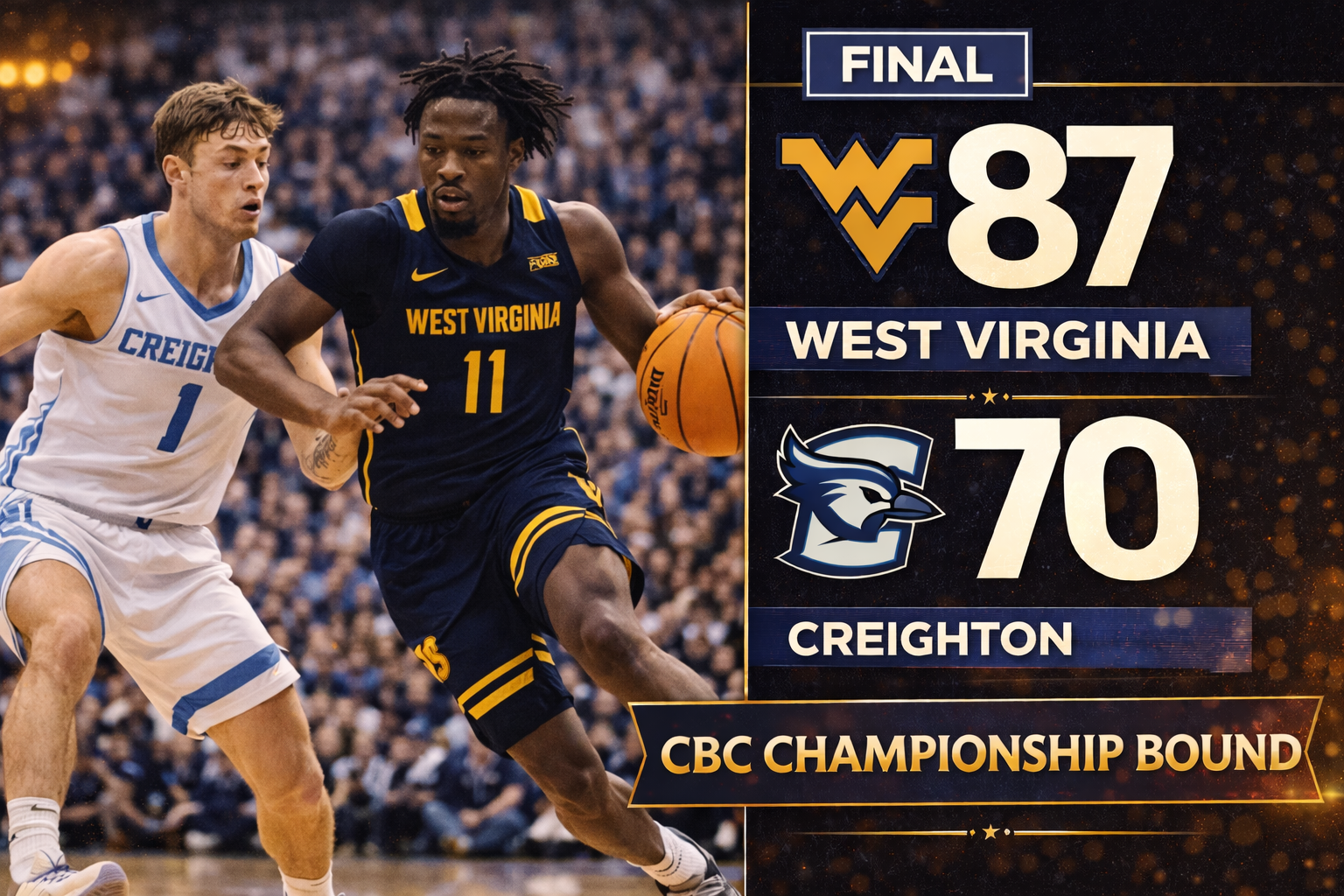
LAS VEGAS — West Virginia controlled the game from the opening minutes and never trailed, defeating Creighton 87–70 in the College Basketball Crown semifinals to earn a spot in the championship game. The Mountaineers delivered one of their most complete performances of the postseason, using efficient shooting, rebounding, and balanced scoring to separate from the Bluejays. The win pushed West Virginia to 20–14 on the season and secured the program’s first 20-win campaign in six years. Creighton, meanwhile, saw its season end at 16–18, with the loss also marking the final game of Greg McDermott’s tenure as head coach. Fast Start Sets the Tone West Virginia wasted no time taking control, opening the game with the first eight points and immediately putting Creighton on its heels. Honor Huff knocked down early three-pointers, while the Mountaineers established an aggressive rhythm on both ends of the floor. That hot start helped West Virginia build an early cushion and forced Creighton to play from behind the rest of the afternoon. Creighton did manage to cut into the deficit after falling behind by as much as 29–17 in the first half. The Bluejays responded with a strong run to make it a one-possession game, but West Virginia answered each push and carried a 43–37 lead into halftime. The Mountaineers had already established an advantage in the paint and looked sharper offensively throughout the opening 20 minutes. DJ Thomas Sparks a Balanced Offensive Attack Freshman DJ Thomas provided the biggest offensive lift for West Virginia, finishing with 20 points off the bench on 9-of-14 shooting. He played with confidence from the start, scoring 12 first-half points and giving the Mountaineers another creator who consistently pressured Creighton’s defense. His scoring punch helped West Virginia maintain control whenever the Bluejays tried to close the gap. Thomas was far from alone. Treysen Eaglestaff added 16 points, Brenen Lorient scored 15, Honor Huff contributed 13, and Chance Moore posted 10 points with a game-high 13 rebounds. With five players in double figures, West Virginia showcased the kind of depth and balance that made it difficult for Creighton to focus on stopping any one player. Second-Half Push Breaks the Game Open After Creighton opened the second half by trimming the margin to four, West Virginia answered with the decisive stretch of the game. The Mountaineers strung together timely baskets and defensive stops to extend the lead into double digits, eventually pushing the advantage to 16 with just over nine minutes remaining. Every time Creighton threatened, West Virginia had a response. The Bluejays later used an 8–0 run to get back within striking distance, but West Virginia shut the door with perimeter shooting. Eaglestaff hit back-to-back three-pointers, Huff added another, and the Mountaineers quickly rebuilt their cushion. That sequence effectively ended Creighton’s comeback hopes and turned the closing minutes into a controlled finish for West Virginia. Rebounding, Shooting, and Interior Play Make the Difference West Virginia’s efficiency was a major factor in the outcome. The Mountaineers shot 53 percent from the field and connected on 12 of 30 attempts from beyond the arc. They also outrebounded Creighton 39–29 and held advantages in second-chance points, points in the paint, bench scoring, and points off turnovers. Those numbers reflected just how complete the performance was. Creighton received 18 points from Josh Dix, 15 from Hudson Greer, and a 14-point, 12-rebound effort from Jasen Green. But despite those contributions, the Bluejays could never fully recover from West Virginia’s early control or match the Mountaineers’ scoring balance over 40 minutes. Championship Berth Secured With the victory, West Virginia advanced to face Oklahoma in the College Basketball Crown title game. The Mountaineers entered that matchup with momentum, confidence, and a level of offensive balance that had carried them convincingly through the semifinal round. Final Takeaway West Virginia’s 87–70 win over Creighton was defined by its strong opening, balanced scoring, and control of the game’s key statistical areas. DJ Thomas led the way, the supporting cast delivered across the board, and the Mountaineers never allowed Creighton to seize momentum. It was a confident, wire-to-wire performance that sent West Virginia to the CBC championship game in impressive fashion.
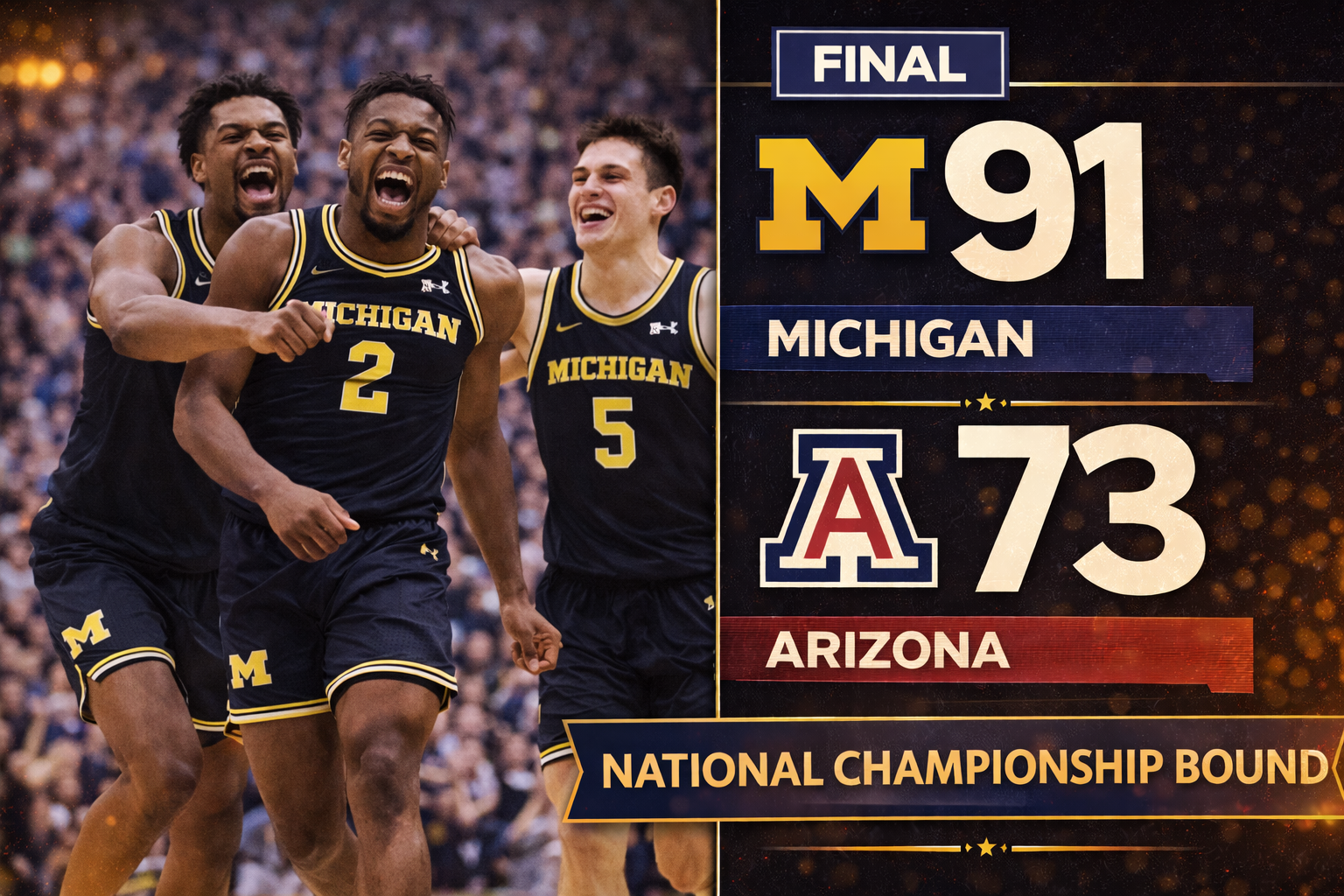
INDIANAPOLIS — Michigan delivered a commanding performance on college basketball’s biggest stage, defeating Arizona 91–73 in the Final Four to secure a spot in the national championship game. In a matchup featuring two of the nation’s top teams, the Wolverines controlled the game from the opening minutes and never allowed Arizona to find sustained momentum. The victory pushed Michigan to 36–3 on the season and into its first national title game since 2018. Arizona, which entered the night with one of the most successful seasons in program history, saw its run end despite a strong year that included a program-record 36 wins and its first Final Four appearance in over two decades. Fast Start Gives Michigan Early Control Michigan wasted no time establishing its presence, opening the game with an aggressive scoring burst that immediately put Arizona on the defensive. The Wolverines raced out to an early lead, capitalizing on missed shots and turnovers to build momentum within the first few minutes. Arizona struggled to find rhythm offensively, missing early opportunities while Michigan continued to convert on the other end. The Wolverines’ ability to score efficiently and apply defensive pressure created separation quickly, forcing Arizona into a catch-up position almost immediately. Even when the Wildcats attempted to respond with a brief run midway through the first half, Michigan answered with timely baskets and extended scoring runs. By the end of the first half, the Wolverines had built a 48–32 lead, putting themselves firmly in control of the game. Efficiency and Execution Define Michigan’s Performance Michigan’s offensive efficiency was a key factor throughout the game. The Wolverines shot over 57 percent from the field and were especially effective in the second half, where they converted at an even higher rate. Their ability to generate high-quality scoring opportunities, combined with strong ball movement and shot selection, made it difficult for Arizona to mount a defensive response. Michigan consistently found open looks and capitalized on them, extending its lead whenever the Wildcats showed signs of momentum. In addition to their shooting efficiency, the Wolverines benefited from strong interior play and transition scoring, further widening the gap as the game progressed. Arizona Struggles to Keep Pace Arizona entered the matchup with one of the nation’s top defenses, but it struggled to contain Michigan’s offensive rhythm. The Wildcats shot just 36 percent from the field and had difficulty creating consistent scoring opportunities. Turnovers also played a significant role, as Arizona committed multiple mistakes that Michigan quickly converted into points. The combination of inefficient shooting and turnovers prevented the Wildcats from sustaining any meaningful comeback attempts. Despite the challenges, Arizona continued to compete and showed flashes of its offensive potential. However, each time the Wildcats attempted to close the gap, Michigan responded with another scoring run to maintain control. Key Performances Lead Michigan Michigan’s success was fueled by a balanced offensive effort, with multiple players contributing throughout the game. Aday Mara led the Wolverines with 26 points, showcasing his scoring ability and efficiency in key moments. Trey McKenney added 16 points, providing perimeter shooting that stretched Arizona’s defense. Elliot Cadeau delivered a strong all-around performance with 13 points and 10 assists, controlling the tempo and facilitating Michigan’s offense effectively. Additional contributions came from Yaxel Lendeborg and Morez Johnson Jr., who provided scoring, rebounding, and defensive presence. This depth allowed Michigan to maintain a high level of play without relying on a single scorer. Second Half Seals the Outcome Any hopes of an Arizona comeback were quickly diminished in the second half as Michigan extended its lead. The Wolverines opened the half with another strong scoring stretch, building a significant advantage that reached more than 20 points. Arizona attempted to respond with brief scoring runs, but the Wildcats were unable to string together enough stops to make a meaningful impact. Michigan’s consistency on both ends of the floor ensured that the lead remained secure throughout the remainder of the game. By the final minutes, the outcome was no longer in doubt, with Michigan maintaining control and closing out the game comfortably. Historic Season Ends for Arizona Despite the loss, Arizona’s season remains one of the most successful in program history. The Wildcats finished with a 36–3 record and made their first Final Four appearance since 2001, marking a significant milestone for the program. Freshman Koa Peat led Arizona in the game with 16 points and 11 rebounds, becoming the first freshman in program history to record a double-double in the Final Four. His performance highlighted the team’s potential moving forward, even as the season came to an end. Championship Stage Awaits Michigan With the victory, Michigan advanced to face UConn in the national championship game. The Wolverines entered the final with momentum, having consistently delivered high-scoring performances throughout the tournament. Final Takeaway Michigan’s 91–73 win over Arizona was defined by early control, offensive efficiency, and consistent execution. The Wolverines set the tone from the opening minutes and never allowed Arizona to recover, delivering a complete performance on both ends of the floor. With balanced scoring and strong defensive pressure, Michigan positioned itself for a chance to capture a national championship, while Arizona’s remarkable season came to a close just short of the title game.
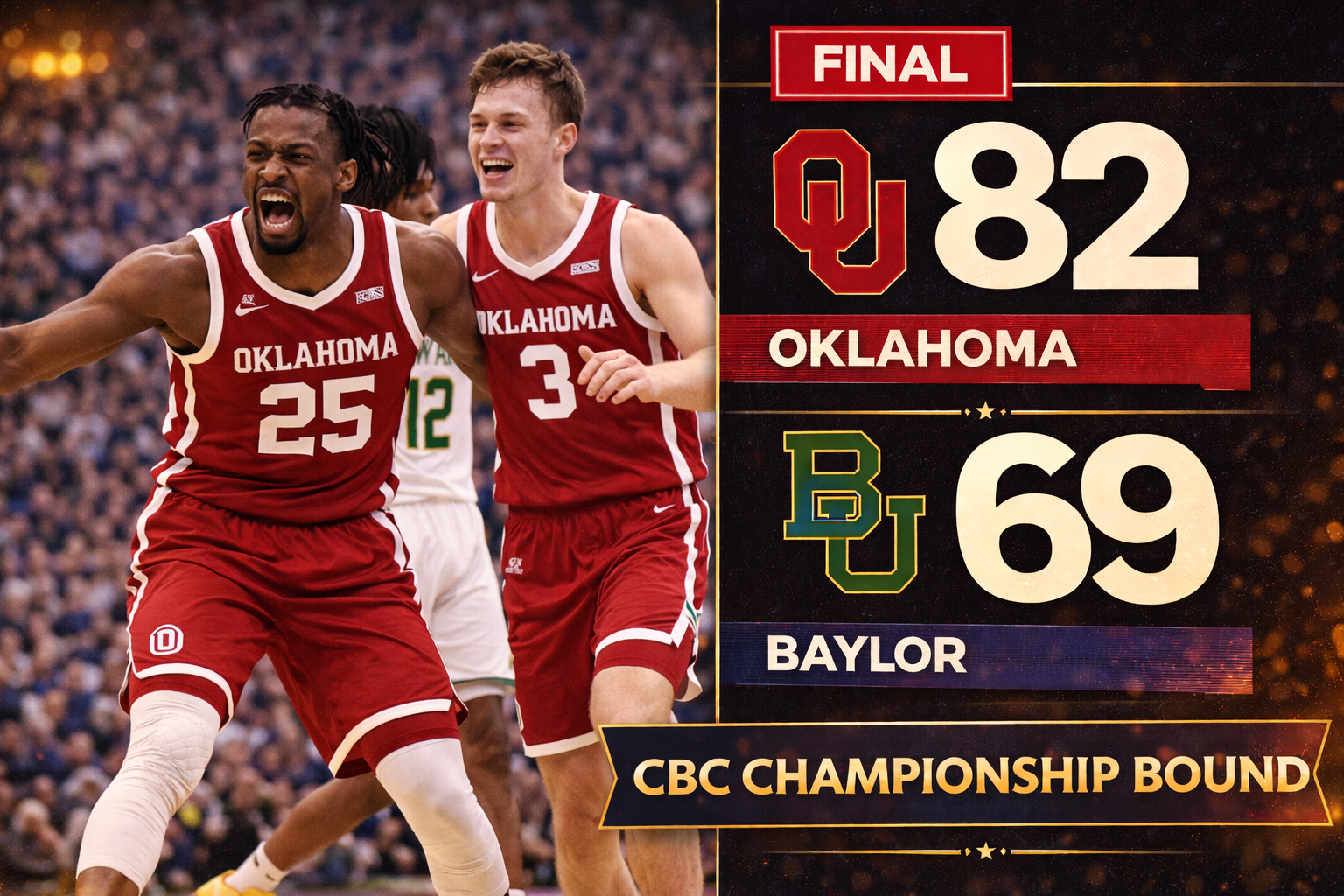
LAS VEGAS — Oklahoma delivered a composed and complete performance in the College Basketball Crown semifinals, defeating Baylor 82–69 behind a dominant closing stretch and balanced scoring effort. In a game that featured momentum swings and a brief second-half scare, the Sooners relied on efficiency, defense, and late execution to secure their place in the championship game. The win pushed Oklahoma to 21–15 on the season and marked its eighth victory in the last nine games, continuing a strong late-season surge. Baylor, which battled throughout and briefly took control in the second half, finished its season at 17–17 after falling short against a team that proved more consistent over the full 40 minutes. Oklahoma Sets the Tone Early with Efficiency and Control From the opening minutes, Oklahoma established control by playing with purpose on both ends of the floor. The Sooners capitalized on Baylor’s early mistakes, turning turnovers into quick scoring opportunities and building momentum through disciplined offense. Xzayvier Brown led the early charge, scoring efficiently while facilitating the offense with poise. His ability to control tempo and avoid turnovers gave Oklahoma a steady presence throughout the first half. Meanwhile, the Sooners’ defense applied pressure that disrupted Baylor’s rhythm and limited clean scoring chances. Oklahoma’s ability to convert on offense while forcing mistakes created a clear separation as the half progressed. The Sooners shot efficiently and maintained a significant advantage in points off turnovers, allowing them to build a 45–35 lead heading into halftime. Baylor Responds with Second-Half Surge Despite trailing by double digits at the break, Baylor came out of halftime with renewed energy and focus. The Bears tightened their defense and found success offensively, putting together a strong run that quickly erased Oklahoma’s advantage. An aggressive push midway through the second half allowed Baylor to take a 52–51 lead, marking a key turning point in the game. During that stretch, Baylor controlled the pace, attacked the basket effectively, and forced Oklahoma into a brief period of inconsistency. The surge shifted momentum and created pressure on the Sooners, who were forced to respond after seeing their comfortable lead disappear. However, Oklahoma’s composure proved to be a defining factor in what followed. Sooners Regain Control with Composure and Execution Rather than allowing the game to slip away, Oklahoma responded with timely shot-making and improved defensive focus. The Sooners quickly regained the lead and stabilized the tempo, preventing Baylor from building on its momentum. Tae Davis played a key role during this stretch, delivering crucial baskets that helped Oklahoma regain control. His scoring, particularly in the second half, provided stability when the game tightened and Baylor threatened to take over. Derrion Reid also contributed with aggressive play in transition and effective finishing around the rim, while Nijel Pack added scoring and defensive pressure. Together, the Sooners reestablished control by executing in key moments and limiting Baylor’s opportunities to sustain its run. Dominant Closing Run Seals the Victory With the game still within reach late, Oklahoma delivered its most decisive stretch of the night. The Sooners outscored Baylor 19–8 over the final 6:18, turning a competitive contest into a comfortable win. During that closing stretch, Oklahoma’s defense tightened significantly, limiting Baylor’s scoring opportunities and forcing difficult shots. The Bears struggled to generate offense, failing to score consistently as the Sooners maintained control. On the offensive end, Oklahoma executed with efficiency, converting key possessions and extending the lead with each trip down the floor. The combination of defensive stops and timely scoring created separation that Baylor could not overcome. Balanced Scoring Fuels Oklahoma’s Performance Oklahoma’s success was driven by a well-rounded offensive effort, with multiple players contributing throughout the game. Brown led the way with 21 points, six assists, and six rebounds, showcasing his ability to impact the game in multiple areas. Davis added 18 points, with the majority coming in the second half, while Reid contributed 17 points through aggressive and efficient scoring. Pack rounded out the group with 15 points, four assists, and three steals, providing leadership and defensive intensity. This balanced attack made it difficult for Baylor to focus on any single player, as Oklahoma consistently found scoring from multiple sources. Efficiency and Defense Make the Difference The statistical edge reflected Oklahoma’s overall control of the game. The Sooners shot 50 percent from the field compared to Baylor’s 39 percent, highlighting their offensive efficiency. More importantly, Oklahoma dominated in points off turnovers, holding a 21–2 advantage. That margin underscored the Sooners’ defensive activity and ability to convert mistakes into immediate scoring opportunities. Even during Baylor’s second-half push, Oklahoma’s consistency on both ends of the floor ultimately proved too much to overcome. Championship Opportunity Ahead With the win, Oklahoma advanced to face West Virginia in the College Basketball Crown championship game. The Sooners entered the final with momentum, confidence, and a balanced style of play that has defined their recent success. Final Takeaway Oklahoma’s 82–69 victory over Baylor was defined by control, resilience, and late-game execution. After building an early lead and responding to a second-half surge, the Sooners delivered a dominant closing run to secure the win. With balanced scoring, strong defense, and consistent execution, Oklahoma positioned itself for a chance to finish its postseason run with a championship performance.
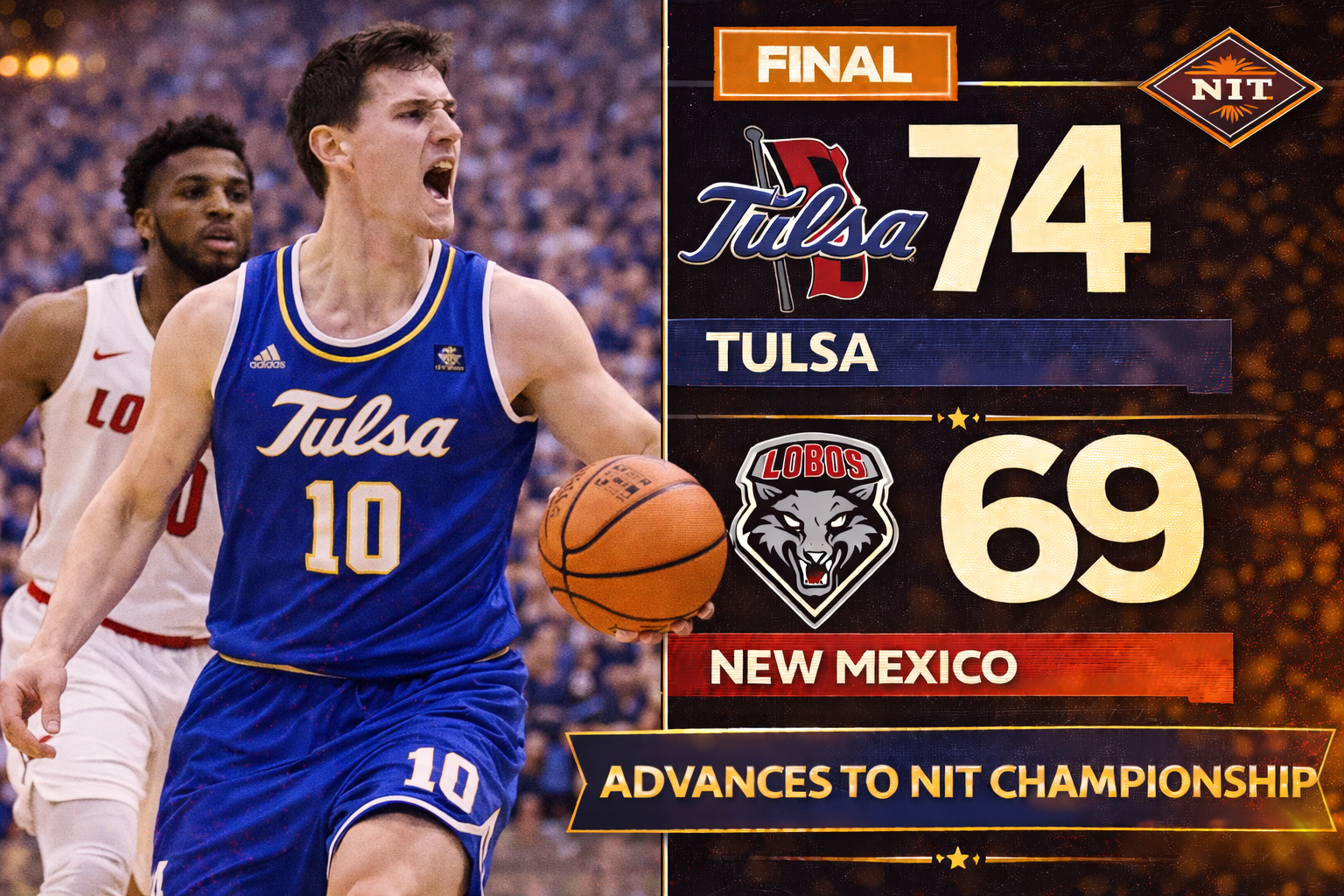
INDIANAPOLIS — Tulsa delivered a composed and balanced performance Thursday night, defeating New Mexico 74–69 in the NIT semifinals at Hinkle Fieldhouse to secure a spot in the championship game. The Golden Hurricane improved to 30–7 on the season and advanced to the NIT title game for the third time in program history, while New Mexico saw its season come to an end at 26–11 after a competitive performance that fell just short. Early Control and First-Half Run Set the Tone Tulsa established control early, using efficient offense and ball movement to build an advantage in the opening minutes. The Golden Hurricane generated consistent scoring opportunities and maintained a steady pace that limited New Mexico’s ability to settle defensively. The Lobos responded midway through the first half, cutting into the deficit and briefly taking the lead with improved perimeter shooting and interior scoring. The game turned into a back-and-forth battle, with both teams trading momentum. The decisive stretch of the first half came in the closing minutes, when Tulsa delivered an 8–0 run to break the tie and create separation. That surge allowed the Golden Hurricane to take a 36–29 lead into halftime, setting the foundation for the rest of the game. Second Half Remains Tight Throughout New Mexico opened the second half with increased intensity, focusing on defensive pressure and efficient scoring to cut into Tulsa’s lead. The Lobos used a series of runs to stay within striking distance, preventing the Golden Hurricane from extending the margin. Midway through the second half, Tulsa maintained a narrow advantage, but New Mexico continued to respond with timely baskets. A key moment came when the Lobos tied the game at 59–59 with just over five minutes remaining, creating a tense finish. The game remained tightly contested, with neither team able to build a significant lead as the final minutes approached. Late Run Secures the Victory Tulsa delivered its most important stretch in the closing minutes, responding to the tie with a decisive 8–0 run. Tyren Riley scored all eight points during the surge, giving the Golden Hurricane a 67–59 lead with just over two minutes remaining. That run proved to be the difference, as it created the separation Tulsa needed to control the final possessions. New Mexico attempted to respond, cutting the deficit to one possession late, but was unable to complete the comeback. Tulsa maintained composure at the free-throw line and executed defensively to preserve the 74–69 victory. Balanced Scoring Leads Tulsa Tulsa’s success was driven by balanced production across its lineup, with five players scoring in double figures. David Green led the team with 13 points, providing steady offense throughout the game. Ade Popoola added 12 points, while Miles Barnstable contributed 11. Tyren Riley and Jaylen Lawal each scored 10 points, giving Tulsa consistent scoring from multiple positions. The balanced attack allowed the Golden Hurricane to maintain offensive efficiency and prevent New Mexico from focusing its defensive efforts on a single player. Ball Movement and Shooting Efficiency Make the Difference Tulsa’s offensive execution played a major role in the win. The Golden Hurricane recorded 17 assists on 24 made field goals, demonstrating strong ball movement and team-oriented play. Perimeter shooting also proved decisive, as Tulsa connected on 12 three-pointers, creating spacing and forcing New Mexico to adjust defensively. The ability to stretch the floor opened opportunities both inside and beyond the arc. The combination of efficient shooting and unselfish play allowed Tulsa to maintain control even as New Mexico applied pressure in the second half. New Mexico Falls Short Despite Strong Effort New Mexico delivered a competitive performance, particularly in the second half, where the Lobos improved offensively and kept the game within reach. Jake Hall led all scorers with 20 points, continuing his strong season and providing consistent production. JT Rock added 14 points off the bench, contributing key scoring during critical stretches. The Lobos showed resilience in erasing deficits and forcing a late tie, but were unable to respond to Tulsa’s decisive run in the final minutes. Defensive Effort Keeps Game Within Reach New Mexico’s defense played a role in keeping the game close, limiting Tulsa’s ability to extend its lead for much of the second half. The Lobos contested shots effectively and created opportunities to stay within striking distance. However, the inability to stop Tulsa’s late run proved costly, as the Golden Hurricane converted key possessions when it mattered most. Tulsa Advances to Championship Stage With the victory, Tulsa advanced to the NIT championship game, continuing one of the most successful seasons in program history. The Golden Hurricane’s balanced scoring, efficient offense, and ability to execute in key moments have defined its postseason run. Tulsa will face Auburn in the championship matchup, with the opportunity to capture its third NIT title. Final Takeaway Tulsa’s 74–69 win over New Mexico was defined by balanced scoring, efficient offense, and late-game execution. The Golden Hurricane built an early advantage, maintained control through a competitive second half, and delivered a decisive run in the closing minutes to secure the victory. New Mexico showed resilience and competitiveness but was unable to overcome Tulsa’s execution in key moments. With the victory, Tulsa advances to the NIT Championship, positioning itself for a chance to add another title to its program history.
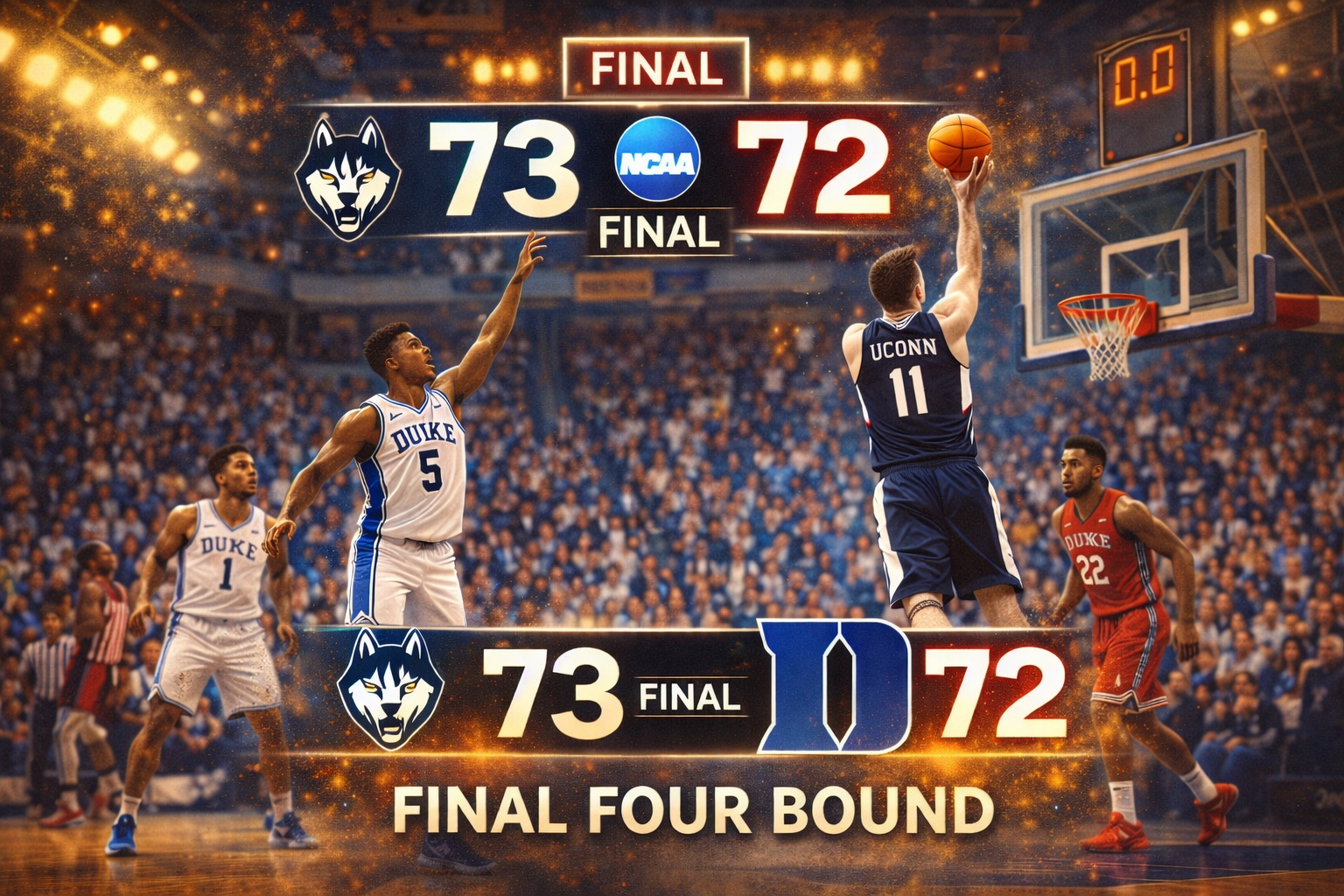
WASHINGTON, D.C. — UConn delivered one of the most dramatic comebacks in NCAA Tournament history, erasing a massive deficit and defeating top-seeded Duke 73–72 in the East Regional Final at Capital One Arena. The Huskies completed the rally with a deep three-pointer in the final second, securing a return to the Final Four and ending Duke’s championship run in stunning fashion. The victory lifted second-seeded UConn to 33–5 on the season and sent the program to its third Final Four in four years. Duke, which entered the tournament as the No. 1 overall seed, finished its season at 35–3 after suffering one of the most heartbreaking losses of the tournament. Duke Builds Early Control Duke established dominance early, controlling the pace and executing efficiently on both ends of the floor. The Blue Devils quickly built a double-digit lead behind strong perimeter shooting and transition scoring, forcing UConn into a reactive position. A decisive first-half run pushed Duke’s advantage to 40–21, highlighting the Blue Devils’ ability to generate stops and convert them into points. Their defensive pressure limited UConn’s offensive rhythm, while their ball movement created high-quality scoring opportunities. By halftime, Duke held a commanding 44–29 lead, appearing firmly in control and on track to secure a Final Four berth. UConn Begins Second-Half Rally UConn responded immediately after the break, showing increased energy and improved execution. The Huskies tightened defensively and began to generate offense through both transition opportunities and interior scoring. Tarris Reed Jr. emerged as the driving force behind the comeback. The senior delivered a dominant performance, consistently finishing in the paint while also contributing defensively with blocks and rebounds. His presence allowed UConn to gradually chip away at Duke’s lead. As the second half progressed, UConn’s efficiency improved significantly. The Huskies found better spacing, converted key possessions, and forced Duke into more difficult offensive sequences. The deficit steadily shrank as UConn built momentum. Momentum Shifts Late With under seven minutes remaining, Duke still held a 10-point advantage, but UConn continued to apply pressure. The Huskies capitalized on turnovers and second-chance opportunities, turning defensive stops into scoring runs. A series of key baskets brought UConn within a single possession, setting up a tense closing stretch. Duke attempted to maintain control, responding with timely scores, but the Huskies’ persistence kept the game within reach. UConn’s defensive intensity proved critical during this stretch. The Huskies forced multiple turnovers and limited Duke’s ability to execute cleanly in half-court situations, allowing them to close the gap further. Final Minute Delivers Historic Finish The final minute produced one of the most memorable sequences of the tournament. Duke held a narrow lead in the closing seconds, but UConn executed under pressure to create a final opportunity. After a defensive play forced a turnover, the Huskies quickly advanced the ball into the frontcourt. With time winding down, Braylon Mullins received the ball near midcourt and launched a deep three-pointer from well beyond the arc. The shot connected with less than a second remaining, giving UConn its first lead since the opening moments of the game and completing the comeback. Duke’s final inbound attempt was unsuccessful, sealing a 73–72 victory for the Huskies. Reed Jr. Leads UConn’s Effort Reed Jr. delivered one of the most impactful performances of the tournament, finishing with 26 points and nine rebounds. His ability to dominate inside provided the foundation for UConn’s comeback and earned him recognition as the region’s most outstanding player. UConn also received balanced contributions across the roster. Multiple players scored in double figures, and the team’s depth allowed it to maintain intensity throughout the second half. Despite struggling from three-point range for much of the game, UConn made timely shots when it mattered most, including the decisive basket in the closing seconds. Duke Falls Short After Strong Start Duke controlled large portions of the game and appeared poised to advance, but the Blue Devils were unable to sustain their early dominance. Cameron Boozer led Duke with 27 points and eight rebounds, providing consistent production throughout the contest. The Blue Devils maintained efficiency offensively for much of the game, but turnovers and defensive lapses in the second half allowed UConn to regain momentum. Duke was outscored 44–28 after halftime, a decisive shift that ultimately determined the outcome. Despite holding a lead deep into the second half, Duke struggled to close out the game as UConn’s pressure increased. Historic Comeback Sends UConn Forward UConn’s rally from a deficit that reached as high as 19 points ranks among the most notable comebacks in NCAA Tournament history. The Huskies demonstrated resilience and execution, overcoming early struggles to deliver a performance that will be remembered for years. The win also continued UConn’s success in late-round tournament games, reinforcing its reputation as one of the most consistent postseason programs in recent years. Final Takeaway UConn’s 73–72 victory over Duke was defined by persistence, defensive adjustments, and late-game execution. The Huskies absorbed an early deficit, steadily regained control, and delivered a decisive moment in the final seconds to complete the comeback. Duke’s strong first half and overall performance were not enough to secure the win, as UConn’s second-half surge and composure under pressure proved decisive. With the victory, UConn advances to the Final Four with momentum and confidence, while Duke’s season ends in a game that will stand as one of the most dramatic finishes of the tournament.
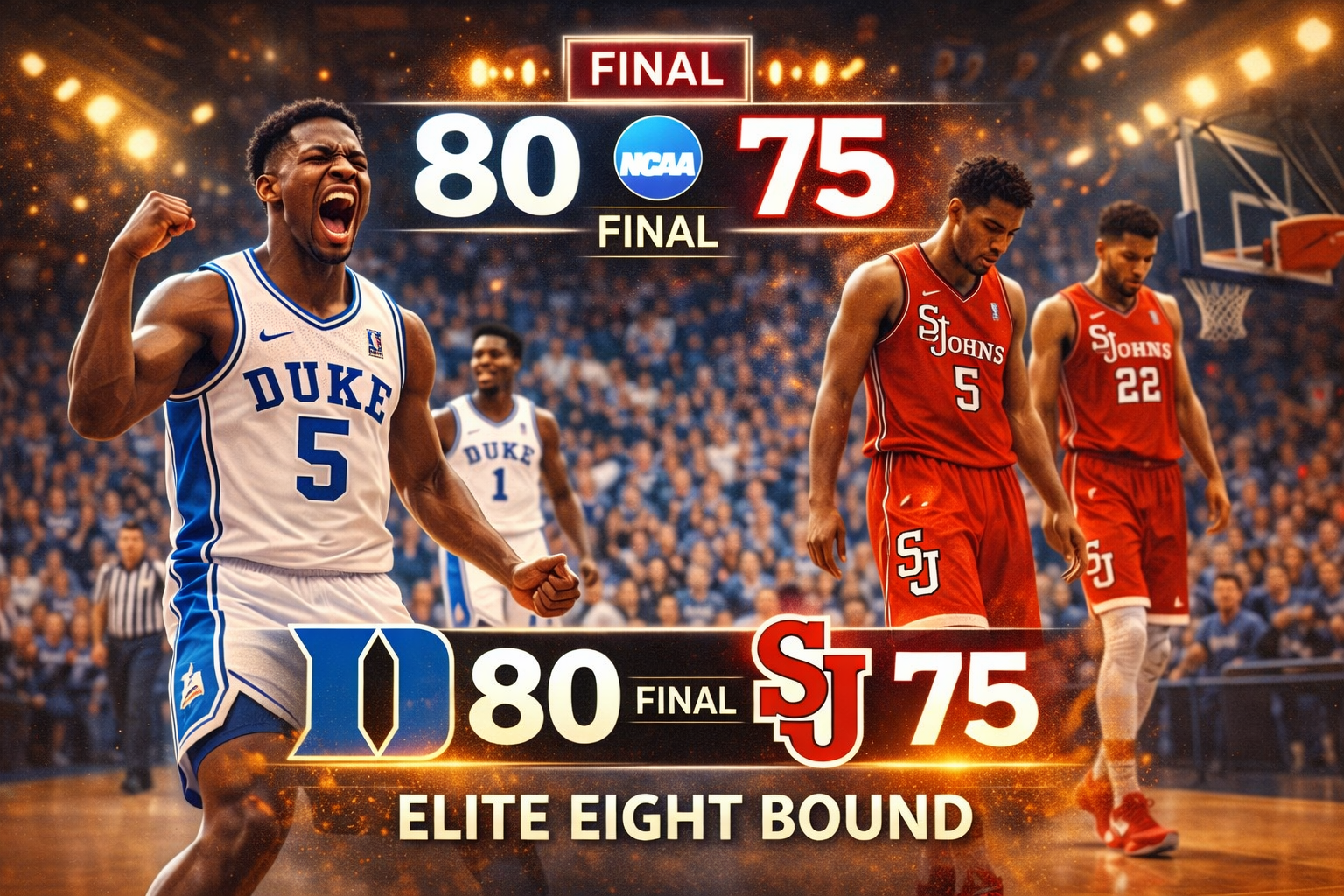
Duke Rallies Past St. John’s 80–75 to Reach Elite Eight WASHINGTON, D.C. — Duke overcame a double-digit second-half deficit and delivered a composed late-game performance to defeat St. John’s 80–75 in the NCAA Tournament Sweet 16 at Capital One Arena. The victory extended the Blue Devils’ winning streak and secured their third consecutive trip to the Elite Eight. The top-seeded Blue Devils improved to 35–2 on the season, continuing one of the most dominant stretches in college basketball. St. John’s, seeded fifth, finished its season at 30–7 after a strong showing that nearly produced a major upset. Back-and-Forth First Half Sets Competitive Tone The opening half featured momentum swings and efficient scoring from both teams. Duke established an early lead, using transition opportunities and interior finishes to create an initial advantage. The Blue Devils built a 35–28 lead during a mid-half run, appearing to take control. St. John’s responded with a strong closing stretch, fueled by perimeter shooting. The Red Storm connected on multiple three-pointers in the final minutes of the half, erasing Duke’s lead and taking a narrow 40–39 advantage into the break. The first half highlighted the contrasting styles of both teams, with Duke relying on interior scoring and rebounding while St. John’s found success from beyond the arc. St. John’s Builds Double-Digit Second-Half Lead St. John’s carried its momentum into the second half and quickly extended its lead. A decisive scoring run early in the period pushed the Red Storm ahead by double digits, placing Duke in its most challenging position of the tournament. The Red Storm’s defensive pressure forced turnovers and created transition opportunities, allowing them to dictate tempo. Their three-point shooting remained effective, stretching Duke’s defense and opening driving lanes. At one point, St. John’s led 55–45 with approximately 15 minutes remaining, putting Duke on the brink of elimination. Duke Responds With Defensive Adjustments Duke responded by tightening its defense and making key lineup adjustments that stabilized the game. The Blue Devils slowed St. John’s offensive rhythm and began to generate more consistent scoring opportunities. Caleb Foster’s return to the lineup proved pivotal. After missing time due to injury, Foster provided immediate impact off the bench, helping Duke regain control of its offense. His ability to attack the basket and create scoring opportunities helped shift momentum back toward the Blue Devils. As Duke increased its defensive pressure, St. John’s offensive efficiency declined. The Blue Devils limited the Red Storm’s scoring in the final stretch, forcing contested shots and closing off driving lanes. Evans and Boozer Lead the Comeback Isaiah Evans and Cameron Boozer anchored Duke’s comeback effort with consistent scoring and leadership. Evans finished with a game-high 25 points, delivering multiple key baskets during the second half that helped erase the deficit. Boozer added 22 points and 10 rebounds, recording another double-double while providing a strong presence inside. His ability to finish through contact and control the glass helped Duke regain control of the game’s physical areas. Together, the duo led a balanced offensive effort that allowed Duke to gradually chip away at St. John’s lead. Late Run Secures the Victory Duke took its first lead of the second half with just under four minutes remaining and never relinquished control. The Blue Devils closed the game on a 22–15 run over the final 10 minutes, demonstrating composure and execution under pressure. Foster contributed critical points during this stretch, including a key jumper and a driving layup that helped extend Duke’s lead in the closing minutes. His performance provided stability during a period where ball control and decision-making were essential. St. John’s continued to compete late, cutting the deficit to a single possession in the final seconds. However, Duke’s ability to convert free throws and secure defensive stops prevented the Red Storm from completing the comeback. Key Statistical Advantages Duke’s success was driven by its control of key areas. The Blue Devils outrebounded St. John’s and maintained an advantage in points in the paint and second-chance opportunities. These factors allowed Duke to remain competitive even when trailing by double digits. Defensively, Duke held St. John’s below its season scoring average and limited its production in the final stretch of the game. The Blue Devils’ ability to adjust defensively played a critical role in shifting momentum. St. John’s Falls Short After Strong Effort St. John’s delivered a strong overall performance, particularly in the first half and early in the second period. The Red Storm’s perimeter shooting and defensive intensity allowed them to control large portions of the game. Zuby Ejiofor led St. John’s with 17 points, eight rebounds, and six assists, providing a versatile performance on both ends. The team also received efficient scoring contributions from multiple players, including strong shooting from beyond the arc. Despite those efforts, St. John’s struggled to maintain its momentum late as Duke’s defensive adjustments limited scoring opportunities in the final minutes. Final Takeaway Duke’s 80–75 victory over St. John’s demonstrated resilience, depth, and late-game execution. Facing a double-digit deficit in the second half, the Blue Devils responded with defensive discipline and balanced scoring to secure the win. St. John’s showed the ability to compete with one of the nation’s top teams and controlled much of the game, but Duke’s composure and adjustments ultimately made the difference. With the win, Duke advances to the Elite Eight once again, continuing its pursuit of a national championship and reinforcing its status as one of the most complete teams in the tournament.
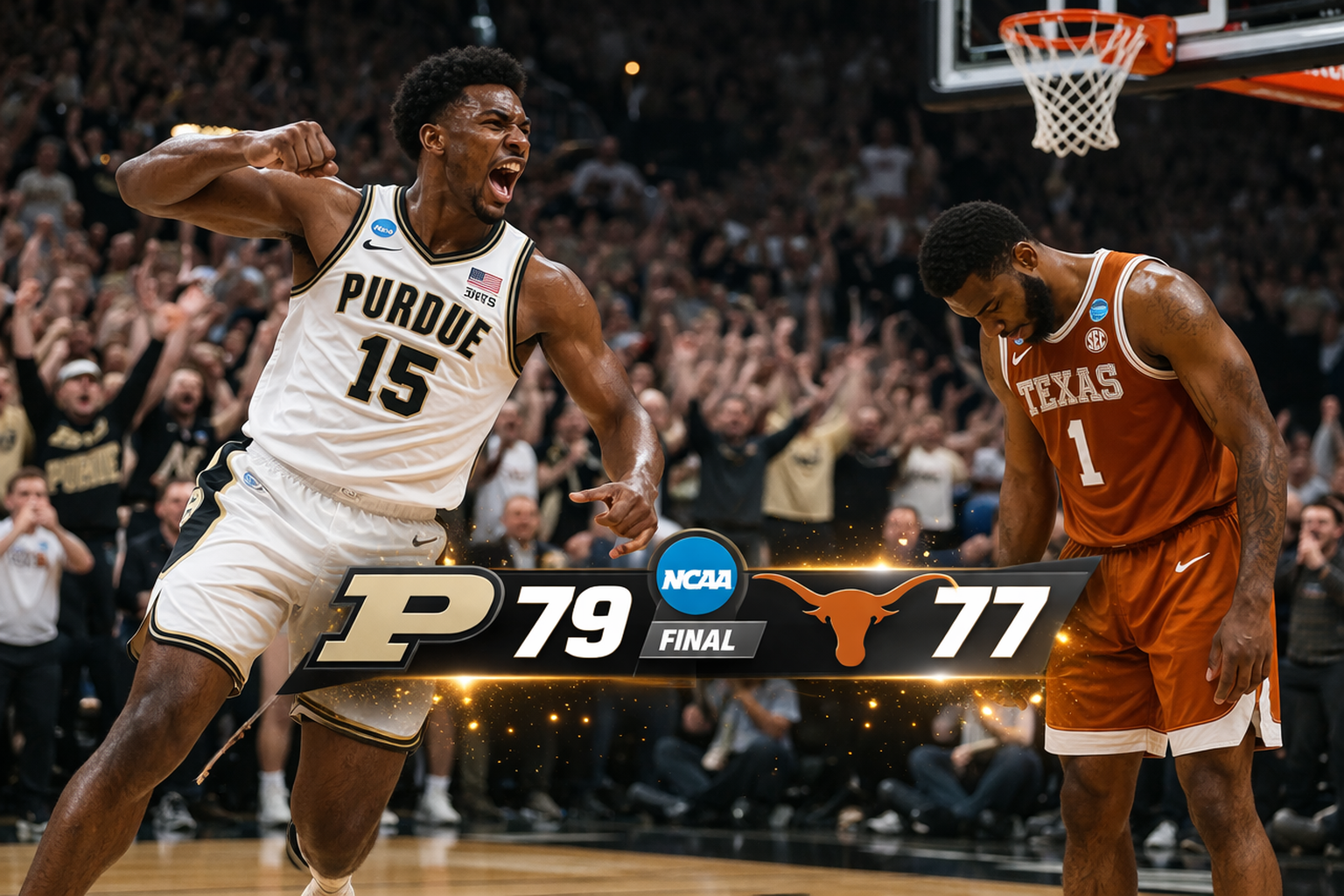
SAN JOSE, Calif. — Purdue delivered under pressure in one of the most tightly contested games of the NCAA Tournament, edging Texas 79–77 in the Sweet 16 to secure a spot in the Elite Eight. The Boilermakers relied on interior toughness, late execution, and a decisive final possession to outlast a Texas team that pushed the game to the final second. The win improved Purdue to 30 victories on the season and marked another deep tournament run for a program that continues to establish itself among the nation’s elite. Texas, meanwhile, concluded its season at 21–15 after an impressive postseason push that included a run from the First Four to the Sweet 16. Tight Battle Defined by Execution From the opening tip, the game played out as a back-and-forth battle between two teams that matched each other possession for possession. Purdue jumped out early behind strong perimeter shooting, taking a 6–0 lead as Fletcher Loyer connected on consecutive three-pointers. Texas responded quickly, settling into the game with improved ball movement and scoring efficiency. The Longhorns erased the early deficit and briefly took control midway through the first half, using a combination of perimeter shooting and second-chance opportunities to create momentum. The first half featured multiple lead changes, with neither team able to build a significant advantage. Purdue closed the half with a late scoring run, taking a 39–35 lead into the break after finding success inside and limiting Texas’ opportunities in transition. Texas Pushes Ahead in the Second Half Texas came out of halftime with urgency, immediately shifting the game’s momentum. The Longhorns opened the second half with a 14–6 run, turning a four-point deficit into a lead as their offense found rhythm from both the perimeter and inside the paint. Tramon Mark led the charge, delivering one of the most impactful performances of the game. His scoring ability kept Texas in control for stretches of the second half, particularly as Purdue struggled to find consistent perimeter production outside of Loyer. The game continued to tighten as both teams exchanged baskets. Texas extended its lead to 70–66 with just over five minutes remaining, putting Purdue in a position where every possession carried increased importance. Purdue Responds With Late Composure Facing a late deficit, Purdue responded with discipline and execution. The Boilermakers shifted their approach, relying more heavily on interior scoring and midrange efficiency as their perimeter shots failed to fall consistently. Fletcher Loyer remained the lone consistent three-point threat for Purdue, finishing with four made shots from beyond the arc. The rest of the team struggled from distance, combining to miss all of their three-point attempts, forcing Purdue to generate offense through other means. Despite those challenges, Purdue found answers through rebounding and second-chance opportunities. Trey Kaufman-Renn emerged as the defining presence in the closing minutes, consistently positioning himself around the rim and creating scoring opportunities on broken plays. Purdue regained the lead late after a critical scoring stretch, building a narrow advantage that set up a dramatic final sequence. Final Possession Decides the Outcome The closing seconds delivered the defining moment of the game. With the score tied at 77–77 and time winding down, Purdue executed its final possession with precision. A missed attempt at the rim created an opportunity for Kaufman-Renn, who secured the offensive rebound and converted a tip-in with less than a second remaining. The basket gave Purdue a two-point lead and left Texas with only a fraction of time to respond. Texas attempted a final play, but Purdue’s defense held, securing the 79–77 victory and advancing to the Elite Eight. Key Performances Shape the Game Kaufman-Renn’s impact extended beyond the final basket. His presence on the glass and ability to create second-chance points proved critical in a game where possessions were limited and efficiency mattered. Loyer’s perimeter shooting provided early momentum and remained Purdue’s most reliable outside scoring option throughout the contest. For Texas, Mark delivered a standout performance with 29 points, consistently creating offense even while dealing with physical limitations. His ability to score under pressure kept Texas competitive throughout the game and nearly pushed the Longhorns into the Elite Eight. Dailyn Swain contributed 15 points and nine rebounds, while Jordan Pope added 12 points, providing additional scoring support as Texas maintained offensive balance. Rebounding and Physicality Make the Difference The game ultimately came down to physical play and control of key possessions. Purdue’s ability to compete on the glass, particularly in critical moments, allowed the Boilermakers to generate extra opportunities when their perimeter shooting struggled. Texas matched Purdue in many statistical areas, including shooting efficiency and overall execution, but the narrow rebounding margin and late second-chance points proved decisive. Both teams demonstrated high-level execution and resilience, but Purdue’s ability to finish possessions and convert under pressure created the separation needed in the final seconds. Final Takeaway Purdue’s 79–77 win over Texas was defined by resilience, adaptability, and execution in the most critical moments. Despite a challenging shooting night from beyond the arc, the Boilermakers found ways to generate offense through rebounding and interior play. Texas delivered a strong performance and controlled stretches of the second half, but Purdue’s late composure and final possession execution ultimately decided the outcome. With the victory, Purdue advances to the Elite Eight, continuing a postseason run that has tested its ability to win in multiple ways and reinforcing its position as a serious contender in March.
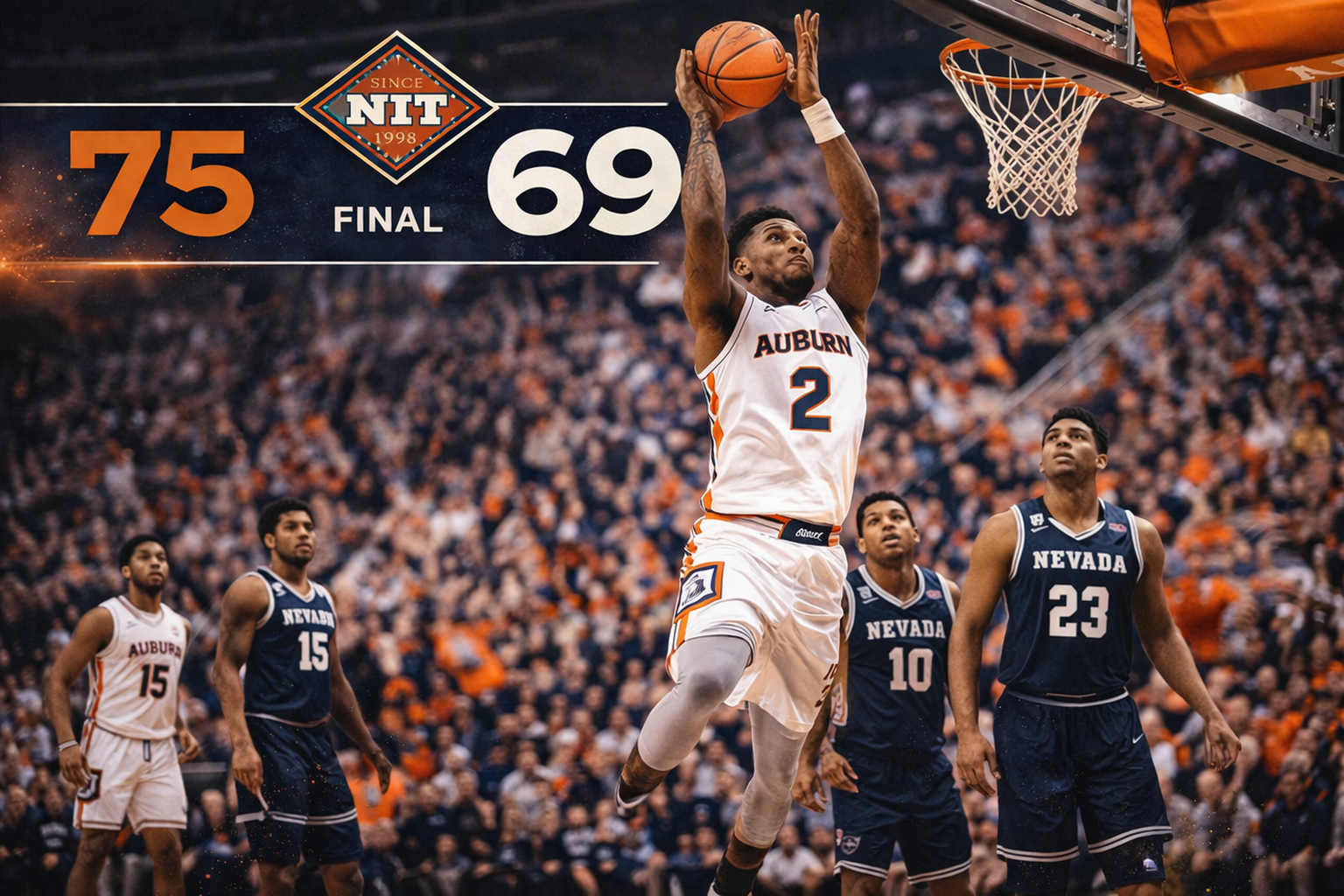
AUBURN, Ala. — Auburn extended its postseason run Wednesday night, defeating Nevada 75–69 at Neville Arena to advance to the National Invitation Tournament semifinals for the first time in program history. The victory secured Auburn’s fifth consecutive 20-win season and continued a strong stretch of play at home, where the Tigers have consistently controlled games throughout the NIT. Auburn improved to 20–16 overall, while Nevada concluded its season at 24–13. Auburn Controls Early and Builds First-Half Lead Auburn established control early in the game, using defensive pressure and efficient scoring to create separation. After a brief opening stretch, the Tigers quickly found rhythm through transition opportunities and perimeter shooting. Keyshawn Hall and Tahaad Pettiford helped spark Auburn’s early run, contributing to a 16–8 lead that forced Nevada to adjust its defensive approach. Auburn maintained momentum despite a brief scoring drought, eventually delivering a decisive 13–1 run that extended the lead to 30–14. Filip Jovic played a key role during this stretch, scoring efficiently inside while also creating opportunities for teammates when double-teamed. Auburn’s ability to move the ball and capitalize on defensive lapses allowed it to build a comfortable margin before halftime. Nevada responded with a late push, cutting the deficit to eight points during the closing minutes of the half. However, Auburn answered with timely interior scoring and strong finishes to carry a 38–26 lead into the break. Balanced Offense Keeps Auburn in Control Auburn’s offensive balance remained a key factor throughout the contest. Four players reached double figures, allowing the Tigers to maintain scoring consistency even as Nevada adjusted defensively. Jovic led Auburn with 18 points and nine rebounds, continuing his strong play during the NIT. His efficiency inside the paint and ability to handle defensive pressure contributed to Auburn’s ability to control the tempo. Pettiford added 16 points and a game-high six assists, providing playmaking and scoring in key moments. Elyjah Freeman contributed 15 points while playing the full 40 minutes, delivering important baskets during critical stretches of the second half. Hall added 14 points, helping Auburn maintain its advantage through consistent offensive production. The Tigers shot 49 percent from the field, reflecting their ability to generate high-percentage looks and convert opportunities across the lineup. Nevada Battles Back in Second Half Nevada showed resilience after halftime, gradually reducing Auburn’s lead through improved shot-making and defensive adjustments. Elijah Price led the effort for the Wolf Pack, recording a double-double with 22 points and 11 rebounds. Nevada used a series of scoring runs to cut the deficit to single digits, applying pressure on Auburn as the game entered its final minutes. Vaughn Weems and Corey Camper Jr. also contributed double-digit scoring, helping Nevada stay within reach. The Wolf Pack’s improved shooting in the second half, including strong efficiency from both the field and beyond the arc, allowed them to challenge Auburn’s control. Nevada shot 46 percent overall and 35 percent from three-point range, creating opportunities to close the gap. Auburn Responds in Key Moments Despite Nevada’s late push, Auburn maintained composure and executed effectively in key situations. The Tigers responded to each scoring run with timely baskets, preventing Nevada from fully shifting momentum. Freeman played a critical role in the closing stretch, scoring eight points in the final four minutes to help Auburn maintain separation. His ability to finish at the rim and convert in transition proved decisive as the game tightened. Pettiford also contributed defensively, creating turnovers and transition opportunities that allowed Auburn to extend its lead during crucial possessions. Nevada cut the deficit to six points late in the game and had opportunities to draw closer, but missed shots and Auburn’s defensive execution prevented further progress. Defensive Effort Secures the Win Auburn’s defensive performance was a key factor in the victory, particularly during the first 30 minutes of the game. The Tigers limited Nevada’s offensive rhythm early and forced the Wolf Pack into difficult possessions. Although Nevada improved offensively in the second half, Auburn’s ability to control key defensive sequences and secure rebounds allowed it to protect the lead. The Tigers also maintained an advantage in the paint, using physical play and interior scoring to create consistent separation throughout the game. What the Result Means The win sends Auburn to the NIT semifinals, where the Tigers will face Illinois State in Indianapolis. The matchup marks the next step in a postseason run that has been defined by balanced scoring, defensive execution, and consistent effort across the roster. Auburn has now won three consecutive NIT games at home and will look to carry that momentum into the next round. For Nevada, the loss ends a strong season that included multiple standout performances and consistent production from its core players. Despite the defeat, the Wolf Pack demonstrated resilience by remaining competitive into the final minutes. Final Takeaway Auburn’s 75–69 victory over Nevada was defined by early control, balanced offense, and timely execution in the closing minutes. The Tigers built a first-half lead, responded to multiple second-half challenges, and maintained composure under pressure to secure the win. With contributions across the lineup and consistent performance on both ends of the floor, Auburn advances to the NIT semifinals positioned to continue its postseason run.
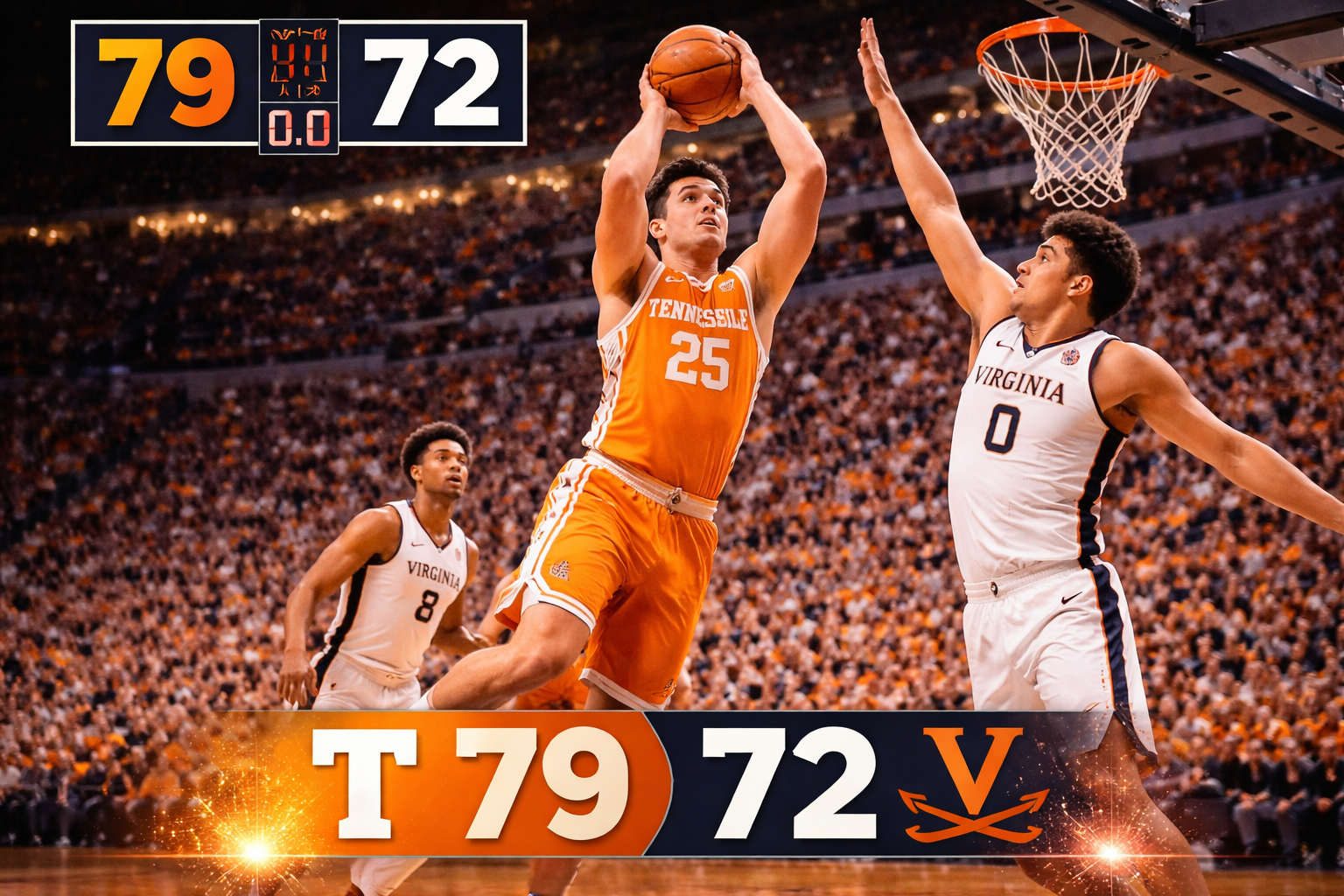
PHILADELPHIA — Tennessee once again proved its consistency on college basketball’s biggest stage, holding off a late push from No. 3 seed Virginia to secure a 79–72 victory Sunday night and advance to the Sweet 16 for the fourth consecutive season. In a game defined by momentum swings, physical defense, and late-game execution, the sixth-seeded Volunteers leaned on composure and clutch free-throw shooting to close out a Virginia team that refused to go away until the final minutes. Gillespie Leads Tennessee’s Offensive Charge Ja’Kobi Gillespie delivered a standout performance, leading Tennessee with 21 points while also contributing six assists. His ability to create offense and convert under pressure proved critical, particularly in the closing moments when he sealed the game at the free-throw line. Gillespie was at his best when the stakes were highest. After Virginia briefly grabbed the lead late in the second half, he calmly responded by knocking down multiple free throws during a decisive stretch, helping Tennessee regain control and finish the game on a 7–0 run. Nate Ament added 16 points, with the majority coming in the second half, while Bishop Boswell contributed 13 points and nine assists without committing a turnover. Tennessee’s balanced attack allowed the Volunteers to maintain offensive rhythm even as Virginia applied pressure late. First Half Defined by Runs and Defensive Adjustments The game opened with both teams trading early momentum before Tennessee established control through defense. Virginia initially found success from beyond the arc, briefly taking the lead after a strong shooting stretch. But Tennessee responded with one of the game’s most important runs, holding the Cavaliers scoreless for more than five minutes while forcing a series of missed shots. That defensive stretch fueled a 12–0 run that gave Tennessee a working margin and shifted control of the first half. The Volunteers capitalized on their physicality inside, building an advantage in the paint and limiting Virginia’s ability to generate consistent offense. By halftime, Tennessee held a 36–31 lead, having taken control through defensive discipline and efficient shot-making. Second Half Turns Into a Back-and-Forth Battle Tennessee appeared to take firm control early in the second half, pushing its lead to as many as nine points behind improved shooting and strong interior play. But Virginia responded with resilience. The Cavaliers gradually chipped away at the deficit, finding rhythm offensively and capitalizing on Tennessee’s brief scoring drought. A stretch of seven consecutive made shots allowed Virginia to erase the deficit and tie the game, setting up a tense finish. Thijs De Ridder led the charge for Virginia, finishing with 22 points while knocking down key shots throughout the second half. His three-pointer with just over two minutes remaining gave the Cavaliers their first lead of the half and briefly shifted momentum. Tennessee Responds in the Final Minutes Despite Virginia’s late surge, Tennessee never lost composure. The Volunteers answered immediately after surrendering the lead, using free throws and timely defensive stops to regain control. Ament and Boswell each made key contributions, but it was Gillespie who delivered the final blow. Over the last 90 seconds, Tennessee executed with precision. Gillespie converted multiple free throws, extending the lead while preventing Virginia from regaining momentum. Virginia had opportunities to tie or take the lead in the closing moments, but missed shots and a turnover in the final seconds sealed its fate. Tennessee’s ability to convert from the line and protect possessions proved to be the difference in a tightly contested finish. Tennessee’s Defense and Efficiency Stand Out Tennessee’s defensive execution played a major role throughout the game. The Volunteers limited Virginia to under 40 percent shooting and forced difficult looks, particularly during key stretches in the first half. They also controlled the paint early, creating a scoring advantage inside that helped build their lead. Offensively, Tennessee remained efficient, shooting over 47 percent from the field and moving the ball effectively to create open looks. The Volunteers finished with 20 assists, highlighting their ability to generate quality scoring opportunities through ball movement. Virginia’s Effort Falls Short Late Virginia showed resilience and competitiveness, particularly in the second half. De Ridder’s performance highlighted the Cavaliers’ offensive potential, while contributions from Malik Thomas and others kept Virginia within striking distance. The Cavaliers also improved their shooting and energy after halftime, turning the game into a true back-and-forth battle. However, late execution proved costly. Missed opportunities in the final minutes, combined with Tennessee’s free-throw efficiency, prevented Virginia from completing the comeback. The Cavaliers finished the game shooting 39 percent and struggled to convert key possessions when it mattered most. What the Win Means With the victory, Tennessee advances to the Sweet 16 for the fourth straight season, continuing one of the most consistent postseason runs in program history. The Volunteers will face No. 2 seed Iowa State in the next round, with a chance to push deeper into the tournament. For Virginia, the loss ends a strong season that included 30 wins and a return to national relevance. Despite the disappointment, the Cavaliers showed they can compete at a high level against top-tier opponents. Final Takeaway Tennessee’s 79–72 win over Virginia was a testament to execution under pressure. The Volunteers combined defensive discipline, balanced scoring, and clutch free-throw shooting to withstand a late comeback and secure the result. Gillespie’s leadership and late-game composure ultimately defined the outcome. Virginia battled until the final moments and nearly completed the rally, but Tennessee’s ability to make winning plays in the closing minutes proved decisive. As the tournament moves forward, Tennessee continues to demonstrate the traits of a team built for March—resilient, disciplined, and capable of delivering when it matters most.
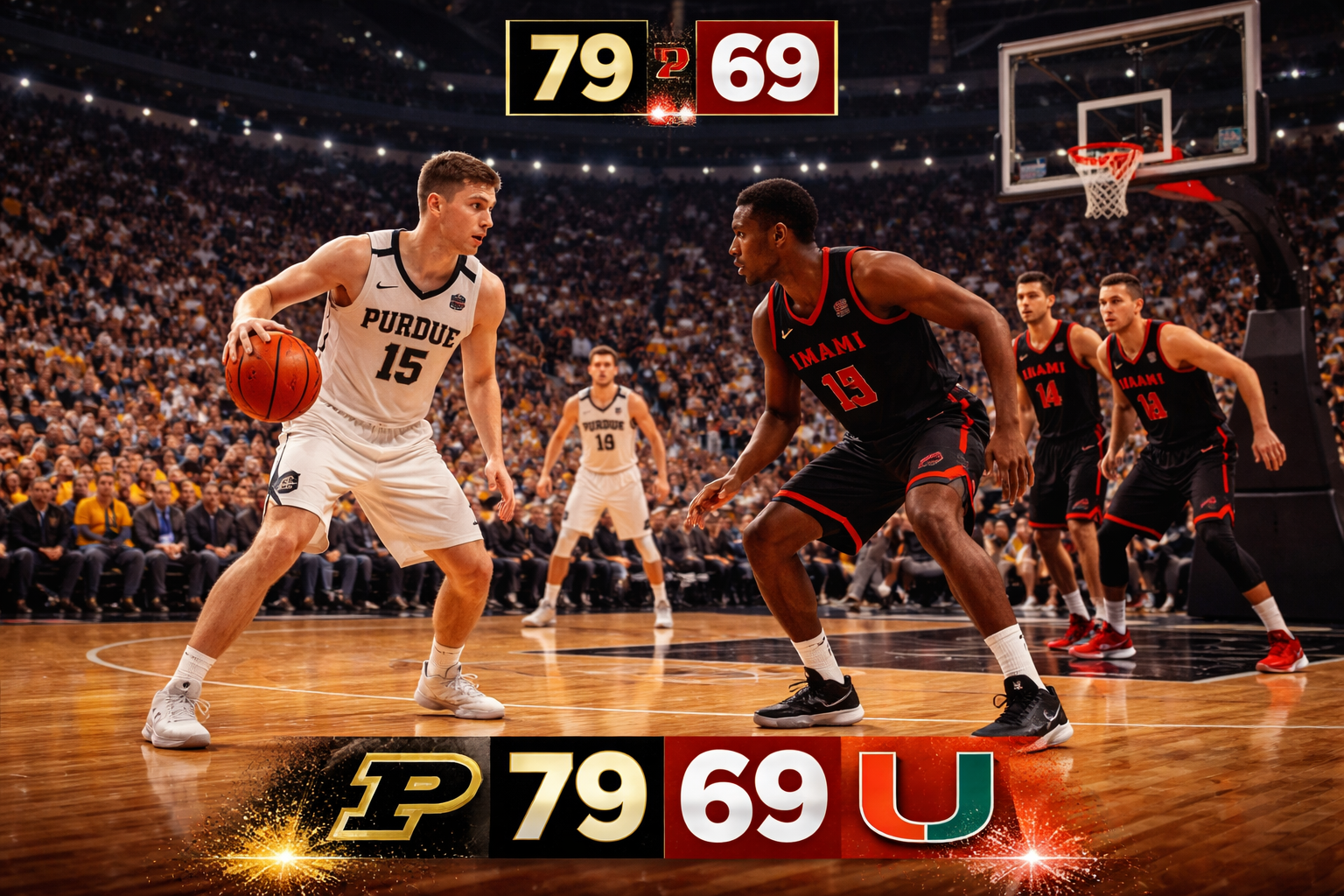
ST. LOUIS — Purdue once again proved why it remains one of the most consistent programs in college basketball, using poise, balance, and late-game execution to defeat Miami 79–69 on Sunday and advance to the Sweet 16 for the third consecutive season. The No. 2-seeded Boilermakers withstood a physical challenge from the Hurricanes and closed the game with composure at the free-throw line, securing their seventh Sweet 16 appearance in the last nine NCAA Tournaments. Purdue Shows Composure in Key Moments While the final margin suggested control, Purdue had to earn every bit of the victory. Miami applied pressure throughout the game, particularly with its physical defense and rebounding presence. The Hurricanes repeatedly created second-chance opportunities and forced Purdue into uncomfortable stretches, including a season-high eight turnovers from star guard Braden Smith. But Purdue never looked rattled. The Boilermakers leaned on experience and execution, especially in the closing minutes. With Miami cutting the deficit to four late, Smith calmly knocked down four free throws in the final minute to seal the win and prevent any late collapse. That composure has become a defining trait for this Purdue group, particularly in March. Loyer Leads Balanced Offensive Attack Fletcher Loyer delivered a standout performance, leading Purdue with 24 points while shooting efficiently from beyond the arc. His ability to stretch the floor and capitalize on open looks helped Purdue maintain offensive rhythm throughout the game. Trey Kaufman-Renn added 19 points and nine rebounds, providing a strong interior presence and consistent scoring when Purdue needed it most. His physical play inside helped counter Miami’s frontcourt and gave the Boilermakers a reliable option in half-court sets. Smith contributed 12 points and eight assists, continuing to serve as the engine of Purdue’s offense despite facing heavy defensive pressure. The balance across Purdue’s lineup proved critical, allowing the Boilermakers to withstand Miami’s runs without relying on a single scorer. First Half Sets the Stage for a Tight Battle Miami came out with energy and confidence, briefly taking control late in the first half. The Hurricanes used physical play and transition scoring to disrupt Purdue’s flow, eventually building a 40–38 lead heading into halftime. Their ability to pressure Smith and contest shots kept Purdue from establishing a comfortable rhythm early. Still, Purdue stayed within striking distance, thanks in large part to Loyer’s scoring bursts. A key stretch in the first half saw Loyer score 10 points during a 13–2 run, helping Purdue regain momentum after Miami had seized control. The back-and-forth nature of the opening half set up a tightly contested second period. Second-Half Execution Makes the Difference Purdue began to create separation midway through the second half with a decisive run that shifted control. An 11–3 stretch gave the Boilermakers breathing room, highlighted by strong finishes from Kaufman-Renn and a transition sequence sparked by Loyer’s defensive play. That run pushed Purdue’s lead to double digits and forced Miami into a chase situation. Even as Miami continued to battle and cut into the deficit, Purdue consistently responded with timely baskets and efficient free-throw shooting. The Boilermakers’ ability to convert opportunities at the line proved decisive. Purdue finished 21-of-22 from the free-throw line, a level of efficiency that prevented Miami from completing its comeback. Miami’s Effort Falls Short Miami showed resilience throughout the game and remained within reach late. Shelton Henderson led the Hurricanes with 18 points and eight rebounds, while Malik Reneau added 16 points. Miami’s physicality and rebounding kept the game competitive, and the Hurricanes’ defensive pressure created multiple opportunities to swing momentum. However, Miami struggled from beyond the arc in the second half, shooting just 1-of-11 from three-point range. That lack of perimeter efficiency made it difficult to fully capitalize on their defensive efforts and rebounding advantages. Despite cutting the deficit to four in the final minute, Miami could not generate enough stops or scoring to complete the rally. What the Win Means The victory continues Purdue’s remarkable run of NCAA Tournament consistency. The Boilermakers have now reached the Sweet 16 in three straight seasons and seven times in the last nine tournaments, reinforcing their position among the nation’s elite programs. Purdue will next face No. 11 seed Texas in the West Region semifinals, a matchup that presents another opportunity to extend its postseason run. For Miami, the loss ends a strong season that saw significant improvement and a return to national relevance. The Hurricanes demonstrated their ability to compete with top-tier teams but ultimately fell short against a more disciplined and experienced opponent. Final Takeaway Purdue’s 79–69 win over Miami was defined by composure, balance, and execution under pressure. The Boilermakers did not play a flawless game, but they made the right plays when it mattered most. Strong performances from Loyer and Kaufman-Renn, combined with clutch free-throw shooting and defensive adjustments, allowed Purdue to maintain control in the final minutes. ' As the tournament moves forward, Purdue continues to look like a team built for March—experienced, disciplined, and capable of winning in multiple ways.
action shots