
EAST COAST SPORTS LIVE
College Volleyball
college volleyball news

No. 19 Texas A&M delivered one of its biggest victories of the young season Wednesday night, upsetting No. 4 Stanford 3-1 (25-23, 25-13, 21-25, 25-19) at the Shriners Children’s Showdown at the Net in Florida. The Aggies hit a season-best .344 , recorded a season-high seven service aces and put four players in double figures in kills. Kyndal Stowers led Texas A&M with 15 kills and 11 digs , while Eliza Sharp added 13 kills and four blocks as the Aggies handed Stanford its first loss of 2026. Texas A&M improved to 4-4 , while Stanford fell to 4-1. Texas A&M Wins Tight Opening Set The Aggies established their offensive rhythm early, but Stanford made sure the opening set remained competitive. The Cardinal tied the score at 15-15 with three consecutive points coming out of the media timeout. Texas A&M responded with a Sharp kill followed by a block from Sharp and Natalie Ring, moving ahead 18-16 and forcing Stanford to call timeout. Neither team created much separation from there. With the set hanging in the balance, Stowers delivered. A pair of late kills from the Texas A&M outside hitter helped the Aggies secure a 25-23 victory and establish an early 1-0 match advantage. Aggies Overwhelm Stanford in Second Set Texas A&M carried that momentum directly into the second. The Aggies raced ahead 6-1 , forcing Stanford to use an early timeout. The break did little to slow Texas A&M. By the media timeout, the Aggies had built a commanding 15-5 advantage . Stanford responded with four consecutive points, but Texas A&M never allowed the Cardinal to seriously threaten the lead. The Aggies answered with a 7-2 run and eventually finished the set 25-13 . Texas A&M’s serving played an important role in the dominant frame. Gabi Rodriguez helped fuel the early separation from the service line and finished the night with a career-high four aces . Suddenly, No. 4 Stanford was one set away from its first defeat. Stanford Responds in Third Set The Cardinal refused to go quietly. After Texas A&M controlled the first two frames, Stanford found its response following the third-set media timeout. The Cardinal scored seven consecutive points to take an 18-15 lead , forcing the Aggies to stop play with a timeout. Stanford maintained control from there and scored four of the final six points to take the set 25-21 . Junior middle blocker Lizzy Andrew played an important role in the comeback, producing a scoring run from the service line. The third-set victory reduced Texas A&M’s advantage to 2-1 and gave Stanford an opportunity to force a deciding fifth. Kyndal Stowers Leads Balanced Aggies Attack Stowers finished with a team-high 15 kills and 11 digs , recording her second consecutive double-double. But Texas A&M’s offensive success extended well beyond its leading attacker. Sharp recorded a season-high 13 kills and led the Aggies with four blocks. Taryn Morris tied her career high with 12 kills while producing an exceptional .550 hitting percentage , a new career best. Ring added 10 kills , giving Texas A&M four players in double figures. Kaia Castle was another highly efficient option, recording seven kills while hitting a season-best .700 . That balance helped Texas A&M finish with 60 kills on 131 attacks with only 15 errors . Stanford’s Lizzy Andrew and Julia Blyashov Answer Stanford had strong individual performances of its own. Andrew finished with 13 kills on a season-high .545 hitting percentage , along with four digs and four blocks. Outside hitter Julia Blyashov led Stanford with 14 kills while hitting .364. She added 10 digs for her third double-double of the season. Jordyn Harvey and Ipar Kurt each contributed nine kills. Setter Logan Parks finished with 41 assists, nine digs, two blocks and a team-high three service aces , while libero Spencer Etzler collected nine digs. Stanford hit a respectable .260 as a team, but Texas A&M’s .344 performance proved too much to overcome. Fourth Set Stays Tight Before Aggies Pull Away Stanford’s third-set victory carried the match into a competitive fourth. The teams played through six early ties , with neither side able to establish control. Then Texas A&M made its move. Around the middle of the set, the Aggies scored five consecutive points to create the separation they had been searching for. Stanford attempted to respond, but Texas A&M refused to allow another comeback. The Aggies eventually scored the final four points of the match , closing the fourth set 25-19 and completing the top-five upset. Kirra Musgrove Directs Season-Best Offense Setter Kirra Musgrove delivered a career performance while directing Texas A&M’s attack. Musgrove recorded a career-high 44 assists and added 11 digs, giving her the first double-double of her collegiate career. Her distribution helped the Aggies attack at .344, their best hitting percentage of the season. Texas A&M also produced its strongest serving performance of 2026. The Aggies recorded a season-high seven aces , with Rodriguez accounting for four. Rodriguez also finished with 10 digs, extending her double-digit dig streak to six matches, and tied her career high with five assists. Texas A&M Earns Another Top-Five Victory The victory marked Texas A&M’s second all-time win over Stanford and its first ranked victory of the season. It also continued the Aggies’ success against elite competition under head coach Jamie Morrison. Texas A&M has now earned three regular-season victories over top-five opponents during Morrison’s tenure . Wednesday’s result was particularly significant because of how the Aggies won. They did not rely on one attacker. Four players reached double-digit kills, the team hit .344, and Texas A&M consistently applied pressure from the service line. Even when Stanford responded by winning the third set, the Aggies remained composed enough to finish the match in four. Stanford Suffers First Loss of 2026 Stanford entered the matchup undefeated at 4-0 but left Florida with its first loss of the season. The Cardinal had opened the year with victories over Wichita State, No. 21 Kansas, South Florida and Marquette before running into an efficient Texas A&M attack. Stanford is now 5-2 all-time against Texas A&M . The Cardinal will have an immediate opportunity to respond against another nationally ranked opponent when it travels to Philadelphia to face No. 12 Penn State on Friday at The Palestra . First serve is scheduled for 3 p.m. PT on Big Ten Network. Aggies Return Home for No. 6 Wisconsin Texas A&M’s schedule does not become easier following the upset. The Aggies return to Reed Arena to face No. 6 Wisconsin on Friday at 7 p.m. They will enter that matchup with a major victory behind them and an offense that just delivered its best performance of the season. Stanford managed to extend Wednesday’s match by winning the third set, but Texas A&M never surrendered control for long. Stowers led the way with 15 kills and 11 digs. Sharp and Morris supplied efficient secondary offense. Musgrove directed the attack with 44 assists, and Rodriguez repeatedly pressured Stanford from the service line. The result was a statement victory as No. 19 Texas A&M defeated No. 4 Stanford 3-1 and handed the Cardinal their first loss of the season .

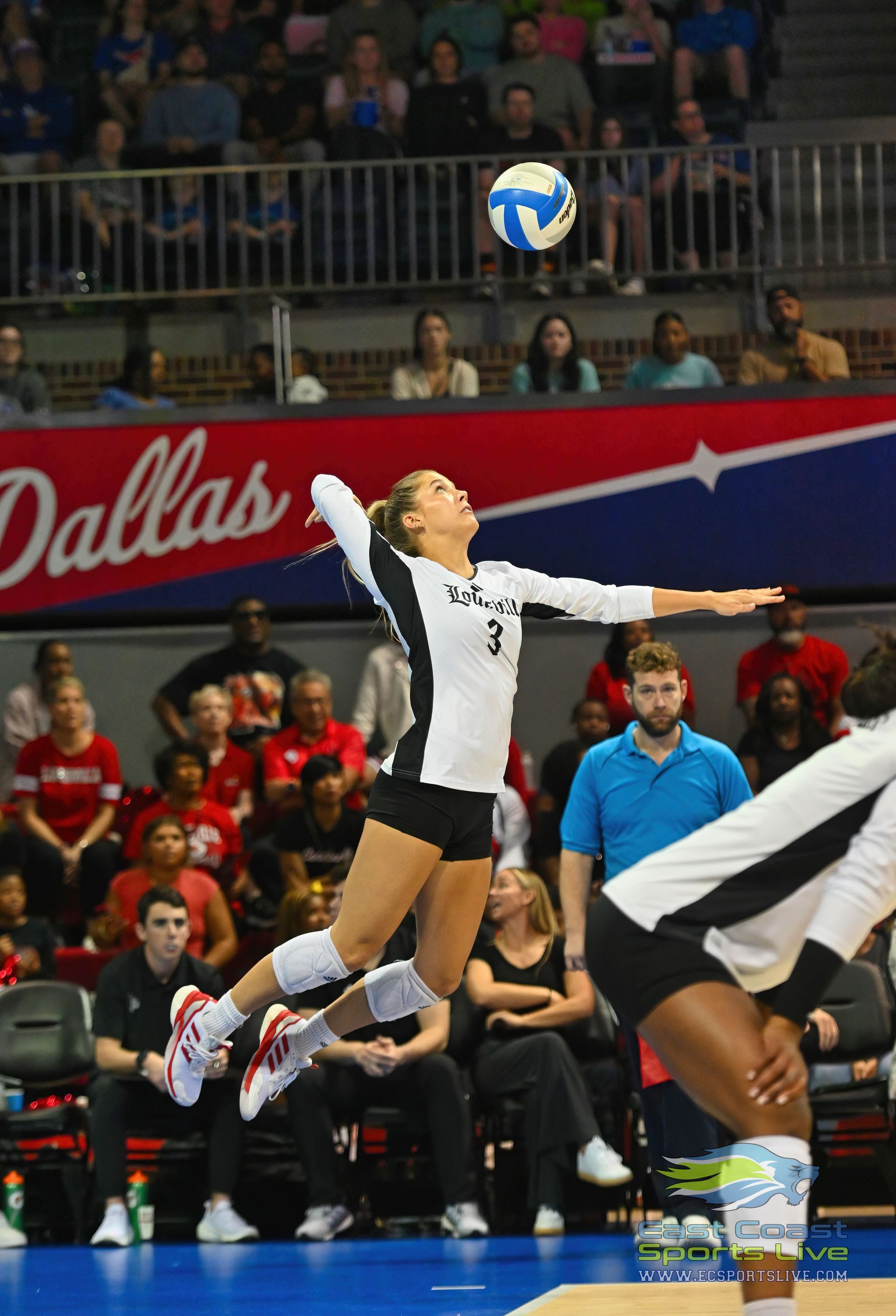
No. 3 Kentucky delivered a decisive performance against previously unbeaten No. 18 North Carolina on Wednesday night, sweeping the Tar Heels 3-0 (25-11, 25-19, 25-18) at Memorial Coliseum in Lexington. The Wildcats improved to 6-1 behind a match-high 17 kills from Morgan Gaerte , while Brooklyn DeLeye added 16. Kentucky totaled 49 kills compared with North Carolina’s 27 and handed the Tar Heels their first loss of the 2026 season in the SEC/ACC Showdown at the Net. North Carolina fell to 4-1 after entering Lexington undefeated. Bridget Malone and Safi Hampton led the Tar Heels with seven kills apiece. Kentucky Dominates Opening Set The Wildcats established control almost immediately. North Carolina stayed within striking distance early, trailing 13-9 , but Kentucky quickly turned a competitive opening stretch into a runaway set. The Wildcats won 12 of the final 14 points to finish the frame 25-11. Kentucky hit .412 , while its defense held North Carolina to just .040 hitting . Kentucky's offensive execution was particularly impressive. The Wildcats recorded 18 kills in the opening frame, with Gaerte accounting for eight kills on .636 hitting . DeLeye added five kills while hitting .571. Kentucky also produced a sideout percentage above 90 percent during the set, making it extremely difficult for North Carolina to generate sustained scoring runs. North Carolina Responds in Second The Tar Heels showed considerably more resistance after the difficult opening frame. Jackie Taylor opened the scoring for UNC, and the Tar Heels stayed close as Kentucky attempted to build another advantage. Taylor later delivered another kill to bring North Carolina within 9-7 . Setter Sienna Cozza then produced a service ace that tied the set at 12-12 . Malone followed with a kill to give North Carolina a 13-12 lead . For the first time in the match, Kentucky was playing from behind during a meaningful portion of a set. The Wildcats responded like a top-three team. Wildcats Pull Away Late in Set Two Kentucky and North Carolina continued exchanging points until the score reached 17-17. From there, the Wildcats took over. Kentucky closed the second set with an 8-2 run , turning a tie into a 25-19 victory . Gaerte remained the central figure in Kentucky’s attack. She had accumulated 14 kills while hitting .565 through two sets , continuing an extraordinarily efficient performance. The Wildcats cooled from their .412 opening-set percentage, hitting .250 in the second, but their late execution was enough to prevent UNC from turning its improved play into a set victory. Kentucky now held a 2-0 advantage. Morgan Gaerte Leads Kentucky Attack Gaerte finished the match with 17 kills , the highest total for either team. Her production was particularly damaging early, when she repeatedly found openings in North Carolina’s defense. DeLeye provided Kentucky with another high-level attacking option, finishing with 16 kills . Together, Gaerte and DeLeye accounted for 33 of Kentucky’s 49 kills . That combination proved difficult for North Carolina to contain throughout the night. Kentucky's ability to produce from multiple attacking positions also prevented the Tar Heels from settling into the defensive rhythm that had helped them begin the season undefeated. Tar Heels Take Another Lead in Third North Carolina refused to disappear despite trailing 2-0. The Tar Heels opened the third set with renewed energy and moved ahead 6-4 following a kill from graduate opposite Chelsea Thorpe. Kentucky responded with four straight points, but UNC remained within reach. The teams continued trading momentum through the middle portion of the set. A Malone kill followed by a block involving Malone and Lauren Schutter eventually moved North Carolina ahead 16-15 . Once again, the Tar Heels had created an opportunity to take a set from the third-ranked Wildcats. Once again, Kentucky produced the decisive late run. Kentucky Finishes Sweep With Another Late Surge Kentucky erased North Carolina's advantage and regained control. With the third set still close late, the Wildcats accelerated toward the finish. One source describes Kentucky turning a 16-15 deficit into a 10-3 closing stretch , while another reports that the Wildcats finished the match with a 7-1 scoring run after the score reached 18-17 . Both accounts support the same larger point: Kentucky dominated the closing portion of the frame. The Wildcats eventually secured the set 25-18 , completing the straight-set victory. North Carolina had made the second and third sets significantly more competitive than the opener, but Kentucky repeatedly found another level late. Bridget Malone and Safi Hampton Lead UNC Malone and Hampton finished with seven kills apiece , tying for North Carolina’s team lead. Malone was especially important during the Tar Heels’ attempts to challenge Kentucky in the final two frames. Her kill gave UNC the 13-12 advantage in the second, and she contributed again when North Carolina moved ahead during the third. At the net, Taylor and Schutter each recorded three blocks . Those contributions helped North Carolina create competitive stretches, but the Tar Heels could not match Kentucky's overall offensive production. The Wildcats finished with 49 kills. UNC had 27. Kentucky Hands UNC Its First Loss North Carolina arrived in Lexington at 4-0 and had not faced a ranked opponent this season. Kentucky represented a significant step up in competition, and the Wildcats immediately demonstrated why they entered the match ranked third nationally. UNC was held below 20 points in all three sets. The opening frame was especially decisive, but the final two showed Kentucky's ability to respond under greater pressure. North Carolina led 13-12 in the second. Kentucky won 25-19. UNC led 16-15 in the third. Kentucky won 25-18. Those late-set responses kept the Tar Heels from gaining enough momentum to seriously threaten the sweep. Kentucky Continues Strong Home Form The victory represented Kentucky's fourth sweep at home this season. The Wildcats now turn toward another major test. Kentucky travels to Nassau, Bahamas, where it will face No. 8 SMU on Saturday at the Paradise Invitational. SMU enters that matchup coming off a five-set victory over No. 9 Texas, setting up another significant early-season test for both nationally ranked programs. Kentucky will later face either Purdue or Houston before returning home for a highly anticipated matchup against No. 5 Louisville on Sept. 20. North Carolina Heads to New York The Tar Heels will try to respond quickly to their first defeat. North Carolina travels to New York City to face Vanderbilt on Sunday at 2 p.m. at the Hammerstein Ballroom. The matchup is part of the Anchor Down in Midtown event connected to the opening of Vanderbilt University's New York campus. UNC leaves Lexington with its undefeated record gone, but with competitive stretches in the final two sets to build on. Kentucky, however, controlled the match when it mattered most. Gaerte led the way with 17 kills, DeLeye added 16, and the Wildcats consistently turned close stretches into decisive scoring runs. The result was another convincing victory for No. 3 Kentucky, which swept No. 18 North Carolina 25-11, 25-19, 25-18 and handed the Tar Heels their first loss of 2026 .

No. 2 Pitt added another ranked victory to its unbeaten start Wednesday night, sweeping No. 17 Tennessee 3-0 (25-17, 28-26, 25-20) in the Shriners Children’s Hospital Showdown at the Net at State Farm Field House in Orlando. The Panthers improved to 7-0 , with five of those victories coming against Top 25 opponents. Tennessee entered the match 5-0 without dropping a set but left with its first loss after Pitt hit .352 and held the Lady Vols to .248. Olivia Babcock led Pitt with 17 kills on .382 hitting , adding eight digs and two blocks. Pitt’s straight-set victory included an opening-frame surge, a dramatic comeback from set point in the second and another response after Tennessee erased a seven-point deficit in the third. Pitt Opens Match With Seven Straight Points Pitt immediately put Tennessee in an unfamiliar position. The Panthers scored the first seven points of the match , with setter Izzy Starck contributing three assists, two digs and an ace during the opening run. Tennessee responded and reduced the deficit to 10-7 , forcing Pitt to call timeout. The Panthers emerged from that break with an immediate answer. Babcock and Ayanna Watson each recorded two kills during a 4-0 Pitt run , restoring the Panthers’ advantage to 14-7. Tennessee never seriously threatened again in the frame, and Pitt secured a 25-17 opening-set victory . The Lady Vols, who had swept each of their first five opponents, had lost their first set of the season. Tennessee Pushes Pitt in Second Set The second set was completely different. Tennessee settled into its offense and turned the frame into a back-and-forth battle in which neither team led by more than two points. With the score tied 9-9, Abbey Emch delivered consecutive kills to move Pitt ahead 11-9. Tennessee responded with three straight points, and the teams continued exchanging the lead. The Lady Vols eventually created one of their best opportunities of the night. Tennessee moved ahead 23-21 , putting itself two points away from evening the match. Babcock answered with a kill, and a Tennessee attack error tied the score at 23-23. The drama was just beginning. Ayanna Watson Saves Pitt From Set Point Watson delivered one of the biggest sequences of the match. After the teams exchanged points several times, Tennessee reached set point at 26-25 . The Lady Vols needed one more point to make it a 1-1 match. Instead, Watson struck twice. She recorded back-to-back kills , turning Pitt’s 26-25 deficit into a 27-26 advantage. Babcock then finished the frame with another kill, completing a 28-26 Pitt victory . The Panthers had survived Tennessee’s strongest set of the match and now carried a 2-0 advantage. For Watson, the late kills were part of a career performance. Watson and Emch Set Career Highs Watson finished with a career-high 15 kills , hitting .344. Emch also established a career best with 10 kills , doing so on an exceptional .643 hitting percentage . Pitt’s middle attack was especially efficient. Emch and freshman Maaike Heilig combined for 14 kills on 20 attacks with only one error . Heilig contributed four kills, a team-high three blocks and a service ace. That balance prevented Tennessee from focusing solely on Babcock, who remained Pitt’s leading offensive threat. Tennessee Erases Seven-Point Deficit in Third Pitt appeared ready to run away with the third set. The Panthers scored five of the first six points, including Starck’s third service ace of the night. Watson later delivered a kill to extend Pitt’s advantage to 11-4 . Tennessee refused to allow the match to end quietly. The Lady Vols steadily reduced the deficit until they were within one at 13-12 . Emch responded with a block assist and a kill, pushing Pitt back ahead 15-12. Tennessee kept coming. The Lady Vols eventually erased the entire seven-point deficit and tied the set 18-18 . Once again, Pitt answered immediately. Pitt Closes Door on Tennessee Comeback Babcock and Watson delivered consecutive kills to restore a 20-18 Pitt advantage . Heilig followed with a service ace, and Emch added another kill to stretch the lead to 22-18. The sequence proved decisive. Pitt finished the third 25-20 , completing the sweep and handing Tennessee its first defeat of the season. The Lady Vols had produced 14 kills while hitting .303 in the third, but Pitt was even better, finishing the frame with 15 kills on .353 hitting. Olivia Babcock Continues Record-Setting Pace Babcock once again led Pitt’s offense. The junior finished with 17 kills, eight digs and two blocks , bringing her season total to 126 kills through seven matches . That pace is significant because Babcock is coming off a record-breaking 2025 season. She finished last year with 646 kills , breaking Pitt’s single-season record of 555 previously held by Wendy Hatlestad. Through seven matches last season, Babcock had 110 kills. This year, she already has 126. Her 17-kill performance against Tennessee continued an opening stretch that has placed the reigning record holder back on an early record watch. Izzy Starck Directs Efficient Pitt Offense Starck finished with 43 assists, three service aces, eight digs and two blocks . Her distribution helped Pitt record 51 kills on .352 hitting , the Panthers’ second-best attack percentage of the season. Pitt also continued its impressive defensive trend. The Panthers outdug Tennessee 43-35 , meaning Pitt has won the digging battle in all seven matches this season. That defensive work was especially notable considering Tennessee entered Wednesday as one of the country’s most efficient offensive teams. Pitt Slows One of Nation’s Best Attacks Tennessee entered the match ranked second nationally in hitting percentage at .353 and first in kills per set at 15.27. Pitt held the Lady Vols to .248 hitting and 38 kills . Kennedi Rogers and Jalyn Stout led Tennessee with 10 kills apiece . Rogers produced six kills in the highly competitive second set and surpassed 250 career kills during the match. Middle blocker Jolene Oddo added six kills and a team-high four blocks. Setter Carolina Kerr finished with 30 assists and seven digs , while Raegan Burns led Tennessee’s defense with 12 digs , her fourth double-digit dig performance of the season. The Lady Vols also finished with seven aces and seven blocks. Pitt Earns Fifth Top-25 Victory The strength of Pitt’s undefeated start is difficult to overlook. Five of the Panthers’ first seven victories have come against ranked opponents . Pitt also improved to 160-20 since the beginning of the 2021 season , which the program notes identify as the best record in NCAA Division I women’s volleyball over that span. The Panthers are 54-6 in non-conference matches during that period and 21-5 against ranked non-conference opponents during the regular season . Wednesday’s victory also improved Pitt to 11-9 all-time against Tennessee , with the Panthers winning the last three meetings. Pitt is now 15-2 all-time when ranked No. 2 nationally. Pitt Returns Home for Historic Victory Heights Opening Pitt now returns to Pittsburgh for a significant weekend. The Panthers will host the Panther Challenge, beginning against Jacksonville on Friday at 7 p.m. That match will officially open Victory Heights Arena , Pitt volleyball’s new home. Pitt then faces High Point on Saturday at 5 p.m. and Wright State on Sunday at 1 p.m. The Panthers will return home carrying one of the strongest early résumés in the country. Tennessee entered Wednesday unbeaten, nationally ranked and without losing a single set. Pitt changed all three of those things. Behind Babcock’s 17 kills, career performances from Watson and Emch, and another efficient night directed by Starck, No. 2 Pitt swept No. 17 Tennessee 25-17, 28-26, 25-20 to improve to 7-0 .

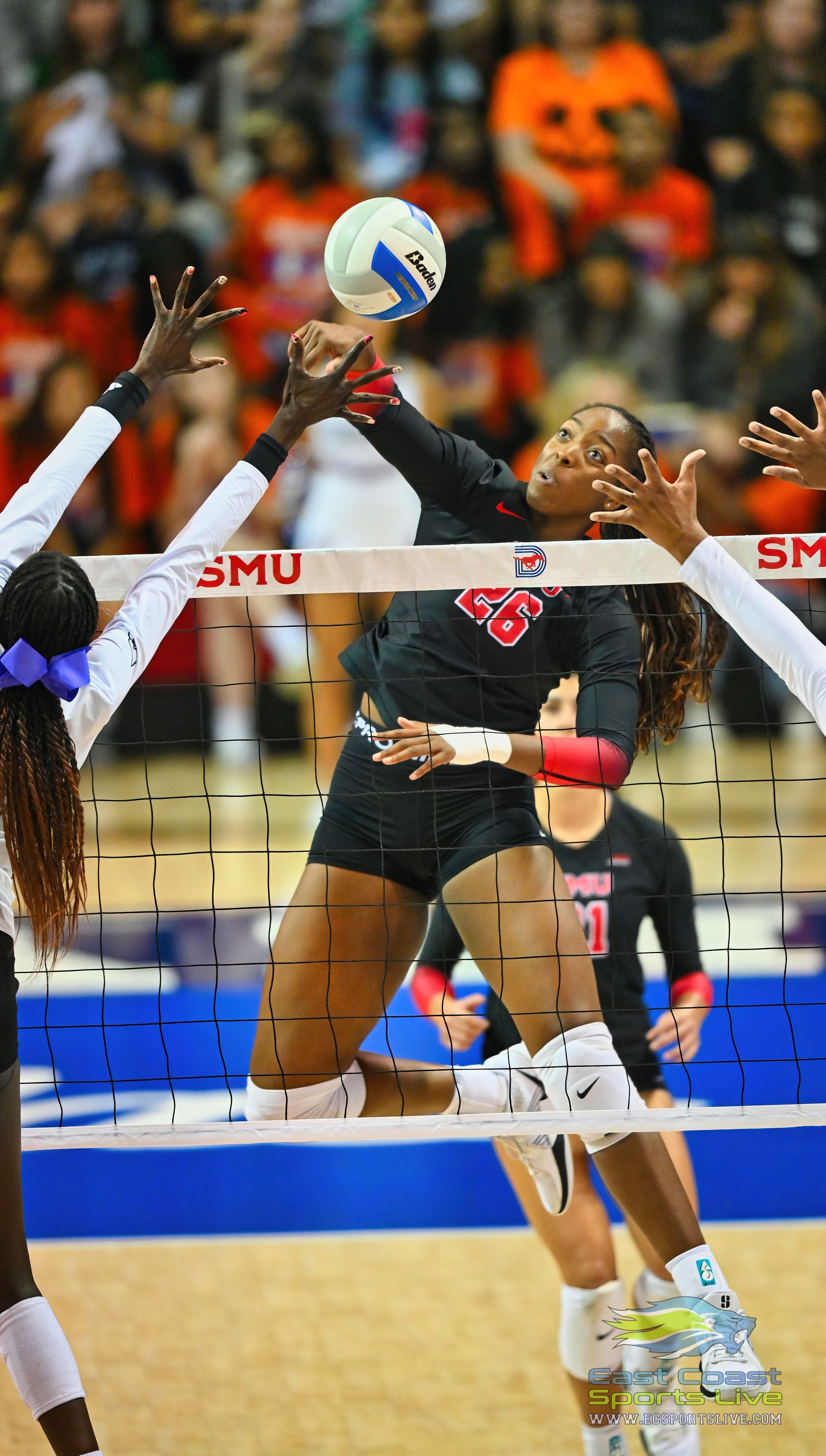
No. 8 SMU delivered another statement victory Wednesday night, taking down No. 9 Texas 3-2 (25-21, 21-25, 25-22, 26-28, 15-10) before a packed crowd at Moody Coliseum in Dallas. The Mustangs survived Texas’ dramatic fourth-set response and took control of the deciding fifth behind career performances from Favor Anyanwu and Hannah Beauford , along with another huge night from Suli Davis. Anyanwu recorded a career-high 16 kills on .481 hitting with eight blocks , while Davis powered the offense with 22 kills and 13 digs . The victory was SMU’s first over Texas since 2000 and extended the Mustangs’ home winning streak to 12 matches. Texas fell to 3-4 after its second consecutive loss. SMU Strikes First Against Texas The Mustangs entered the matchup with an opportunity to add another marquee victory to their early-season résumé. They wasted little time taking advantage. SMU attacked Texas effectively down the line and secured the opening set 25-21 , continuing a remarkable early-season trend. The Mustangs improved to 6-0 in opening sets this season. Under head coach Sam Erger, SMU has been especially difficult to beat after taking the first frame, improving to 92-11 in those matches following Wednesday’s victory. Texas, however, had an immediate response. Nya Bunton Helps Texas Even the Match The Longhorns found better rhythm in the second set behind senior middle blocker Nya Bunton . Bunton became an important factor both offensively and defensively as Texas answered with its own 25-21 victory , evening the match at one set apiece. She finished the night with seven kills on .412 hitting and three blocks . After struggling to consistently control SMU’s attack in the opening frame, Texas made adjustments at the net and temporarily changed the direction of the match. The Mustangs answered in the third. Favor Anyanwu Powers Mustangs at the Net Anyanwu emerged as one of the defining players of the match. The SMU middle blocker produced a career-high 16 kills while hitting .481 and added a match-high eight blocks . Her performance was part of a dominant night for SMU’s middle blockers. The group combined for 31 kills while hitting .490 with only four attack errors . Freshman Elle Vandeweghe contributed seven kills in what SMU described as her best performance of the season. That efficiency helped the Mustangs regain control. SMU took the third set 25-22 , moving within one frame of the upset and forcing Texas to respond again. Texas Survives Dramatic Fourth Set The Longhorns did exactly that. Facing the possibility of losing in four, Texas pushed SMU through the most dramatic set of the match. Neither team could finish the other at the standard 25-point mark, and the fourth eventually moved into extra points. Texas finally prevailed 28-26 , tying the match 2-2 and forcing a deciding fifth set. The comeback gave the Longhorns a chance to escape Dallas with a road victory after twice trailing by a set. But the fifth belonged to SMU. Mustangs Take Control of Deciding Set With more than 6,000 fans inside Moody Coliseum, SMU regained its composure and prevented the deciding set from becoming another extended battle. Anyanwu remained a major factor, delivering an important kill as the Mustangs created the separation they needed. Texas could not reproduce its fourth-set finish. SMU closed the deciding frame 15-10 , completing the five-set victory and setting off a celebration in Dallas. The Mustangs improved to 15-8 in five-set matches under Erger . Suli Davis Delivers 22-Kill Double-Double Davis continued her outstanding start to the season with another major offensive performance. She recorded a match-high 22 kills on .281 hitting , along with 13 digs and four blocks . The 13 digs helped Davis secure her third double-double of the season. She finished with a match-high 24 points . Davis has now recorded at least 15 kills in every match this season and has surpassed 20 kills three times in 2026. Her ability to consistently produce from the outside complemented SMU’s exceptional efficiency through the middle. Hannah Beauford Records Career-High 53 Assists Setter Hannah Beauford directed one of SMU’s strongest offensive performances of the season. Beauford recorded a career-best 53 assists as the Mustangs hit .303 against the ninth-ranked Longhorns. She also collected 10 digs, giving her the first double-double of her career , and added two service aces. SMU’s offensive balance forced Texas to defend multiple threats throughout five sets. The Mustangs were especially effective through the middle, while Davis provided consistent production from the outside. SMU Wins Battle at the Net Blocking provided another significant advantage for the Mustangs. SMU out-blocked Texas 12-7 , with Anyanwu accounting for eight blocks herself. The Mustangs also held Texas to a .224 hitting percentage while producing a .303 mark of their own. Those numbers became particularly significant during a match in which both teams had opportunities to take control. Texas could extend rallies and push the match to five, but SMU’s combination of efficient attacking and blocking ultimately created the difference. Historic Crowd Watches SMU Beat Texas The atmosphere added another layer to the victory. Wednesday’s announced attendance of 6,207 was the second-largest home crowd in SMU volleyball history . A record 801 students attended the home opener, setting a program record for student attendance at a volleyball match and ranking as the second-highest student turnout for any sport at Moody Coliseum. The crowd witnessed a result SMU had waited more than two decades to celebrate. The Mustangs had not defeated Texas since a 3-0 victory in Dallas in 2000 . Wednesday was also the first meeting between the programs in Dallas since 2004. SMU Extends Home Winning Streak The victory extended SMU’s home winning streak to 12 consecutive matches , tying the longest streak in program history. It was also another significant ranked victory for a program that has increasingly proven capable of competing with the nation’s elite. SMU has now earned six top-10 victories since joining the ACC in 2024 . Wednesday’s result was its second top-10 victory of the current season. The Mustangs also improved to 2-0 against SEC opponents in 2026 after defeating Texas A&M in their season opener. Texas Falls to 3-4 After Difficult Opening Stretch For Texas, the defeat continued an unusually challenging start. The Longhorns dropped to 3-4 , following their straight-set loss to No. 6 Louisville with another defeat against a top-10 opponent. Texas has faced a demanding early schedule filled with nationally ranked teams, but Wednesday’s result leaves the Longhorns searching for greater consistency. The source also notes that senior setter Ella Swindle saw limited action but contributed when called upon, finishing with two kills, seven assists and one block . Texas now faces another major challenge when it hosts No. 6 Wisconsin on Sunday at the Moody Center in Austin . SMU Heads to Bahamas for No. 3 Kentucky SMU’s schedule offers no opportunity to relax after the historic victory. The Mustangs travel to Nassau, Bahamas, for the Paradise Invitational, where they will face No. 3 Kentucky on Saturday, Sept. 12, at 1 p.m. CT . They will arrive with momentum and another top-10 victory on their résumé. Texas forced Wednesday’s match into a fifth set with its 28-26 fourth-set win, but SMU responded exactly when it needed to. Davis supplied 22 kills. Anyanwu produced a career night with 16 kills and eight blocks. Beauford distributed 53 assists. And when the deciding set arrived, the Mustangs finished the job. After 26 years without a victory over Texas, No. 8 SMU defeated No. 9 Texas 3-2 in front of a historic crowd in Dallas .
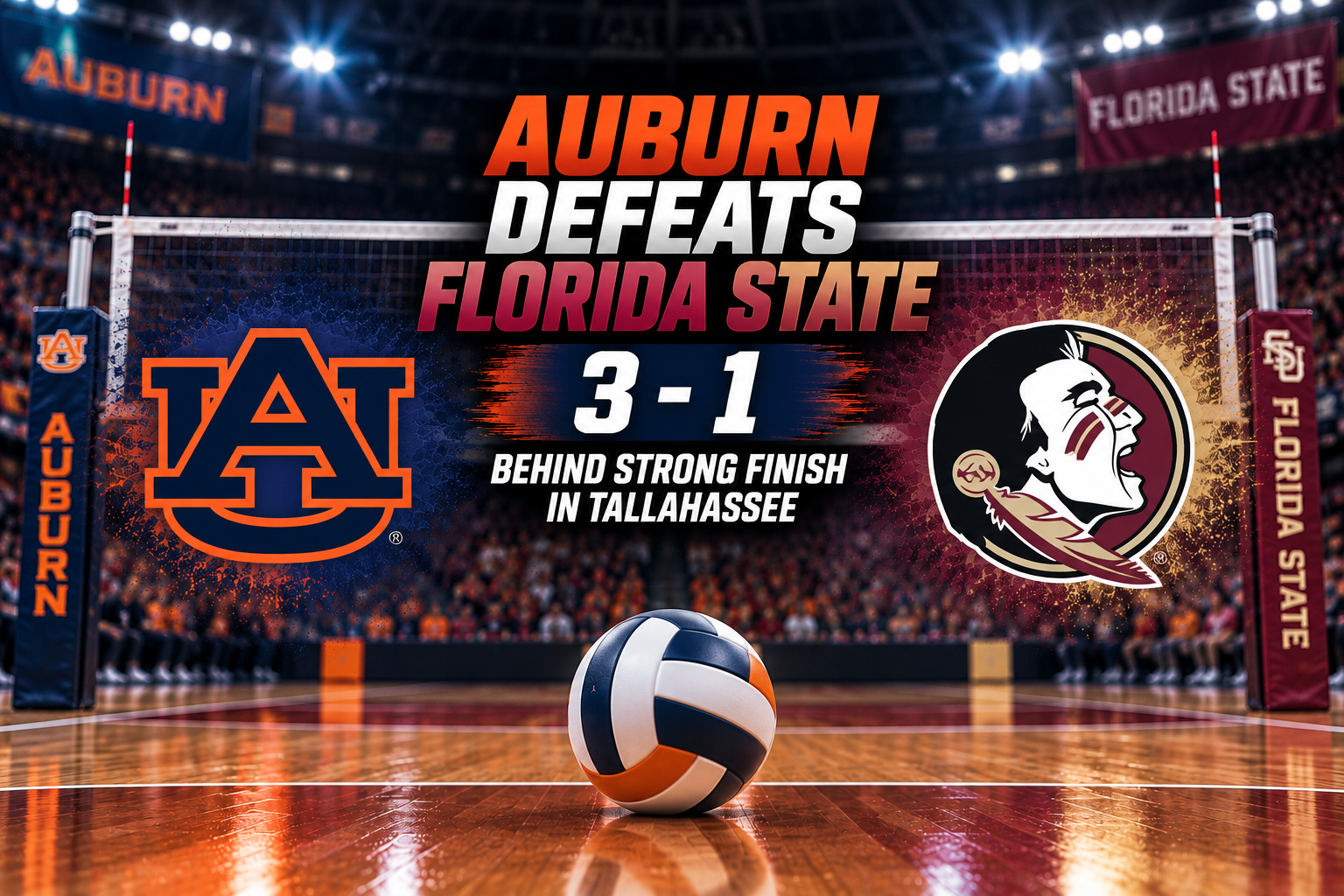
Auburn spoiled Florida State’s 2026 home opener Tuesday night, defeating the Seminoles 3-1 (25-18, 25-18, 16-25, 25-18) at Tully Gymnasium in Tallahassee. The Tigers controlled the first two sets, weathered a dominant response from Florida State in the third and then produced their most efficient offensive set of the match to close the victory. Belle Patrick led Auburn with 14 kills , while Grace Havlicek contributed seven blocks and two service aces. Florida State fell to 3-3 , while Auburn improved to 4-2 . Senior outside hitter Kyleene Filimaua led the Seminoles with 14 kills, nine digs, three aces and two blocks. Auburn Establishes Control Early Florida State entered the night playing its first home match of the season and the first home contest under new head coach Lindsay Allman. A crowd of 602 was on hand at Tully Gymnasium, but Auburn quickly took some of the energy out of the building. The Tigers established an early advantage and eventually moved ahead 10-4 . Florida State responded with a 4-1 run, cutting the deficit to 11-8 and creating an opportunity to work its way back into the frame. Auburn did not allow the comeback to develop. The Tigers pulled away again and secured the opening set 25-18 . Florida State struggled offensively during the frame, hitting -.048 , while Auburn’s defense kept the Seminoles from establishing a consistent attacking rhythm. Tigers Build Another Early Lead in Second The second set followed a similar pattern. Auburn again created early separation, moving ahead 10-5 before extending the advantage to 15-7 at the technical timeout. Florida State spent much of the set attempting to recover. The Seminoles eventually reduced Auburn’s advantage to five at 22-17 , but the Tigers remained composed and finished the frame with another 25-18 victory . After two sets, Auburn had a commanding 2-0 match advantage. For Florida State, the problem was clear. Early deficits had forced the Seminoles to chase Auburn throughout both frames. That changed dramatically in the third. Florida State Responds With Dominant Third Set Facing a possible sweep, the Seminoles produced their best volleyball of the night. Florida State opened the third set with a 6-3 run , forcing Auburn to call an early timeout. The Seminoles maintained the pressure and built a 10-6 advantage. FSU then used another 5-2 run to move ahead 15-8 . This time, Auburn was the team playing from behind. Florida State’s offensive improvement was substantial. After hitting -.048 in the opening set and .226 in the second, the Seminoles attacked at .385 in the third . Their defense was equally effective. Auburn was held to -.033 hitting , and Florida State cruised to a 25-16 victory to extend the match. Kyleene Filimaua Leads Seminoles Filimaua was Florida State’s most productive all-around player. The senior finished with 14 kills, three service aces, nine digs and two blocks , giving the Seminoles production in virtually every phase of the match. Freshman outside hitter Sofia Moss added seven kills and led FSU with 11 digs . Setters Emma Lilo and Callie Kieffer shared the distribution responsibilities. Lilo finished with 19 assists , while Kieffer recorded 18. Their work helped Florida State finish with 43 kills, but Auburn ultimately produced the more efficient offensive night. Auburn Responds After Third-Set Setback Florida State’s third-set performance created an opportunity to completely change the direction of the match. Auburn made sure it did not happen. The Tigers raced to a 10-4 advantage in the fourth set, once again forcing the Seminoles to recover from an early deficit. FSU responded impressively. The Seminoles cut Auburn’s advantage to 11-9 , bringing themselves within two points and creating another surge of momentum inside Tully Gymnasium. But Auburn responded before Florida State could complete the comeback. The Tigers moved ahead 15-10 at the technical timeout and regained control of the frame. Tigers Hit .458 to Finish the Match Auburn saved its most efficient attacking performance for the final set. The Tigers hit .458 in the fourth , their best percentage of the match. Florida State could not keep pace. Auburn continued creating separation after the Seminoles had closed within two and eventually finished the set 25-18 , securing the 3-1 road victory. The response was particularly significant after what happened in the third. Auburn went from hitting -.033 in a 25-16 loss to attacking at .458 in the very next frame. That turnaround prevented Florida State from forcing a fifth set. Belle Patrick Leads Auburn Attack Patrick finished with 14 kills , providing Auburn with a consistent offensive threat at the net throughout the match. The Tigers also received career-high kill performances from Anastasija Ivkovic, Shanelle Puetz and Havlicek , according to the Auburn report included in the source material. Havlicek made her biggest impact defensively, recording seven blocks along with two aces. That production helped Auburn win the blocking battle 11-7 . The Tigers also received an important all-around performance from sophomore setter Carson Eickenloff , who finished with 20 assists and 10 digs for a double-double. Auburn Wins Key Statistical Battles Auburn finished the match with 50 kills and a .289 hitting percentage , compared with Florida State’s 43 kills and .215 hitting percentage . The Tigers also held the 11-7 advantage in blocks. Serving was even, with both teams recording six aces . Those numbers reflected Auburn’s ability to combine offensive efficiency with net defense. Florida State showed what it could do during its dominant third set, but the Seminoles were unable to sustain that level over the entire match. The slow starts proved especially costly. FSU trailed 10-4 in the first set, 10-5 in the second and 10-4 again in the fourth. Auburn Spoils Florida State’s Home Opener The defeat came on a notable night for the Seminoles. Tuesday was Florida State’s first home match of the season and Allman’s first appearance at Tully Gymnasium as the program’s head coach. The source’s photos on pages 3 and 9 show the Seminoles gathering together on the court during the home opener. FSU provided its home crowd with a strong response in the third set, but Auburn’s fourth-set efficiency ended the comeback attempt. For the Tigers, the victory continued their success in a series that reached its 21st meeting Tuesday. Both Teams Face Quick Turnarounds Florida State does not have much time to dwell on the loss. The Seminoles continue their six-match homestand against Louisiana on Wednesday at 6 p.m. at Tully Gymnasium. The match is scheduled for ACCNX. Auburn heads to Chicago for the three-day DePaul Invitational , beginning with a match against UIC on Friday at 6 p.m. CT. Tuesday’s result ultimately came down to Auburn’s ability to control the beginning and end of the match. Florida State showed its potential by dominating the third set 25-16, but Auburn answered immediately. The Tigers hit .458 in the fourth, controlled the blocking battle and prevented the Seminoles from turning their third-set surge into a full comeback. With Patrick leading the offense and Havlicek controlling the net, Auburn left Tallahassee with a 3-1 victory over Florida State .
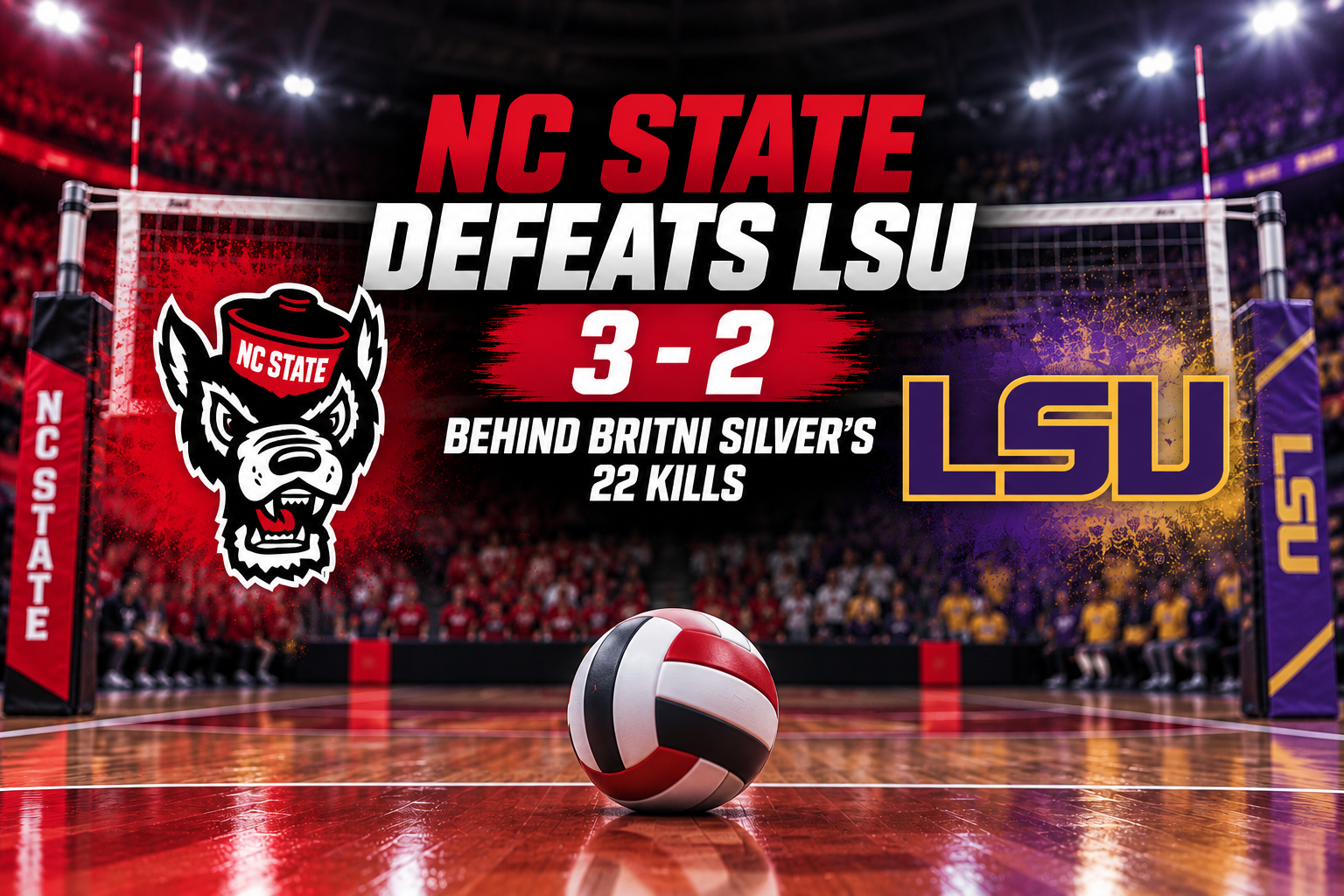
\ NC State survived nearly three hours of back-and-forth volleyball Tuesday night, defeating LSU 3-2 (23-25, 25-21, 26-24, 19-25, 15-12) at the Pete Maravich Assembly Center in Baton Rouge. The Wolfpack improved to 6-1 and earned their first true road victory of the 2026 season behind Britni Silver’s 22 kills and a 53-assist, 23-dig performance from setter Eva Long. Jordan Smith added 14 kills as NC State overcame LSU’s strong blocking performance and held off a late Tigers rally in the fifth set. LSU fell to 2-3 despite another huge performance from Jurnee Robinson, who finished with 25 kills and 14 digs for her third double-double of the season. LSU Takes Tight Opening Set The first set established what would become a night filled with narrow margins. LSU built an early 10-7 advantage , but NC State gradually worked its way back into the frame. The Tigers maintained a one-point edge before the Wolfpack eventually pulled even. LSU then moved ahead 21-19 , forcing NC State to use a timeout. The Tigers increased their advantage to 23-21, leading to another Wolfpack timeout. NC State stayed close, but LSU middle blocker Angelina Lee helped finish the frame with a block as the Tigers secured a 25-23 victory . It was only the beginning of a match that eventually featured 40 ties and 16 lead changes . Britni Silver Helps NC State Answer NC State responded in the second set. LSU briefly fought its way into the lead behind a Robinson kill, but Silver increasingly became the offensive difference for the Wolfpack. With NC State leading late, Silver scored on consecutive plays to help preserve a 22-19 advantage . The Wolfpack closed the frame 25-21 , tying the match at one set apiece. Silver finished the night with 22 kills , marking her second 20-kill performance in a span of four days. She also reached a career milestone when her 13th kill of the match gave her 100 career kills . Third Set Becomes Turning Point The third set produced the most significant momentum swing of the night. LSU appeared to have taken control late. The Tigers used a four-point run featuring a Robinson service ace, kill and block, along with a Jessica Jones kill, to put pressure on NC State. An attack error following a Wolfpack timeout helped LSU build a late advantage. But NC State refused to concede the set. A disputed block-touch call went against LSU during the closing stretch, and the Wolfpack continued its comeback. NC State's own recap says the Wolfpack trailed 19-16 before producing a 7-3 scoring run . The frame eventually went beyond 25 points, where NC State prevailed 26-24 . Instead of LSU taking a 2-1 advantage, the Wolfpack moved one set away from victory. LSU Forces a Fifth Set The Tigers responded with their best offensive frame of the match. LSU hit .389 in the fourth set , compared with NC State’s .156. The Tigers moved ahead 15-13 at the media timeout and continued creating separation. With LSU leading 22-17 , NC State called timeout, but the Wolfpack could not produce another comeback. LSU finished the frame 25-19 , forcing a deciding fifth set. After four sets, neither team had been able to establish lasting control. The fifth finally gave NC State the separation it needed. Wolfpack Erases Early Deficit in Fifth LSU scored the first two points of the deciding frame. NC State quickly answered. The Wolfpack caught fire and eventually built an 11-6 advantage , putting the Tigers in a difficult position. LSU continued fighting and narrowed the margin, forcing NC State to earn the final points. The Tigers saved match point multiple times, extending the fifth set despite the Wolfpack’s earlier five-point advantage. Smith finally ended it. Her 14th kill secured a 15-12 NC State victory , finishing a five-set road battle that lasted almost three hours. Britni Silver Records Another Double-Double Silver once again delivered when NC State needed offensive production. In addition to her 22 kills , she recorded a double-double, her third of the season. Her performance continued a productive stretch after another 20-plus-kill outing just days earlier. Smith also recorded a double-double, the first of her career , while contributing 14 kills. Middle blocker Talia Francom gave NC State another efficient attacking option. She finished with eight kills while hitting a match-best .412 and led the Wolfpack with five blocks. Sophie Groom added seven kills. Eva Long Delivers 53 Assists and 23 Digs Long played a major role in keeping NC State's offense functioning through five demanding sets. She finished with 53 assists and 23 digs , recording her third double-double of the season. It was also the second 53-assist performance of her career. Her 23 digs led NC State. The Wolfpack finished with 65 kills on 62 assists and collected 84 digs as a team. NC State's ability to generate kills became important because LSU held clear advantages in other areas. Jurnee Robinson Powers LSU With 25 Kills Robinson produced the biggest individual offensive total of the match. The LSU outside hitter finished with 25 kills and 14 digs , earning her third double-double of the season. She also recorded four blocks, including two solo blocks, and added an ace. Robinson totaled a match-high 29 points . She was central to LSU's success throughout the night, particularly during the late third-set surge and the Tigers' fourth-set response. Camryn Jeffery tied a career high with nine kills on .300 hitting , while Samara Coleman also recorded nine kills. LSU Dominates at the Net One of the most impressive aspects of LSU's performance came from its blocking. The Tigers finished with a season-high 13.5 blocks , nearly doubling NC State's seven. Jeffery, Jessica Jones and Lee each recorded five blocks . LSU also finished with 73 digs , its third match of the season with at least 70. Libero Kiley Brooks led the Tigers with season highs of 21 digs and three service aces , while also contributing six assists. Setter Takyla Brown recorded LSU's other double-double with 24 assists and 10 digs . Lauren Brooker added 17 assists and six digs. NC State Overcomes LSU’s Statistical Advantages LSU won several important statistical battles. The Tigers outblocked NC State 13.5-7 and held a 6-4 advantage in service aces . The overall hitting percentages were virtually identical, with one source listing both teams at approximately .180 for the match. NC State, however, finished with 65 kills and 84 digs , while finding the decisive points in the two closest sets it won. The Wolfpack captured the third 26-24 and the fifth 15-12. Those margins were enough. Wolfpack Continues Strong Start at 6-1 NC State improved to 6-1 , marking the second consecutive season in which the Wolfpack has lost only once through its first seven matches. The victory was also the 837th in program history , the 21st under head coach Megan Wargo-Kearney and the program's second win over an SEC opponent during her tenure. Most importantly, it gave NC State its first true road win of 2026 . For LSU, the loss was its third consecutive defeat and dropped the Tigers to 2-3. NC State Returns Home After Five-Set Thriller NC State returns to Reynolds Coliseum to host Belmont on Sunday, Sept. 13, at 1 p.m. on ACCNX. LSU remains home and will try to end its three-match losing streak against Charlotte on Friday at 11 a.m. on SEC Network+. Tuesday's match offered little separation between the two programs. There were 40 ties. There were 16 lead changes. LSU won the blocking battle and received 25 kills from Robinson. NC State answered with Silver's 22 kills, Long's 53 assists and a crucial late finish from Smith. When the match finally reached its deciding moments, the Wolfpack made the final push. Smith's 14th kill ended the nearly three-hour battle and sent NC State out of Baton Rouge with a 3-2 victory over LSU .
Georgia Tech remained perfect Tuesday night, defeating Oklahoma 3-1 (25-15, 25-19, 23-25, 25-21) at O'Keefe Gym in Atlanta as part of the SEC/ACC Showdown at the Net. The Yellow Jackets improved to 7-0 by controlling the opening two sets, responding after Oklahoma extended the match in the third and finishing the Sooners in four. Georgia Tech hit .343 and held important advantages in both service aces and blocks despite Oklahoma finishing with more total kills. Oklahoma fell to 3-2, but the Sooners received standout performances from Elise Hani and Tekoa Barnes, who recorded 13 kills apiece . Hani was nearly flawless offensively, hitting .619 without committing an attack error. Georgia Tech Pulls Away in Opening Set Oklahoma scored the first two points of the match, but Georgia Tech quickly settled into its home court. The Yellow Jackets moved ahead 5-4 before producing a four-point run that stretched the advantage to 10-5. Oklahoma responded and eventually pulled within two at 13-11 . That was the closest the Sooners would get. Georgia Tech regained control and used another run to build a commanding 21-12 advantage . The Yellow Jackets closed the opening set 25-15 , putting Oklahoma under immediate pressure. Oklahoma Leads Before Georgia Tech Takes Over Set Two The second frame was more competitive early. Hani delivered a kill to give Oklahoma an 8-7 advantage , and the Sooners remained in front 11-10. Georgia Tech answered with one of the most important runs of the match. The Yellow Jackets outscored Oklahoma 7-1 , turning their one-point deficit into a 17-12 lead . The Sooners managed to cut the margin to 18-15, but Georgia Tech prevented the comeback from developing. The Yellow Jackets finished the set 25-19 , taking a 2-0 advantage and moving within one frame of maintaining their undefeated start. Elise Hani Delivers Near-Perfect Offensive Night Oklahoma's most efficient performance came from Hani. The senior finished with 13 kills on 21 attacks without an error , producing a remarkable .619 hitting percentage . Barnes matched Hani with 13 kills while hitting .409 . She also contributed five digs and two service aces. Those two performances helped Oklahoma finish the match with a strong .319 hitting percentage , its second-best mark of the season. The Sooners also received 11 kills from Alaleh Tolliver and 10 from Alyssa Flack. Carley Butler added seven kills on .353 hitting. Oklahoma's offensive production was enough to create problems for the unbeaten Yellow Jackets, particularly in the third set. Sooners Fight Back in Third Set Facing a possible sweep, Oklahoma produced its strongest frame of the night. The third set remained tight throughout. Georgia Tech used a 4-0 run to turn an 11-10 deficit into a 14-11 advantage, but Oklahoma continued applying pressure and eventually tied the score at 16-16 . Neither side could build more than a one-point advantage during the next stretch. With the score tied 21-21, Oklahoma finally created the separation it needed. The Sooners scored consecutive points to move ahead 23-21 . Tolliver then delivered a kill that gave Oklahoma set point at 24-22. Georgia Tech saved one opportunity, but the Sooners finished the frame 25-23 , reducing the Yellow Jackets' match advantage to 2-1. Oklahoma Hits .389 to Extend Match The third-set victory reflected just how effective Oklahoma could be offensively. The Sooners hit .389 in the frame , their best set of the night. After dropping the first two sets by six or more points, Oklahoma found enough offensive rhythm to win a close finish and force Georgia Tech into a fourth. The Sooners now had an opportunity to push the unbeaten Yellow Jackets to a deciding fifth set. Georgia Tech did not allow that opportunity to develop. Yellow Jackets Build Early Fourth-Set Advantage Georgia Tech created the first significant separation of the fourth set. A 4-0 Yellow Jackets run produced a 9-4 advantage and immediately forced Oklahoma to play from behind. The Sooners continued fighting and tried to close the margin during the later stages of the frame. Georgia Tech maintained its advantage. Unlike the third set, Oklahoma could not produce the late scoring burst needed to change the outcome. The Yellow Jackets closed the set 25-21 , securing their seventh consecutive victory to begin the season. Georgia Tech Wins Serving and Blocking Battles Oklahoma actually finished with more kills than Georgia Tech, holding a 55-47 advantage . The Yellow Jackets found their separation elsewhere. Georgia Tech recorded 10 service aces compared with Oklahoma's five and finished with a 7.5-4 advantage in blocks . The Yellow Jackets also held the slight edge in overall hitting efficiency, attacking at .343 compared with Oklahoma's .319 . Those numbers helped explain how Georgia Tech overcame Oklahoma's advantage in total kills. The Sooners could score efficiently, but the Yellow Jackets created more pressure from the service line and at the net. Avaya Maga Records 48 Assists Oklahoma setter Avaya Maga finished with 48 assists and six digs , directing an offense that had four players reach double-digit kills. Aniya Warren led Oklahoma defensively with eight digs, while Kinsley Singleton contributed seven. The Sooners' balanced attack was one of the strongest elements of their performance. Hani and Barnes each had 13 kills. Tolliver had 11. Flack had 10. But Oklahoma's efficiency and 55 kills were not enough to overcome the decisive scoring runs Georgia Tech produced in three of the four sets. Georgia Tech Remains Perfect at 7-0 Tuesday's result kept Georgia Tech's unbeaten start intact. The Yellow Jackets improved to 7-0 , while Oklahoma dropped to 3-2 . Georgia Tech's ability to respond was particularly important. When Oklahoma pulled within two in the first, the Yellow Jackets surged ahead. When the Sooners led 11-10 in the second, Georgia Tech answered with a 7-1 run. And after Oklahoma finally broke through with a 25-23 victory in the third, the Yellow Jackets opened a five-point advantage early in the fourth and never surrendered control. Oklahoma Returns Home Against Abilene Christian The Sooners will now return home to face Abilene Christian on Sunday at 2 p.m. Oklahoma leaves Atlanta with several encouraging offensive performances despite the defeat. Hani finished without an attack error. Barnes hit above .400. Four Sooners reached double-digit kills, and Oklahoma hit .319 against an undefeated opponent. Georgia Tech simply produced more in the areas that ultimately separated the teams. The Yellow Jackets served more effectively, controlled the blocking battle and consistently created runs at critical moments. Oklahoma managed to extend the match with an impressive third-set response, but Georgia Tech answered in the fourth to complete a 25-15, 25-19, 23-25, 25-21 victory and keep its perfect start alive.
California turned an opening-set loss into a convincing road victory Tuesday night, defeating South Carolina 3-1 (25-27, 25-11, 28-26, 25-20) in the 2026 Shriners Children’s Showdown at the Net in Columbia. The Golden Bears responded to a tight 27-25 loss in the first set by dominating the second, surviving another tense finish in the third and controlling the fourth to improve to 5-1 . True freshman Abby Zimmerman recorded 15 kills for the second consecutive match , while freshman setter Anna Flores finished with 47 assists. South Carolina fell to 4-2 despite three players reaching double-digit kills. Elise Marchal led the Gamecocks with a season-high 12 kills on .455 hitting. South Carolina Survives Tight Opening Set There was little separation between the teams from the beginning. The opening set featured 13 ties and five lead changes , with neither side able to establish lasting control. California eventually created a three-point advantage, but South Carolina remained close behind kills from Ava Leahy, Ceci Vance and Marchal. The Gamecocks tied the score at 17-17 and then made their move. A Sydney Davis kill and two Cal errors helped South Carolina build a 20-17 lead . The Golden Bears fought back and eventually tied the frame at 24-24, pushing the opener beyond the standard 25 points. South Carolina found the final answer. Three consecutive Cal errors allowed the Gamecocks to close the set 27-25 and take a 1-0 match lead. Cal Answers With Dominant 25-11 Set Whatever momentum South Carolina gained from the opener disappeared quickly in the second. The Gamecocks remained within one at 9-8 after kills from Leahy and Vance. Then Cal took over. The Golden Bears produced a 7-0 run , taking advantage of three consecutive South Carolina attack errors and adding an ace to build a 15-8 advantage. Leahy ended the run with a kill, but South Carolina could not slow Cal for long. The Golden Bears continued extending the margin until the lead reached 22-10 . Cal finished the set 25-11 , evening the match and delivering a decisive response to its opening-set defeat. Gamecocks Build Four-Point Lead in Third The third set returned to the back-and-forth style of the opener. South Carolina answered Cal's runs and eventually used kills from Marchal and Olivia Borgman to fuel a 4-0 surge , giving the Gamecocks a 17-13 advantage . Cal responded aggressively and gradually erased the deficit. The Golden Bears tied the score at 21-21 , setting up another tense finish. South Carolina regained control and reached set point with a 24-22 lead . A 2-1 match advantage appeared within reach for the Gamecocks. Instead, Cal produced the most important comeback of the night. Golden Bears Rally to Win Third Set 28-26 Cal refused to allow South Carolina to finish the set. The Golden Bears erased the 24-22 deficit, forced extra points and eventually completed a 6-2 closing run to take the frame 28-26 . Like the opening set, the third was filled with momentum changes. There were nine ties and three lead changes . This time, Cal won the decisive points. The difference was significant. Instead of South Carolina taking a 2-1 advantage, the Golden Bears entered the fourth set needing only one more frame to secure the road victory. Abby Zimmerman Leads Cal Attack Zimmerman continued an impressive start to her freshman season by recording 15 kills for the second straight match . Cal also received balanced production behind her. Cari Bohm and Ashley Li combined for 24 kills , giving Flores several reliable attacking options as she directed the Golden Bears' offense. Flores finished with 47 assists , an impressive total for the freshman setter in a four-set road victory. That balance became increasingly difficult for South Carolina to contain after the opening frame. Elise Marchal Delivers Season-High 12 Kills Marchal led South Carolina with 12 kills , her highest total of the season, while hitting an efficient .455 . She also contributed three blocks. Two other Gamecocks reached double figures offensively. Borgman finished with 11 kills , while Vance added 10 . Vance also recorded three blocks, joining Marchal, Leahy and Davis with that total. The Gamecocks had enough offensive production to challenge Cal, particularly in the first and third sets, but the Golden Bears' scoring runs repeatedly changed the match. Cal Creates Separation in Fourth Set South Carolina needed the fourth set to keep the match alive but spent much of the frame playing from behind. Kills from Vance and Borgman helped the Gamecocks stay within one early. Cal gradually began creating separation. South Carolina errors contributed to the Golden Bears building a 15-10 advantage . The Gamecocks made another push. Kills from Cavanaugh and Leahy contributed to a 3-1 run that reduced Cal's advantage to three. The Golden Bears remained composed and prevented the comeback from developing further. Cal closed the fourth set 25-20 , completing its 3-1 victory. Kiana Dinn and Lilly Gillespie Lead Gamecocks Setter Kiana Dinn recorded 25 assists , marking the fifth time this season she has reached at least 20 assists. Dinn nearly completed a double-double, finishing with eight digs. Defensively, Lilly Gillespie collected a team-high 20 digs . Those numbers reflected South Carolina's effort to stay competitive during extended stretches, but Cal proved more effective at converting momentum into decisive scoring runs. The 7-0 surge in the second set changed that frame. The 6-2 finish in the third changed the match. Cal Completes Perfect Three-Match Road Trip The victory completed a successful road swing for the Golden Bears. Cal won all three matches on its road trip and improved to 5-1, giving the program its best start since opening the 2023 season 6-0. The result also gave the ACC a victory in its challenge against the SEC. Cal's ability to respond to adversity stood out throughout the night. The Golden Bears lost an opening set featuring 13 ties and five lead changes. Rather than allowing South Carolina to build on that momentum, they answered with a 14-point victory in the second. Then, when the Gamecocks reached set point at 24-22 in the third, Cal responded again. South Carolina Heads to Clemson Next South Carolina now turns its attention to an in-state matchup. The Gamecocks travel to face Clemson on Friday, Sept. 11, at 7 p.m. before visiting Wofford on Saturday for a 4 p.m. match. Cal will return to California for the Santa Clara Mission Classic, where the Golden Bears are scheduled to play their next two matches. Tuesday's result ultimately came down to Cal's responses. South Carolina won the first set. Cal dominated the second. South Carolina reached set point in the third. Cal rallied to win it. And once the Golden Bears gained control of the match, they did not give it back. With Zimmerman delivering 15 kills, Flores distributing 47 assists and the Golden Bears producing their biggest runs when they mattered most, Cal left Columbia with a 3-1 victory over South Carolina .