
High School Football Recruiting: How the Process Works
High school football recruiting is the process college football coaches use to identify and evaluate high school players and extend roster spots and athletic scholarships, and the process student athletes use to get noticed, compare programs, and choose a school. For most players, getting recruited depends on three things working together: film and performance that show college level ability, grades that meet eligibility requirements, and proactive communication with the right college programs. Understanding how the football recruiting process works, and the NCAA recruiting rules that govern it, helps families make better decisions and avoid surprises.
This guide explains how the recruiting process works, what NCAA Division I eligibility requires, how to get noticed, and the mistakes families commonly make.

How the Football Recruiting Process Works
Recruiting is a two way evaluation. College staffs find prospects through high school coaches, film, camps, showcases, recruiting services, and the internet, including social media, then evaluate them through game film, in person visits, and conversations. Student athletes evaluate each program on playing opportunity, academics, coaching staff, campus fit, and cost.
The recruiting process usually moves through a few broad stages:
- Identification. A staff becomes aware of a prospect through film, a recommendation, a camp, or the player's own outreach.
- Evaluation. The staff watches film, checks grades, and may watch the player in person or at a camp.
- Contact and relationship building. Calls, messages, and conversations within the periods the rules allow.
- Visits. Unofficial and official visits to campus.
- Commitment. A scholarship or roster spot, followed by a verbal commitment and, later, a signed agreement.
Every step is shaped by rules on when and how staffs can contact prospects, and those rules differ by division and change over time.
NCAA Recruiting Rules and Calendars
NCAA recruiting rules govern when college staffs can call, message, have face to face contact, and host visits, and the year is divided into periods such as contact, evaluation, quiet, and dead periods. Because these rules and specific dates change, and differ across Division I, Division II, and Division III, families should check the current football recruiting calendar for the applicable division rather than relying on dates from a past year. Your high school coach and counselor can also help families understand the current rules.
For context on how rule changes affect players already in college, see our coverage of how the NCAA shortened transfer windows.
Grades and NCAA Division I Initial Eligibility
Athletic ability gets a player noticed, but grades determine whether a player can compete. According to the NCAA Eligibility Center, a student who wants to compete at a Division I school must meet these requirements:
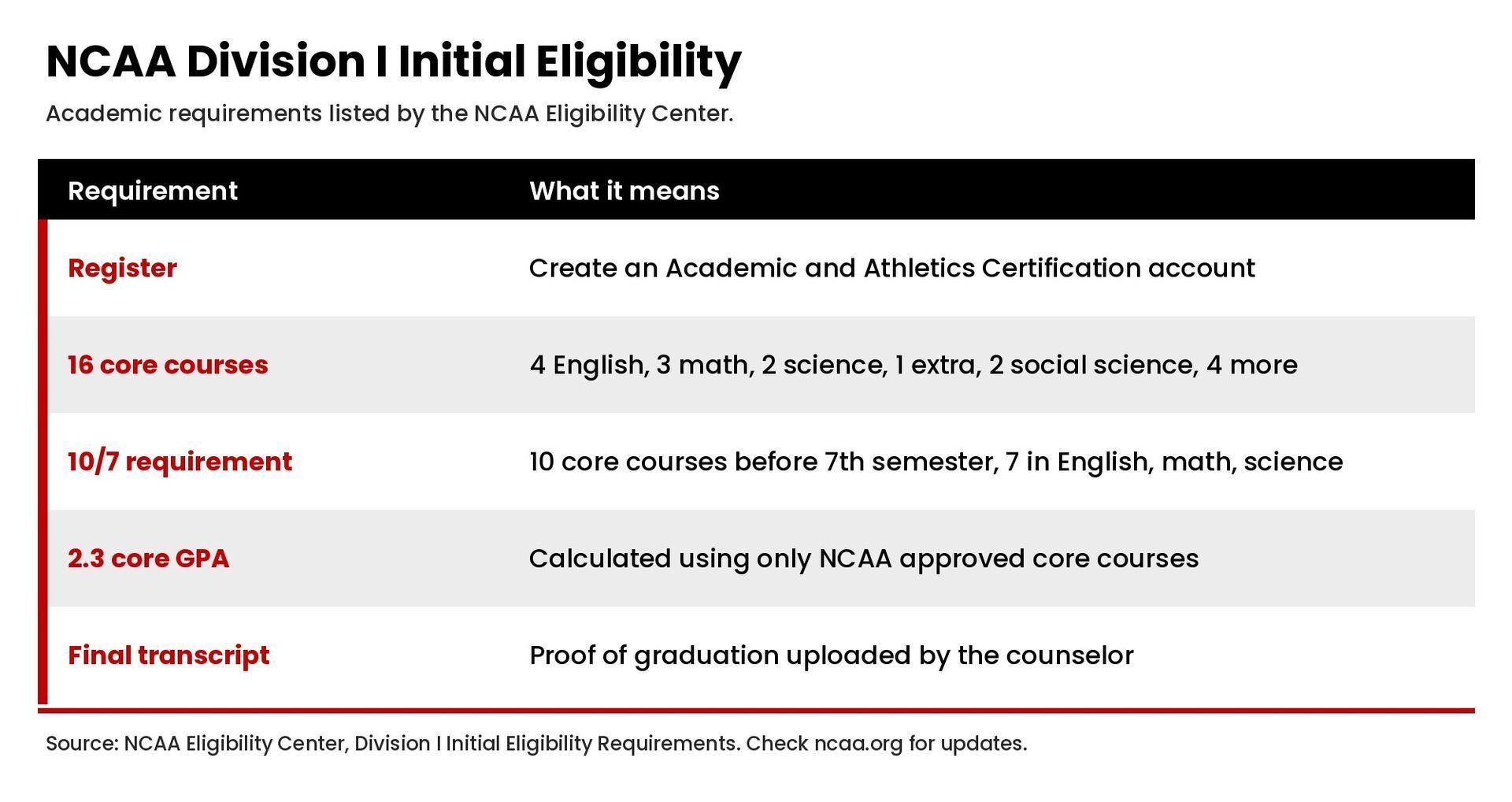
- Register with the NCAA Eligibility Center and create an Academic and Athletics Certification account.
- Complete 16 NCAA approved core courses in required subject areas: 4 years of English, 3 years of math (Algebra I or higher), 2 years of natural or physical science (including 1 year of lab science if offered), 1 additional year of English, math, or science, 2 years of social science, and 4 additional years of core courses.
- Meet the 10/7 requirement. Ten of the 16 core courses must be completed before the start of the seventh semester (senior year), and seven of those ten must be in English, math, or natural or physical science.
- Earn at least a 2.3 core course GPA, calculated using only approved core courses.
- Submit a final transcript with proof of graduation through the high school counselor.
The NCAA notes that the 16 core course requirement and the 10/7 requirement are the most important parts of Division I eligibility, and recommends reviewing your school's approved course list with your counselor before finalizing your schedule. Planning starts in ninth grade, not senior year.
Tips for Student Athletes: How to Get Recruited
Build a strong highlight film
Film is the most important recruiting tool. Put your best plays first, keep the film focused, and make sure viewers can identify which player you are. Update it as the season goes on.
Create a recruiting profile
A simple profile should include your position, height and weight, school, graduation year, key stats, GPA and test information, film link, and contact information for you and your high school coach.
Identify the right schools
Research colleges at every level, including Division I, Division II, Division III, NAIA, and junior college. Be realistic about where you can compete, and consider academics, location, cost, and campus fit. Many athletes find their best opportunity outside the colleges they first imagined.
Contact college football coaches
Do not wait to be discovered. Send concise, personal emails to position coaches or recruiting coordinators at programs that fit, with your film and profile. Follow up with updates on your season and grades. Recruiting rules limit when staffs can respond or initiate contact, so be patient with responses.
Attend camps strategically
Camps let college staffs see you in person. Choose camps where staff from the teams on your list will be present, and prepare to compete.
Involve your high school coach
College staffs often trust a high school coach's evaluation. Make sure your coach knows your goals and has your film and transcript.
Stay on top of your grades
Strong grades in core courses expand your options, keep more colleges interested, and can open academic aid in addition to an athletic scholarship.
A Recruiting Timeline by Grade
Every player's path is different, but most families find it helps to plan the recruiting process year by year. Exact contact dates come from the current recruiting calendar, so treat this as a planning guide, not a rulebook.
- Freshman year. Sit down with your counselor to map out core courses, get as many snaps as you can, and start saving game clips. The focus is on development and grades.
- Sophomore year. Build a first highlight film, research colleges at every level, and attend camps or events where staff from teams on your list will be present.
- Junior year. For many student athletes this is a key recruiting year. Update film after the season, send personal emails to staffs at programs that fit, take unofficial visits, and keep your grades strong. Interested staffs will often request transcripts.
- Senior year. Finish core courses, take official visits if invited, compare scholarship and financial aid packages side by side, and confirm the signing date and paperwork that apply to the college you pick.
Players who start late can still find a roster spot, especially at Division II, Division III, NAIA, and junior college programs, but they need to move quickly and reach out to more teams.
How to Tell if College Football Coaches Are Interested
Not every message from a program means the same thing. General camp invitations and questionnaires are often sent to many athletes and are a first step, not a sign of serious recruitment. Stronger signals include personal messages from a position coach, a request for your full game film or transcript, a staff member who comes to watch you practice, an invitation to an unofficial or official visit, and, ultimately, a scholarship or roster spot.
When a staff reaches out, respond promptly, answer questions honestly, and ask your own: where you fit on the depth chart, what the staff wants to see next, and when they expect to make decisions. Keeping a simple spreadsheet of each school, coach, contact date, and next step helps you manage relationships with several teams at once and follow up at the right time.
Visits, Offers, and Signing
Campus visits are one of the most important parts of recruitment. Unofficial visits are paid for by the family; official visits are paid for by the school and are limited by the rules for each division. On any visit, prospects should spend time with the coaching staff, watch a practice if possible, talk with current student athletes, see academic support resources, and ask direct questions about where they fit on the depth chart.
Scholarships come in different forms. A full athletic scholarship may cover tuition, fees, room, and board, while many teams, especially outside the Football Bowl Subdivision, award partial scholarships or combine athletic aid with academic aid, so only a portion of the cost may be covered. Ask every school what the package includes, how long it lasts, and what happens if the coaching staff changes. Before signing, a program can cancel a scholarship promise, or a player can cancel a commitment, so a verbal agreement is not the same as a signed one.
When it is time to sign, the signing date and paperwork depend on the current calendar and the school's process. Read every document carefully, and ask your high school coach or counselor to review it with you.
Scholarship Opportunities at Every Level
Division I FCS, Division II, Division III, NAIA, and junior college programs all recruit high school football players, and each has different scholarship rules, academics, and competition. Keeping other schools in the conversation gives prospects options if their first choice does not work out.
- Division I FBS and FCS. The most visible level, with the most competition for roster spots.
- Division II. Awards athletic scholarships, which can be partial and combined with academic aid, and recruits many players who are overlooked by bigger teams.
- Division III. Does not award athletic scholarships, but colleges may provide academic and need based aid, and many athletes choose a school for both football and academics.
- NAIA. A separate association from the NCAA with its own eligibility process and its own scholarship rules.
- Junior college. Gives players a chance to develop, improve grades, and be evaluated again by four year colleges.
Players who want options at more than one level should send film to staffs across divisions and watch how each program responds.
Common Recruiting Mistakes
- Waiting too long. Academic planning and outreach should start early.
- Targeting only one level. Limiting yourself to a few big programs reduces your chances.
- Ignoring grades. Missing core course requirements can affect eligibility.
- Sending generic messages. Staffs respond to personal, specific outreach.
- Not understanding scholarship terms. Ask what a package includes and what is guaranteed.
- Relying on outdated rules. Recruiting rules and calendars change; check the current calendar for the division.
The Role of Parents in the Recruiting Process
Parents play an important role in the football recruiting process: helping manage communication, keeping grades on track, budgeting for camps and visits, and asking the hard questions about playing time, academic support, and resources. The player should still lead conversations with each staff, since that is part of what they evaluate.
Frequently Asked Questions
How does a high school football player get recruited?
By showing college level ability on film and in person, meeting eligibility requirements, and proactively contacting college coaches at programs that fit, with help from the high school coach.
When does football recruiting start?
Staffs may begin evaluating players early in high school, but recruiting rules limit when they can contact prospects. Check the current recruiting calendar for the applicable division.
What GPA do you need for Division I football?
The NCAA requires at least a 2.3 GPA in approved core courses for Division I initial eligibility, along with the 16 core course and 10/7 requirements.
What are the 10/7 rules?
Ten of the 16 required core courses must be completed before the start of the seventh semester, and seven of those ten must be in English, math, or natural or physical science.
Do you need to register with the NCAA Eligibility Center?
Yes. Students who want to compete at a Division I school must register with the Eligibility Center and receive an Academic and Athletics Certification.
How do I know if a college coach is interested in me?
Personal messages from a position coach, requests for film or transcripts, in person evaluations, and visit invitations are stronger signals than mass camp invitations or questionnaires.
Can Division III schools offer football scholarships?
Division III colleges do not award athletic scholarships, but they may provide academic and need based financial aid, so ask each one what aid is available.
Take Control of Your Recruiting
Recruiting rewards players and families who start early, keep grades on track, understand the rules, and reach out to the right programs. For more on where programs stand, see our 2026 college football recruiting rankings.
Sources: NCAA Eligibility Center, Division I Initial Eligibility Requirements and Eligibility Center registration.