By Amber Aniston
•
September 13, 2026
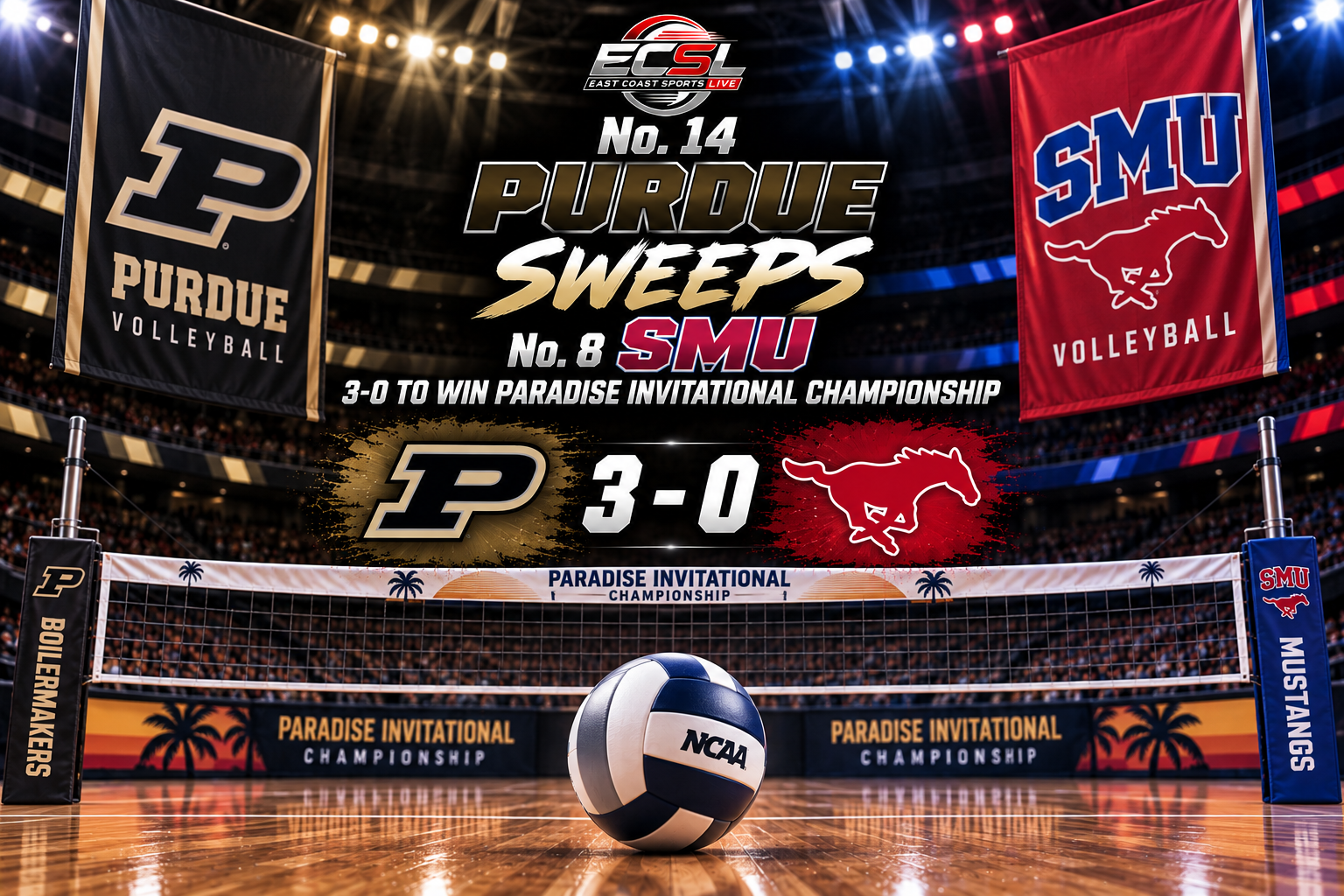
No. 14 Purdue completed a perfect trip to the Bahamas on Sunday, sweeping No. 8 SMU 3-0 (30-28, 25-23, 25-22) to capture the inaugural Paradise Invitational championship in Nassau. The Boilermakers improved to 5-2 after surviving three competitive sets against a Mustangs team that had defeated No. 3 Kentucky one day earlier. Grace Heaney led Purdue with 12 kills , while Kate Hansen and Mimi Mambu added 10 apiece. Purdue also won the battle at the net with a 10-7 advantage in blocks . SMU fell to 6-2 despite another strong performance from Suli Davis, who recorded 17 kills and 10 digs for her fourth consecutive double-double. Purdue Survives Marathon Opening Set SMU had opportunities to establish early control, but service errors kept Purdue within striking distance. The Mustangs committed five service errors in the opening set , allowing the Boilermakers to remain close even when SMU appeared to have the better rhythm. Purdue also began creating pressure with its blocking. The Boilermakers recorded five blocks in the first set alone , making it increasingly difficult for the Mustangs to finish attacks cleanly. Neither team could create the two-point margin needed to end the frame at 25. The battle continued into extra points before Purdue finally broke through for a 30-28 victory . That two-point margin became a preview of the rest of the afternoon. Boilermakers Win Another Tight Set The second set produced another opportunity for SMU to even the championship match. Again, Purdue found the points it needed late. The Boilermakers added four more blocks during the second set , bringing their total to nine through only two frames. SMU remained within striking distance throughout the set but could not produce the closing run needed to get even. Purdue took the frame 25-23 , moving within one set of the Paradise Invitational title. After two sets decided by a combined four points, the Mustangs faced the difficult task of winning three straight against a Purdue team that had not dropped a set during the tournament. Grace Heaney Leads Balanced Purdue Offense Heaney finished with a team-high 12 kills on 30 attacks , while also contributing six digs and three blocks. But Purdue's offensive success came from its balance. Hansen produced her best match of the season, finishing with 10 kills on 19 attacks and four blocks . Purdue increasingly featured the middle blocker on the slide after a slower start, and Hansen capitalized on those opportunities. Mambu added another 10 kills , giving the Boilermakers three players in double figures. Tindall finished just behind them with nine kills. That balance made it difficult for SMU to focus its defensive attention on one attacker. Suli Davis Extends Double-Double Streak Davis remained SMU's biggest offensive threat. The sophomore finished with a match-high 17 kills on .292 hitting and added 10 digs. It was her fourth consecutive double-double , continuing a productive stretch that included her 25-kill, 15-dig performance in SMU's 3-1 victory over Kentucky in the tournament semifinal. Davis finished Sunday's championship with a team-high 18.5 points . She was not SMU's only efficient attacker. Favor Anyanwu recorded 12 kills while hitting .429 , reaching double figures for the third time this season. She also tied Hannah Beauford for the team lead with four blocks. Purdue Wins Battle at the Net Blocking became one of the defining differences in the championship. Purdue finished with 10 blocks compared with seven for SMU . Dior Charles led the Boilermakers with five blocks , while Hansen added four and Heaney contributed three. Purdue accumulated nine of its 10 blocks in the first two sets. That defensive presence helped the Boilermakers withstand SMU's offensive threats and survive two sets decided by only two points. The Mustangs had opportunities. Purdue repeatedly denied them. Taylor Anderson Directs Purdue Attack Setter Taylor Anderson finished with 33 assists and nine digs , narrowly missing a double-double. She helped Purdue finish the match hitting .257 , compared with SMU's .220. Ryan McAleer and Elle Schara combined for 20 digs , strengthening Purdue's back-row defense, while MaryKate Scheumann contributed two timely service aces. Purdue's balance was also evident in the distribution of its kills. Heaney had 12. Hansen and Mambu each had 10. Tindall added nine. No single attacker needed to carry the Boilermakers. Victoria Harris Anchors SMU Defense SMU libero Victoria Harris recorded 16 digs , extending an impressive individual streak. Harris has now reached double figures in digs in all eight SMU matches this season . Beauford directed the Mustangs with 38 assists and joined Anyanwu with four blocks. SMU entered the championship with significant momentum after defeating No. 3 Kentucky, but Purdue's ability to remain composed in close situations prevented the Mustangs from carrying that momentum into another ranked victory. Purdue Closes Sweep 25-22 After losing the first two sets by only two points each, SMU still had an opportunity to extend the match in the third. Purdue instead produced another efficient offensive performance. The Boilermakers finished the final two sets with a combined .417 kill percentage , according to the Purdue report included in the source. Although Purdue recorded only one block in the third, its offense supplied enough production to maintain control. The Boilermakers closed the frame 25-22 , completing the straight-set victory and securing the inaugural Paradise Invitational championship. Every set had been competitive. Purdue won all three. Boilermakers Complete Perfect Bahamas Trip Purdue's championship capped a historic weekend for college volleyball. The Paradise Invitational was described in the source as the first collegiate volleyball tournament played internationally , with Purdue participating in the first NCAA match held outside the United States when it faced Houston. The Boilermakers swept Houston 25-18, 25-22, 29-27 to reach the championship. Tindall led Purdue with 22 kills in that match, while Anderson distributed 41 assists. Purdue then followed that victory by sweeping a top-10 SMU team. The photo on page 6 of the uploaded source shows the Boilermakers celebrating together, while the image on page 8 features Tindall attacking during Purdue's tournament run. Purdue Extends Sweep Streak The Boilermakers have responded impressively since being swept by No. 11 TCU. Purdue has now swept IU Indy, Houston and SMU in three consecutive matches . The Paradise Invitational title also continued Purdue's success in its major early-season events. The Boilermakers previously swept No. 14 Texas A&M and defeated Georgia in five sets during the Big Ten-SEC Challenge. They followed that performance with a perfect 2-0 trip to the Bahamas . Purdue Remains Perfect Against SMU Sunday's victory also continued Purdue's unbeaten history against the Mustangs. The Boilermakers improved to 5-0 all-time against SMU . This meeting, however, carried considerably more significance than a typical nonconference matchup. SMU entered ranked eighth nationally and had just defeated No. 3 Kentucky. Purdue answered by holding the Mustangs to .220 hitting, controlling the blocking battle and winning three sets decided by two, two and three points. Purdue Returns Home With Tournament Title Purdue now returns to West Lafayette for four consecutive home matches, beginning against Albany on Thursday, Sept. 17 , on the opening night of the Stacey Clark Classic. SMU returns to Texas and will face Rice on Thursday, Sept. 17, at 6:30 p.m. CT at Schollmaier Arena in Fort Worth. The Mustangs pushed Purdue throughout Sunday's championship but could not turn their opportunities into a set victory. Davis delivered another double-double. Anyanwu hit .429. Harris continued her double-digit dig streak. Purdue simply had more answers. Heaney led a balanced offense, Hansen produced her best match of the season, Charles controlled the net, and the Boilermakers executed in three consecutive close finishes. The result was a championship as No. 14 Purdue swept No. 8 SMU 30-28, 25-23, 25-22 to win the inaugural Paradise Invitational title.