
Amber Aniston • November 14, 2024

Georgia Tech Dominates West Georgia in 88-53 Victory

Georgia Tech women’s basketball team showcased their dominance at McCamish Pavilion with an 88-53 victory over the University of West Georgia. The Yellow Jackets, now 3-0 for the season, capitalized on turnovers and strong inside play to maintain control throughout the game. Freshman standout Dani Carnegie led the team in scoring for the third consecutive game, posting 15 points.


Georgia Tech’s victory underscored their ability to execute both offensively and defensively, a hallmark of their early-season success. The team demonstrated excellent chemistry, with contributions from multiple players showcasing their depth. Head coach Nell Fortner has emphasized balanced scoring and strong defensive fundamentals, and the results were evident throughout the game.


Strong Start Sets the Tone

Georgia Tech established an early lead, closing the first quarter with a commanding 19-8 advantage. Freshmen Dani Carnegie and Zoesha Smith played pivotal roles in the opening minutes, contributing key points that fueled the Jackets’ momentum. A pair of free throws from Tonie Morgan in the final seconds of the quarter widened the gap, signaling the start of a one-sided affair.


The Yellow Jackets expanded their lead in the second quarter, with Kara Dunn’s mid-quarter basket pushing the margin to over 20 points. Georgia Tech’s ability to dominate in transition and capitalize on turnovers was on full display as they forced West Georgia into several unforced errors. Smith continued her impressive performance, amassing 10 points and six rebounds in the first half. By halftime, the Jackets led 38-20, setting the stage for a decisive victory.


Offensively, the team showcased its versatility, with scoring contributions from both the starting lineup and the bench. Defensively, they held West Georgia to just 30% shooting from the floor, effectively shutting down any potential comeback attempts.


Continued Dominance in the Second Half

The third quarter saw Georgia Tech solidify their control of the game, outscoring the Wolves 29-17. Carnegie and Smith combined for back-to-back three-pointers, extending their lead and showcasing their offensive versatility. The team’s precision passing and court awareness were key factors in maintaining their rhythm. Kayla Blackshear, a consistent force throughout the night, added 13 points and nine rebounds, narrowly missing a double-double.


Georgia Tech’s defense remained relentless, forcing West Georgia to take difficult shots while controlling the boards. The Jackets’ ability to rebound effectively led to several second-chance points, further widening the gap. Transition play also became a focal point, with Tonie Morgan leading the charge in fast-break situations.


The Yellow Jackets displayed their depth as five players finished in double figures. Zoesha Smith added 14 points and eight rebounds to her stat line, while Dunn and Morgan contributed 12 and 10 points, respectively. Georgia Tech’s defensive efforts also shone, with the team forcing 24 turnovers, converting them into 27 points.


The fourth quarter allowed Georgia Tech to rotate their bench players, giving valuable minutes to the younger roster. Despite the substitutions, the Jackets continued to dominate, finishing strong and ensuring the victory was never in doubt.


West Georgia’s Struggles

The Wolves faced significant challenges against Georgia Tech’s size and pace. Grace O’Gara emerged as a bright spot for West Georgia, leading the team with 15 points on an efficient 6-of-10 shooting. Destiny Jones continued her streak of double-digit scoring with 12 points, while K’Nari Holliday contributed eight rebounds. Despite their efforts, the Wolves were unable to overcome the Jackets’ dominant play in the paint and struggles with turnovers.


West Georgia’s lack of depth became evident as the game wore on. The team’s struggles to keep up with Georgia Tech’s tempo and defensive pressure resulted in missed opportunities. The Wolves also struggled to contain the Jackets’ transition game, which accounted for several quick points that shifted the momentum firmly in Georgia Tech’s favor.


Statistical Highlights

Georgia Tech’s efficiency on both ends of the court was evident throughout the game. The team shot 46.6% from the floor and an impressive 81.3% from the free-throw line. They dominated in the paint, outscoring West Georgia 42-24, and won the rebounding battle 44-32, led by Blackshear’s nine boards.


The Jackets’ balanced scoring effort, coupled with their ability to capitalize on West Georgia’s mistakes, highlighted their depth and cohesion. Their defensive intensity, marked by seven blocks and numerous forced turnovers, ensured their lead was never in jeopardy. The ability to consistently generate offense from turnovers demonstrated Georgia Tech’s commitment to an aggressive style of play.


The team’s strong free-throw shooting was another standout aspect, helping them maintain their lead and close out the game efficiently. This level of execution will be critical as Georgia Tech faces tougher competition later in the season.


Looking Ahead

Georgia Tech’s next challenge will come against in-state rival Georgia on Sunday, November 17, in the 47th edition of “Clean, Old-Fashioned Hate.” With a strong start to the season and standout performances from freshmen Carnegie and Smith, the Yellow Jackets are poised to continue their momentum as they aim to further establish themselves in the ACC. The team’s ability to dominate in multiple facets of the game sets a promising tone for their upcoming matchups.
football
By Amber Aniston • November 5, 2026
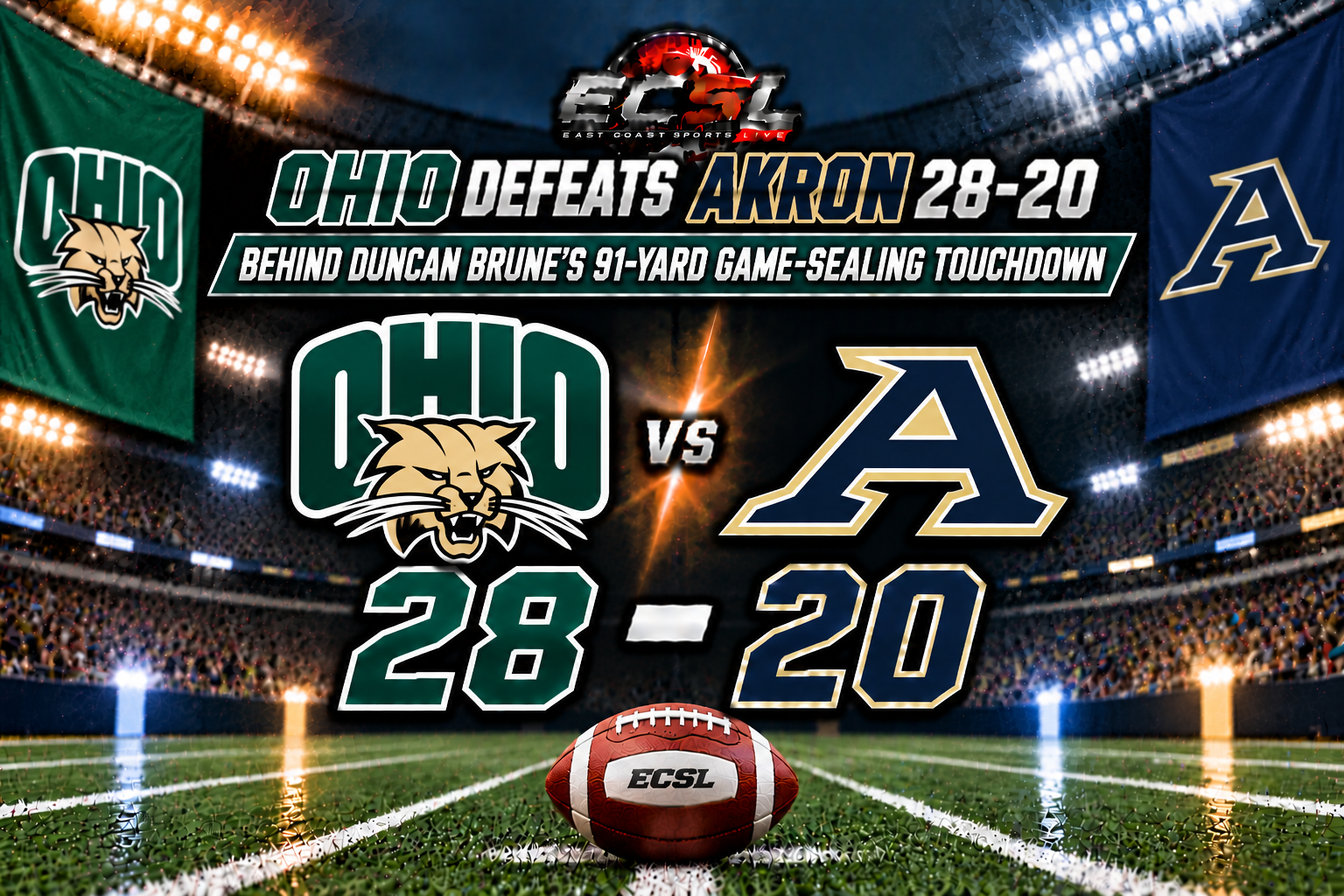
AKRON, Ohio — Ohio extended its winning streak to five games Tuesday night, November 3, 2026, defeating Akron 28-20 at InfoCision Stadium behind a dramatic fourth-quarter comeback highlighted by Duncan Brune's 91-yard touchdown run. The Bobcats overcame two second-half deficits to remain unbeaten in Mid-American Conference play, improving to 7-2 overall and 5-0 in the MAC. Akron dropped to 1-8 and 0-5 in conference competition despite holding a fourth-quarter lead. Brune finished with 111 rushing yards and a touchdown on 10 carries, while quarterback Nick Poulos contributed 197 passing yards, 45 rushing yards and two total touchdowns. Wide receiver Dom Dorwart added 108 receiving yards and a touchdown, helping Ohio escape with a crucial conference road victory. Duncan Brune Delivers Game-Changing 91-Yard Touchdown Brune produced the defining moment of the contest with fewer than four minutes remaining. Ohio led 21-17 when Akron drove deep into Bobcats territory, threatening to reclaim the advantage. Facing fourth-and-six at Ohio's nine-yard line, Akron quarterback Cibastian Broughton attempted a pass toward the end zone. The throw fell incomplete, giving Ohio possession near its own goal line. Rather than simply protecting its four-point lead, Ohio immediately delivered an explosive response. Brune broke through the defensive front and raced 91 yards for a touchdown with 3:57 remaining, extending the Bobcats' advantage to 28-17. The run was the fourth-longest touchdown rush in Ohio football history and the longest of Brune's career. His performance helped the Bobcats overcome an Akron team that had controlled significant portions of the contest. Akron Establishes Early Lead With Strong Defensive Performance Akron entered Tuesday's matchup seeking its first conference victory of the season. The Zips opened with an effective offensive possession but missed a 40-yard field goal attempt. Their defense continued applying pressure, forcing Ohio into difficult situations during the opening quarter. Akron eventually took a 3-0 lead when kicker Aidan Stire converted a 42-yard field goal. Running back Jordan Gant provided a significant contribution during the scoring possession, breaking tackles on a 31-yard run despite facing third-and-28. The Zips' defense limited Ohio's offensive production throughout much of the first half. However, turnovers prevented Akron from fully capitalizing on its early advantage. DJ Walker's Pick-Six Gives Ohio First-Half Advantage Ohio's defense delivered the game's first touchdown late in the opening quarter. With Akron attempting to move the football, Bobcats safety DJ Walker intercepted Broughton's pass and returned it 45 yards for a touchdown. The defensive score gave Ohio a 7-3 advantage and marked Walker's first interception of the season and first collegiate touchdown. The Bobcats produced another important takeaway during the second quarter. Safety Darren James-Hamilton forced a fumble after an Akron reception, and linebacker Jack Fries recovered the football to end a promising Zips possession. Akron responded with another field goal from Stire, this time from 47 yards, reducing Ohio's lead to 7-6. The Bobcats entered halftime holding a narrow one-point advantage despite being outgained 216-87 during the opening two quarters. Akron Regains Lead Before Nick Poulos Responds Akron continued its strong defensive performance after halftime. Defensive end Cyrus Durham forced a fumble while sacking Poulos, and linebacker Donelius Johnson recovered the football at Ohio's 32-yard line. The turnover gave Akron another scoring opportunity. Although the Zips advanced near the goal line, Ohio's defense prevented a touchdown. Stire converted a 24-yard field goal, giving Akron a 9-7 lead during the third quarter. Ohio responded with a nine-play, 75-yard scoring drive. Poulos connected with Dorwart for a 36-yard completion, moving the Bobcats into scoring position. The quarterback then scored on a five-yard rushing touchdown with 4:22 remaining in the quarter. The touchdown restored Ohio's advantage at 14-9 entering the fourth quarter. Jordan Gant Gives Akron Late Fourth-Quarter Lead Akron's offense delivered its strongest possession during the final period. Gant led a 12-play, 81-yard touchdown drive, repeatedly gaining difficult rushing yards against Ohio's defense. The running back completed the possession with a one-yard touchdown run with 9:35 remaining. The score reduced Ohio's advantage before Akron successfully attempted a two-point conversion. Broughton connected with Marcel Williams in the end zone, giving the Zips a 17-14 lead. Gant finished the contest with 112 rushing yards and a touchdown on 16 carries, averaging seven yards per attempt. His performance helped Akron remain competitive against one of the MAC's strongest teams. However, the Zips' lead lasted only 13 seconds. Nick Poulos Connects With Dom Dorwart for 60-Yard Touchdown Ohio answered Akron's go-ahead touchdown immediately. Following the kickoff, the Bobcats began their possession at their own 40-yard line. On the first offensive play, Poulos found Dorwart for a 60-yard touchdown reception, restoring Ohio's advantage at 21-17. Dorwart finished with four receptions for 108 yards, providing the Bobcats with their most productive receiving performance of the evening. Poulos completed 12 of 20 passes for 197 yards and a touchdown without an interception. He also rushed for 45 yards and scored Ohio's first offensive touchdown earlier in the game. The quarterback's ability to produce timely scoring plays proved essential during the second-half comeback. Ohio Defense Makes Critical Stops Against Akron Ohio's defense played an important role throughout the victory. Linebacker Michael Molnar recorded a team-high 16 tackles and one tackle for loss, while Fries contributed 10 tackles. Walker added four tackles alongside his interception return for a touchdown. Defensive lineman Nehemiah Dukes recorded three tackles and two tackles for loss. Although Akron finished with 392 total offensive yards compared with Ohio's 358, the Bobcats forced two turnovers while committing only one. The defensive unit also prevented Akron from scoring touchdowns on several promising possessions. Those stops ultimately created the opportunity for Brune's decisive fourth-quarter run. Akron Makes Final Push Before Ohio Secures Victory Akron continued battling after falling behind 28-17. Broughton directed another offensive possession, moving the Zips into field-goal range. Stire converted a 43-yard field goal with 1:56 remaining, reducing Ohio's lead to 28-20. Broughton finished with 232 passing yards on 22 completions in 34 attempts. Wide receiver Kyan Mason led Akron with six receptions for 71 yards. The Zips attempted an onside kick to regain possession, but Ohio receiver Blake Guffey recovered the football. The Bobcats then ran out the remaining clock to secure the eight-point victory. Ohio Remains Unbeaten in MAC Play The victory marked another significant achievement for Ohio during the 2026 season. The Bobcats improved to 5-0 in MAC competition for the first time since 1997, strengthening their position in the conference championship race. Ohio also extended its winning streak against Akron to eight consecutive meetings. Despite trailing twice during the second half, the Bobcats demonstrated their ability to respond with explosive offensive plays and timely defensive stops. For Akron, the defeat represented another frustrating result in a difficult season. The Zips generated more total offense than Ohio but failed to convert several scoring opportunities into touchdowns. What's Next for Ohio and Akron?  Ohio travels to face rival Miami (Ohio) on Tuesday, November 10, in the Battle of the Bricks at Yager Stadium. Kickoff is scheduled for 8 p.m. ET, with television coverage on ESPN2. Akron returns home to host Western Michigan on November 10, seeking its first MAC victory of the season. For Ohio, Brune's historic 91-yard touchdown run, Poulos' timely passing and Walker's defensive score combined to produce another important conference victory. The Bobcats enter their rivalry matchup with momentum and an unbeaten MAC record.
football
By Amber Aniston • November 1, 2026
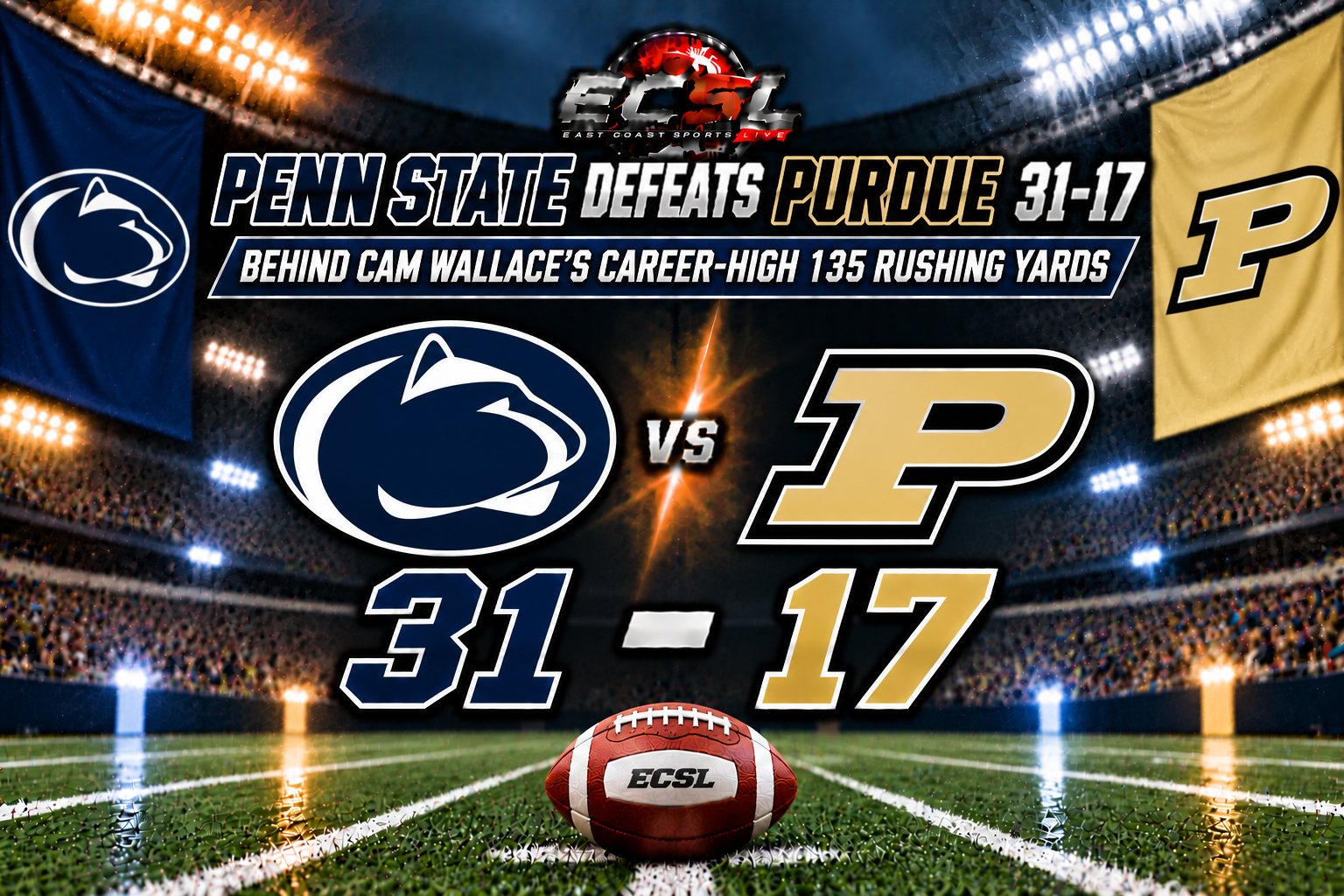
UNIVERSITY PARK, Pa. — Penn State snapped its four-game losing streak Saturday, October 31, 2026, defeating Purdue 31-17 at Beaver Stadium behind a career-best rushing performance from Cam Wallace and a dominant defensive effort. Wallace rushed for 135 yards and a touchdown on 22 carries, helping the Nittany Lions secure their first Big Ten Conference victory under head coach Matt Campbell. Quarterback Rocco Becht contributed a passing touchdown and a rushing score, while Carson Hansen added 96 rushing yards and another touchdown. Penn State improved to 4-4 overall and 1-4 in Big Ten play, while Purdue dropped to 3-5 and 2-3 in the conference. The Nittany Lions generated 457 total yards, including 269 rushing yards, and held Purdue to just 175 yards of offense. Cam Wallace Delivers Breakout Performance After Injury Recovery Wallace's performance carried significance beyond the final score. The redshirt junior had spent much of the previous two seasons recovering from serious injuries that resulted in broken bones in both legs. After undergoing surgeries and extensive rehabilitation, Wallace entered Saturday's contest with only 125 rushing yards on 22 carries this season. Against Purdue, he surpassed that previous production in a single game. Wallace finished with 135 rushing yards on 22 attempts, averaging more than six yards per carry. His performance included a 48-yard run during the first quarter that helped establish Penn State's offensive momentum. He later scored on a two-yard touchdown run during the fourth quarter, extending the Nittany Lions' advantage. Wallace also contributed three receptions for nine yards, demonstrating his versatility within Penn State's offense. His return to form provided an encouraging development for a team seeking greater consistency in its rushing attack. Penn State Opens With Strong Offensive Execution Penn State established its offensive approach during the opening quarter. After forcing Purdue to punt, the Nittany Lions assembled a scoring drive highlighted by Hansen's 42-yard run. Facing fourth-and-seven at the Purdue 20-yard line, Penn State successfully executed a fake field goal. Punter Nathan Tiyce completed a shovel pass to tight end Benjamin Brahmer, extending the possession. Becht capitalized on the opportunity by connecting with Andrew Rappleyea for a four-yard touchdown pass, giving Penn State a 7-0 lead. Purdue responded when quarterback Ryan Browne found Xavier Townsend for a 33-yard touchdown, tying the game at 7-7. However, Penn State answered immediately. Wallace broke free for a 48-yard gain, positioning the Nittany Lions for another scoring opportunity. Becht completed the drive with a six-yard touchdown run, restoring Penn State's seven-point advantage. Purdue Blocks Punt to Tie Game Before Halftime Purdue's special teams delivered one of the game's most significant plays during the second quarter. With Penn State leading 14-7, Bisi Owens broke through the protection and blocked a punt. Jalil Hall recovered the football and returned it 31 yards for a touchdown, tying the contest at 14-14. The play marked Purdue's first blocked punt returned for a touchdown since 2008. Owens also tied the program's single-season record with his second blocked punt of the year. Despite the momentum shift, Penn State maintained its offensive composure. The Nittany Lions responded with a 15-play drive covering 65 yards and consuming approximately seven minutes. Hansen finished the possession with a one-yard touchdown run, sending Penn State into halftime with a 21-14 lead. Penn State Defense Limits Purdue to 33 Rushing Yards Penn State's defensive performance proved essential to the victory. The Nittany Lions held Purdue to 33 rushing yards, preventing the Boilermakers from establishing offensive balance. Purdue entered the matchup averaging more than 280 passing yards per game, but Penn State limited Browne to 142 passing yards. The Boilermakers finished with just 175 total yards and converted only two of 11 third-down opportunities. Penn State's defensive front consistently disrupted Purdue's offensive rhythm. Defensive end Yvan Kemajou recorded a sack, while the secondary produced two important interceptions. The performance represented a significant improvement for a Penn State defense that had struggled against opposing rushing attacks earlier in conference play. Jamison Patton Interception Shifts Third-Quarter Momentum Purdue remained within one touchdown early in the third quarter, but Penn State's defense prevented the Boilermakers from mounting a comeback. Safety Jamison Patton intercepted Browne near midfield and returned the football 13 yards. The takeaway gave Penn State possession at Purdue's 41-yard line. The Nittany Lions converted the opportunity into points when kicker Ryan Barker connected on a 44-yard field goal, extending the advantage to 24-14. Penn State's defense continued limiting Purdue's offensive opportunities, forcing another punt before the end of the quarter. The Nittany Lions entered the final period with control of the game and an opportunity to extend their lead. Wallace Seals Victory With Fourth-Quarter Touchdown Penn State's rushing attack delivered another decisive possession during the fourth quarter. The Nittany Lions marched 85 yards in 10 plays, consuming nearly seven minutes of game time. Wallace contributed 40 rushing yards during the drive before scoring from two yards out. His touchdown extended Penn State's lead to 31-14 with fewer than 10 minutes remaining. Purdue responded with a career-long 49-yard field goal from freshman kicker Jacobo Echeverria Lozano, reducing the deficit to 31-17. However, Penn State's defense prevented any further scoring. With less than two minutes remaining, safety Jeremiah Cooper intercepted Browne on fourth down, effectively ending Purdue's comeback hopes. Penn State Controls Possession and Dominates the Ground Game Penn State's ability to control possession was another defining factor. The Nittany Lions held the football for 43 minutes and 27 seconds, compared with Purdue's 16 minutes and 33 seconds. That advantage allowed Penn State to establish its rushing attack while limiting Purdue's offensive opportunities. Hansen finished with 96 rushing yards on 17 carries, complementing Wallace's career-best performance. Becht completed 16 of 24 passes for 175 yards and a touchdown. Together, Penn State's offensive contributors helped generate 269 rushing yards and 457 total yards. For Purdue, Townsend finished with four receptions for 46 yards and a touchdown, while Asaad Waseem led the team with 64 receiving yards. Defensively, Justin Denson Jr. recorded a career-high 15 tackles, and Curt Neal contributed two sacks. Matt Campbell Earns First Big Ten Victory at Penn State The victory represented an important milestone for Campbell during his first season leading Penn State. The Nittany Lions entered the contest having lost four consecutive games, struggling to establish consistency in conference competition. Saturday's performance demonstrated improvements on both sides of the football. Wallace provided explosive rushing production, while the defense limited Purdue's opportunities and generated important turnovers. Penn State also extended its winning streak against Purdue to 12 consecutive games. The result gives the Nittany Lions momentum as they enter the final month of the regular season. What's Next for Penn State and Purdue? Penn State travels to face Washington on Saturday, November 7, seeking its second consecutive Big Ten victory. Purdue returns home to host Maryland on November 7 at Ross-Ade Stadium, with kickoff scheduled for 12:30 p.m. ET on Big Ten Network. For Penn State, Wallace's remarkable comeback performance and a dominant defensive effort provided the foundation for a much-needed victory. The Nittany Lions will look to build on their improved rushing attack and defensive execution as they continue their conference schedule.
football
By Amber Aniston • November 1, 2026
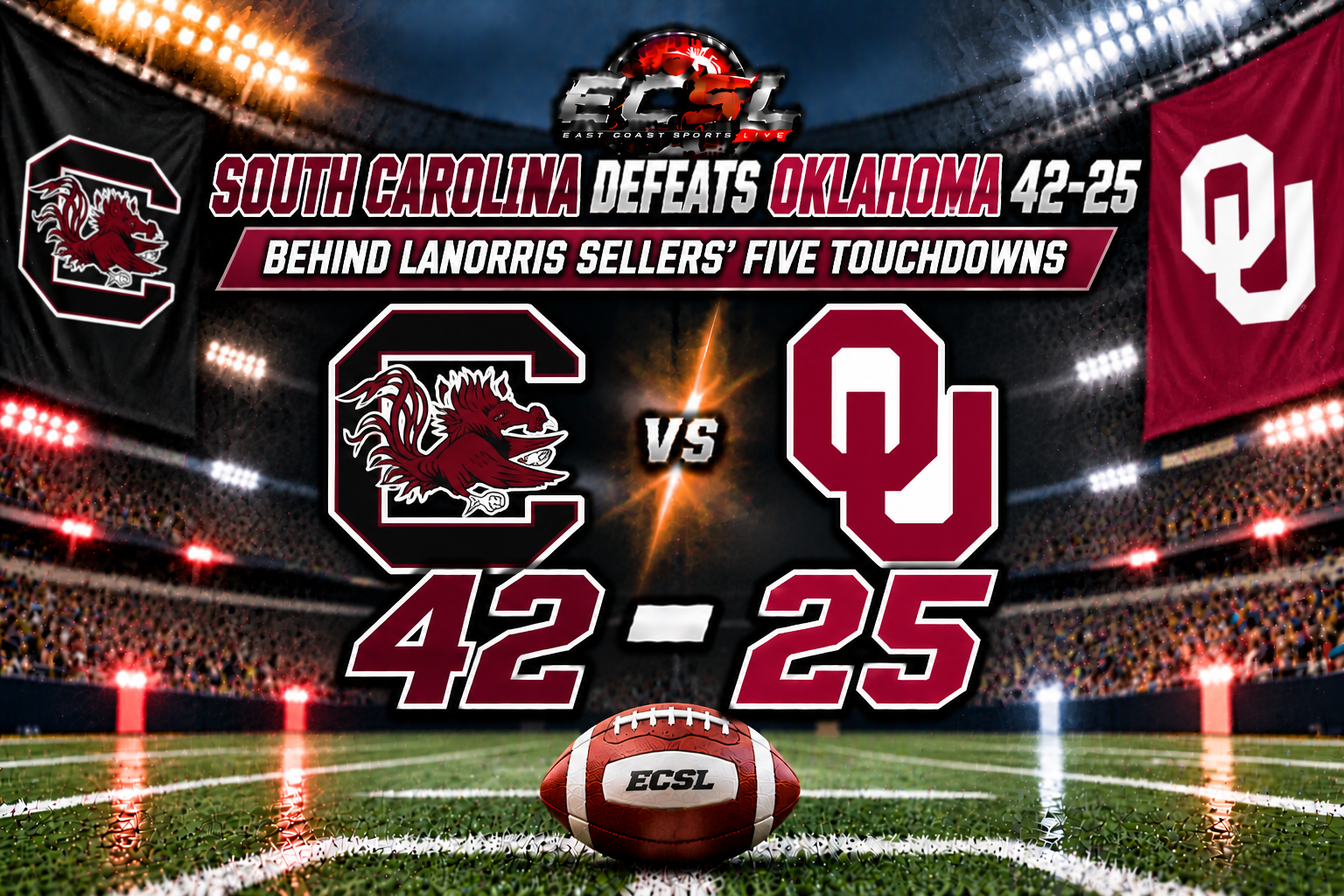
NORMAN, Okla. — South Carolina extended its winning streak to three games Saturday, October 31, 2026, defeating Oklahoma 42-25 at Gaylord Family–Oklahoma Memorial Stadium behind an outstanding five-touchdown performance from quarterback LaNorris Sellers. Sellers passed for 301 yards and three touchdowns while adding 96 rushing yards and two scores. The Gamecocks generated 521 yards of total offense, overwhelming an Oklahoma defense that entered the matchup among the nation's best. South Carolina improved to 5-3 overall and 3-3 in Southeastern Conference play, earning its third consecutive victory after defeating ranked opponents Florida and Tennessee. Oklahoma dropped to 4-4 and 2-3 in the SEC, suffering another setback despite three defensive interceptions. LaNorris Sellers Leads South Carolina's Explosive Offense Sellers delivered one of his most impressive performances of the season. The South Carolina quarterback accounted for 397 total yards and five touchdowns, consistently creating problems for Oklahoma through the air and on the ground. His passing performance included an 84-yard touchdown to DJ Black and a 79-yard scoring connection with Mazeo Bennett Jr. Those explosive plays helped South Carolina establish control against a Sooners defense that had previously limited opponents effectively. Sellers also scored on rushing plays of 15 and 11 yards, demonstrating his ability to finish drives with his legs. The Gamecocks' balanced offensive approach forced Oklahoma to defend multiple threats throughout the contest. South Carolina finished with 22 first downs and converted eight of 14 third-down opportunities. Oklahoma Opens With Defensive Touchdown From Kip Lewis Oklahoma initially remained competitive despite South Carolina's early offensive production. Sellers opened the scoring with a 15-yard touchdown run, giving the Gamecocks a 7-0 advantage. The Sooners responded early in the second quarter when linebacker Kip Lewis intercepted Sellers and returned the football 30 yards for a touchdown. The defensive score tied the game at 7-7 and briefly shifted momentum toward Oklahoma. Lewis' interception return was the third pick-six of his collegiate career, tying the school record shared by four other Oklahoma players. He also became the first linebacker in Oklahoma history to return three interceptions for touchdowns. However, the defensive highlight proved insufficient to slow South Carolina's offense. South Carolina Builds Commanding Halftime Lead Following Lewis' interception return, South Carolina regained control through three consecutive scoring possessions. Running back Christian Clark scored on a one-yard touchdown run, restoring the Gamecocks' advantage. Sellers then connected with Black for an 84-yard touchdown, producing one of the game's biggest offensive plays. He followed with an eight-yard touchdown pass to Nyck Harbor, extending South Carolina's lead. Oklahoma managed a 52-yard field goal from Tate Sandell late in the second quarter. The kick represented another career milestone for Sandell, tying school records for field goals made from 40-plus and 50-plus yards. Despite that contribution, South Carolina entered halftime leading 28-10. The Gamecocks' explosive passing plays and rushing production had established a substantial advantage. South Carolina Defense Limits Oklahoma's Offense South Carolina's defense delivered an equally important performance. The Gamecocks held Oklahoma to just 118 total yards and 10 points through three quarters, preventing the Sooners from establishing offensive rhythm. Oklahoma quarterback John Mateer struggled to generate consistent passing opportunities during the opening half. The Sooners also faced difficulties protecting their quarterback and sustaining possessions against South Carolina's defensive pressure. Although Oklahoma finished with three interceptions, its offense could not capitalize on those takeaways. The Sooners committed no turnovers, marking a rare defeat despite holding a plus-three turnover margin. South Carolina's ability to control the line of scrimmage and generate explosive offensive plays ultimately outweighed Oklahoma's defensive takeaways. Mazeo Bennett Jr. Extends Gamecocks' Advantage South Carolina continued building its lead during the second half. Sellers scored on an 11-yard touchdown run during the third quarter, increasing the Gamecocks' advantage to 35-10. The quarterback then connected with Bennett for a 79-yard touchdown reception during the fourth quarter. The explosive scoring play extended South Carolina's lead to 42-10 and effectively secured the victory. Bennett's touchdown continued his productive stretch as one of Sellers' most reliable receiving targets. South Carolina's ability to produce long touchdowns repeatedly prevented Oklahoma from mounting a sustained comeback. John Mateer and Ivan Carreon Spark Late Oklahoma Rally Oklahoma finally found offensive momentum during the fourth quarter. Mateer connected with wide receiver Ivan Carreon for touchdown passes of 34 and 10 yards, reducing the deficit. Carreon finished with five receptions for a career-high 88 yards and his first two collegiate touchdown catches. Mateer completed 26 of 43 passes for 244 yards and two touchdowns without an interception. He also rushed for 29 yards on 11 attempts. Oklahoma generated 241 of its 359 total offensive yards during the fourth quarter, highlighting the difference between its late production and earlier struggles. However, the rally came too late to threaten South Carolina's substantial lead. Oklahoma Defense Records Three Interceptions Despite the defeat, Oklahoma produced several notable defensive performances. Along with Lewis' interception return, defensive back Michael Boganowski recorded his first career interception during the third quarter. Freshman Markel Ford added his first collegiate interception in the end zone during the fourth quarter. Linebacker Owen Heinecke and defensive back Courtland Guillory each recorded 10 tackles. Heinecke reached double-digit tackles for the second consecutive game, while Guillory established a career high. However, Oklahoma surrendered 521 total yards, including several long touchdown plays. The Sooners entered the matchup ranked among the nation's leaders in limiting first downs and third-down conversions, making South Carolina's offensive success particularly significant. South Carolina Extends Winning Streak Despite Injury Concern The victory represented another important step for head coach Shane Beamer and the Gamecocks. South Carolina entered the contest following consecutive victories over ranked Florida and Tennessee teams. The win over Oklahoma extended that streak to three games, strengthening the Gamecocks' position entering November. However, South Carolina also suffered a potentially significant injury. Running back Matt Fuller exited during the first quarter after recording 17 rushing yards on four carries. Beamer indicated afterward that Fuller had suffered a serious lower-leg injury that could require surgery and potentially end his season. Fuller's absence could affect South Carolina's rushing attack during the remaining conference schedule. What's Next for South Carolina and Oklahoma? South Carolina returns home to face Texas A&M on Saturday, November 7, looking to extend its winning streak to four games. Oklahoma travels to Gainesville to face No. 17 Florida, with kickoff scheduled for 6:45 p.m. ET on SEC Network. The Sooners must improve their offensive consistency and defensive execution after surrendering 42 points and more than 500 yards. For South Carolina, Sellers' five-touchdown performance demonstrated the Gamecocks' offensive potential against SEC competition.  With three consecutive victories and an increasingly productive offense, South Carolina enters the final stretch of the regular season carrying significant momentum.
football
By Amber Aniston • November 1, 2026
PITTSBURGH, Pa. — Pittsburgh ended its three-game losing streak Saturday night, October 31, 2026, defeating Georgia Tech 34-11 at Acrisure Stadium behind a dominant rushing performance from freshman running back Damon Ferguson Jr. and a relentless defensive effort. Ferguson rushed for a season-high 185 yards on 31 carries, leading a Pittsburgh ground attack that produced 281 yards. Quarterback Holden Geriner added 180 passing yards and a touchdown as the Panthers controlled the matchup from the opening half. Pittsburgh improved to 6-3 overall and 3-3 in Atlantic Coast Conference play, securing bowl eligibility for the 2026 season. Georgia Tech dropped to 2-6 and 1-4 in the ACC after suffering its third consecutive defeat. The Panthers outgained the Yellow Jackets 461-238, using their physical rushing attack and five defensive sacks to secure a much-needed conference victory. Damon Ferguson Jr. Powers Pittsburgh's Rushing Attack Ferguson delivered his most productive rushing performance of the season against Georgia Tech. The freshman running back carried the football 31 times for 185 yards, repeatedly finding openings against an injury-depleted Yellow Jackets defense. His performance helped Pittsburgh establish control of the line of scrimmage and maintain offensive momentum throughout the contest. The Panthers finished with 281 rushing yards, creating a significant advantage against a Georgia Tech defense that struggled to contain the ground game. Ferguson's production also provided balance for Pittsburgh's offense, allowing Geriner to operate without carrying the entire offensive workload. The freshman's emergence represents an important development for a Panthers team attempting to regain consistency during the final stretch of its ACC schedule. Pittsburgh Builds 17-3 Halftime Advantage Pittsburgh established control during the opening two quarters despite several missed scoring opportunities. The Panthers moved the football effectively but struggled with penalties and mistakes that prevented them from building an even larger lead. Early in the game, a 28-yard touchdown pass from Geriner to Malik Knight was erased by a penalty. Pittsburgh eventually settled for a 45-yard field goal from Antonio Chadha. The Panthers also lost a potential touchdown when tight end Carson Kent fumbled into the end zone during the second quarter. Georgia Tech recovered the football for a touchback, preventing Pittsburgh from extending its advantage. Despite those mistakes, Pittsburgh entered halftime leading 17-3. The Panthers outgained Georgia Tech 270-77 during the first half, demonstrating their offensive superiority even while leaving points on the field. Pittsburgh Defense Records Five Sacks Against Georgia Tech Pittsburgh's defense delivered one of its strongest performances of the season. The Panthers recorded five sacks, consistently disrupting Georgia Tech's passing attack and preventing the Yellow Jackets from establishing offensive rhythm. Georgia Tech quarterback Alberto Mendoza struggled under pressure, completing 16 of 25 passes for just 81 yards. Mendoza also fumbled three times, with Pittsburgh recovering one of those mistakes.' The Panthers' defensive front repeatedly forced Georgia Tech into difficult passing situations, limiting the Yellow Jackets' ability to sustain drives. Georgia Tech finished just 4-for-23 on combined third- and fourth-down attempts. The Yellow Jackets also managed only 106 offensive yards during their first 12 possessions before making a quarterback change. Pittsburgh's defensive response was particularly significant following its difficult road loss against No. 1 Miami the previous week. Holden Geriner Connects With Blue Hicks for Fourth-Quarter Touchdown Geriner continued developing as Pittsburgh's starting quarterback following Mason Heintschel's season-ending knee injury. The Panthers entered the matchup having lost three consecutive games, struggling to regain offensive consistency without their original starter. Against Georgia Tech, Geriner passed for 180 yards and one touchdown. His most important completion came early in the fourth quarter when he connected with Blue Hicks for a 30-yard touchdown. The scoring play extended Pittsburgh's advantage to 24 points and effectively ended Georgia Tech's hopes of mounting a comeback. Although Pittsburgh committed several offensive mistakes, Geriner's touchdown pass helped the Panthers finish the contest comfortably. The victory marked Pittsburgh's first win since Heintschel suffered his injury during the team's earlier victory over Virginia Tech. Georgia Tech Forces Three Turnovers but Struggles Offensively Georgia Tech's defense created several opportunities despite the lopsided final score. The Yellow Jackets forced a season-high three turnovers, including two second-quarter fumble recoveries. Defensive back Jonas Duclona produced an impressive individual performance, finishing with 10 tackles, two pass breakups, a forced fumble and a fumble recovery. Duclona's recovery in the end zone prevented a Pittsburgh touchdown during the second quarter. Taje McCoy also forced a fumble, which Zachary Tobe recovered. Freshman cornerback Trae Stevenson Jr. added his first career interception during the fourth quarter. However, Georgia Tech could not convert those defensive plays into sustained offensive production. The Yellow Jackets finished with season lows of 11 points and 238 total yards, illustrating the difficulties facing their offense. Grady Adamson Provides Fourth-Quarter Spark Georgia Tech found some offensive momentum after replacing Mendoza with sophomore quarterback Grady Adamson during the fourth quarter. Adamson generated 125 total yards, including 63 rushing yards and 62 passing yards, in one quarter of action. He also scored the first touchdown of his collegiate career on an 18-yard rushing play. The touchdown came immediately after Stevenson's interception gave Georgia Tech favorable field position. Adamson accounted for 132 of Georgia Tech's 238 total offensive yards across the four possessions he directed. His ability to create plays with his legs provided a different dimension to the Yellow Jackets' offense. However, the improvement came too late to overcome Pittsburgh's substantial lead. Pittsburgh Secures Bowl Eligibility and Ends Losing Streak Saturday's victory represented an important turnaround for head coach Pat Narduzzi and the Panthers. Pittsburgh entered the contest seeking its first victory in several weeks after consecutive defeats disrupted its season. The Panthers responded with a physical rushing attack and an aggressive defensive performance. Their 34-point offensive output helped secure the program's sixth victory, making Pittsburgh bowl eligible. However, discipline remains an area requiring improvement. Pittsburgh committed 10 penalties for 95 yards and turned the football over three times. Those mistakes prevented the Panthers from converting their statistical dominance into an even larger victory. For Georgia Tech, the defeat continued a difficult stretch following a nine-win campaign in 2025. The Yellow Jackets have now lost three consecutive games and face a challenging remaining schedule. What's Next for Pittsburgh and Georgia Tech? Pittsburgh will have a bye week before hosting Florida State on Friday, November 13, at Acrisure Stadium. Kickoff is scheduled for 7 p.m. ET. Georgia Tech returns home to face Louisville on Saturday, November 7, at Bobby Dodd Stadium at Hyundai Field, with kickoff scheduled for 7:30 p.m. ET. The Yellow Jackets will need significant offensive improvement to challenge a Louisville team averaging more than 40 points per game. For Pittsburgh, Ferguson's 185 rushing yards, Geriner's fourth-quarter touchdown pass and a defense that consistently pressured Georgia Tech combined to deliver a convincing 34-11 victory.  The Panthers enter their upcoming bye week with bowl eligibility secured and renewed momentum heading into the final stretch of the season.
FOOTBALL
By Amber Aniston • November 1, 2026
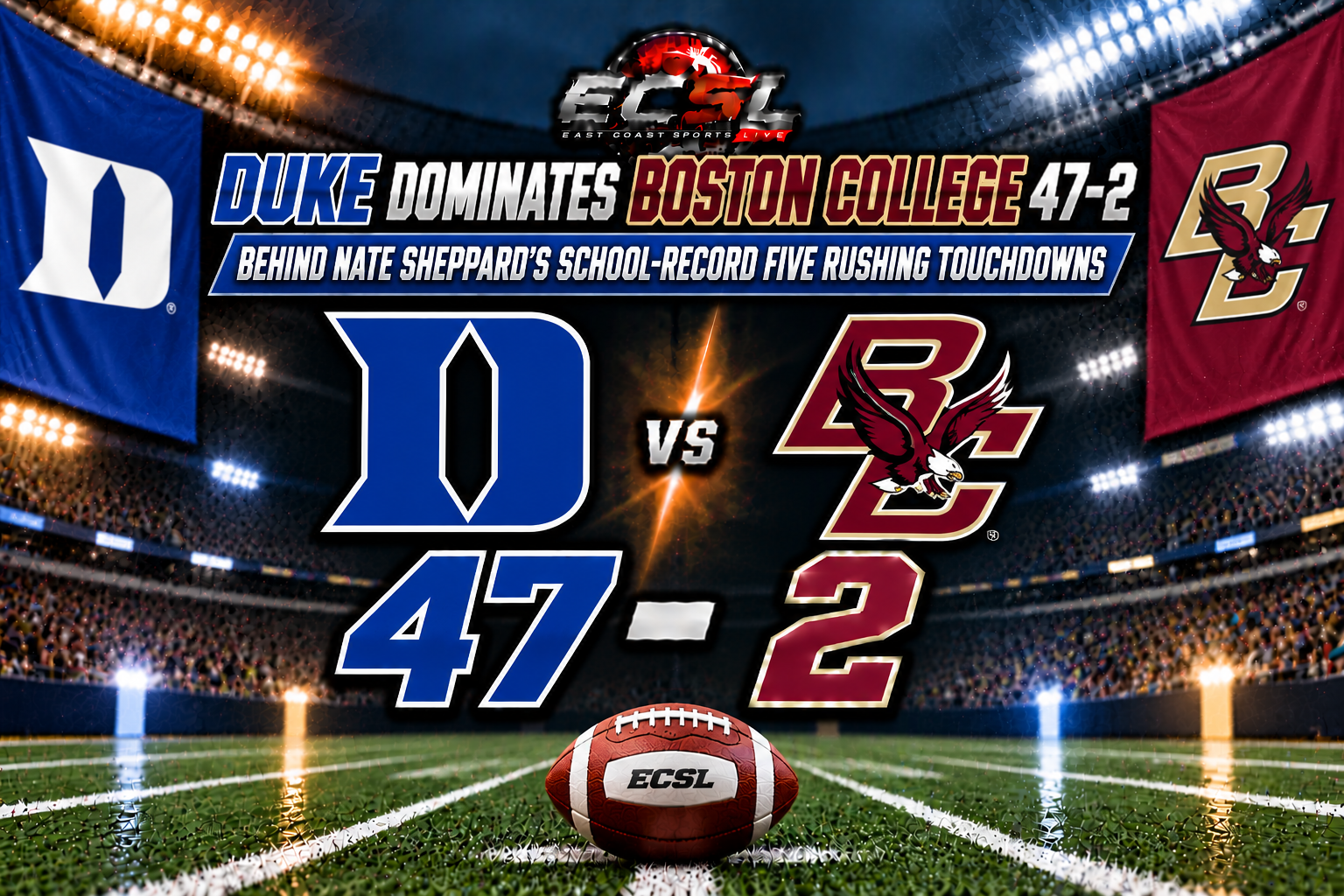
DURHAM, N.C. — Duke delivered one of its most commanding performances of the 2026 college football season Saturday, October 31, defeating Boston College 47-2 at Wallace Wade Stadium behind a historic five-touchdown performance from running back Nate Sheppard. Sheppard rushed for 97 yards on 20 carries, scoring five touchdowns to establish a Duke single-game rushing touchdown record. Quarterback Walker Eget added 201 passing yards and a touchdown as the Blue Devils controlled the contest on both sides of the football. Duke improved to 6-2 overall and 3-2 in Atlantic Coast Conference play, securing bowl eligibility for the fifth consecutive season. Boston College dropped to 4-4 and 2-3 in the ACC. The Blue Devils' 45-point victory represented their second-largest winning margin in ACC competition since joining the conference in 1953. Nate Sheppard Breaks Duke's Single-Game Touchdown Record Sheppard delivered a performance that will be remembered in Duke football history. The sophomore running back scored on runs of one, two, 54, four and one yards, becoming the first Duke player to record five rushing touchdowns in a single game. His 54-yard touchdown during the second quarter was the longest scoring run of his career. Sheppard entered halftime with three touchdowns before adding two more during the third quarter to establish the record. His five touchdowns increased his season total to 14 rushing touchdowns and 18 touchdowns from scrimmage, establishing another Duke single-season program record. The performance highlighted Sheppard's effectiveness near the goal line and his ability to generate explosive plays. Duke Builds Early Lead Against Boston College Both teams punted on their opening possessions before Duke established offensive momentum. The Blue Devils marched 80 yards in 10 plays, finishing with Sheppard's one-yard touchdown run. A 44-yard reception from Javen Nicholas on third-and-five helped extend the possession. Duke's defense then forced Boston College into another difficult situation. Kobe Smith recorded a six-yard sack, and KD Cotton returned the ensuing punt 18 yards to give Duke possession at the Eagles' 35-yard line. Sheppard completed the short-field opportunity with a two-yard touchdown run, extending Duke's advantage to 13-0. Boston College produced its only points when Carter Davis returned a blocked extra-point attempt 100 yards for a defensive two-point conversion. The unusual play reduced Duke's lead to 13-2 late in the opening quarter. Sheppard and Walker Eget Extend First-Half Advantage Duke continued controlling the game during the second quarter. Sheppard broke free for a 54-yard touchdown with 9:06 remaining before halftime, increasing the Blue Devils' advantage to 20-2. The rushing touchdown demonstrated Duke's ability to generate explosive plays against a Boston College defense that had struggled to contain the ground game. Eget later directed another scoring possession, connecting with tight end Jeremiah Hasley for a five-yard touchdown pass. The completion marked Hasley's first touchdown reception of the season. Earlier in the drive, Eget completed passes of 32 yards to Sheppard and 31 yards to Jaivon Solomon, moving Duke into scoring position. The Blue Devils entered halftime with a commanding 27-2 lead. Duke Defense Shuts Down Boston College's Offense Duke's defense delivered an equally impressive performance. The Blue Devils held Boston College to just 213 total offensive yards, including 78 rushing yards on 33 attempts. Boston College entered the matchup following a 49-27 victory over Georgia Tech in which the Eagles had rushed for nearly 400 yards. Against Duke, that rushing success disappeared. The Blue Devils recorded six sacks, 11 tackles for loss and nine quarterback pressures. Boston College also failed to convert any of its six third-down opportunities during the first half. The Eagles' only points came from the defensive extra-point return, meaning Duke's defense did not surrender a single point. The performance marked the fourth time this season Duke held an opponent to single-digit scoring. Sheppard Adds Two More Touchdowns in Third Quarter Duke maintained its intensity after halftime. Following another Boston College three-and-out, Eget moved the Blue Devils into scoring position with a 32-yard completion to Hasley. A roughing-the-passer penalty helped advance Duke to the Eagles' six-yard line. Sheppard then scored on a four-yard run with 10:41 remaining in the third quarter. The touchdown extended Duke's advantage to 34-2. Sheppard returned to the end zone later in the period, scoring from one yard with 6:44 remaining. His fifth rushing touchdown established the school record and pushed Duke ahead 41-2. The Blue Devils completed their scoring in the fourth quarter when kicker Gavin Strange converted field goals from 41 and 24 yards. The 41-yard attempt represented a career long for Strange. Boston College Struggles After Two-Game Winning Streak Boston College entered the contest with momentum after consecutive victories, including its road win over Georgia Tech. However, the Eagles could not establish offensive consistency against Duke. Quarterback Mason McKenzie completed nine of 17 passes for 87 yards. McKenzie and Bo MacCormack each rushed for 24 yards, sharing the team lead. Jackson Wade finished with 36 receiving yards, while Javarius Green and Jaden Skeete recorded two receptions apiece. Defensively, Anthony Palano led Boston College with nine tackles. KP Price reached an individual milestone, surpassing 250 career tackles during the opening quarter. Carter Davis also recorded his second interception of the season in the third quarter. Despite those contributions, Boston College committed 15 penalties and struggled to sustain drives. Duke Secures Fifth Consecutive Bowl-Eligible Season The victory represented an important milestone for head coach Manny Diaz and the Blue Devils. Duke reached six victories for the fifth consecutive season, securing bowl eligibility while remaining competitive in the ACC standings. The Blue Devils also extended their winning streak to two games following a difficult stretch earlier in conference play. Their defensive performance and Sheppard's record-breaking production demonstrated the team's ability to respond after setbacks. For Boston College, the defeat exposed significant offensive challenges after the Eagles appeared to be building momentum. Duke's ability to dominate the line of scrimmage and create negative plays ultimately determined the outcome. What's Next for Duke and Boston College? Duke travels to face NC State on Saturday, November 7, with kickoff scheduled for 12:30 p.m. ET on The CW. Boston College returns home to face Florida State on November 7 at noon ET on ACC Network. For Duke, the 47-2 victory provided momentum heading into a challenging November schedule that also includes matchups against Miami, Wake Forest and Clemson. Sheppard's five rushing touchdowns, Eget's efficient passing and a defense that prevented Boston College from scoring offensively combined to produce one of Duke's most complete performances of the season. The Blue Devils enter the final stretch with bowl eligibility secured and renewed confidence in their ability to compete against ACC opponents.
football
By Amber Aniston • October 31, 2026
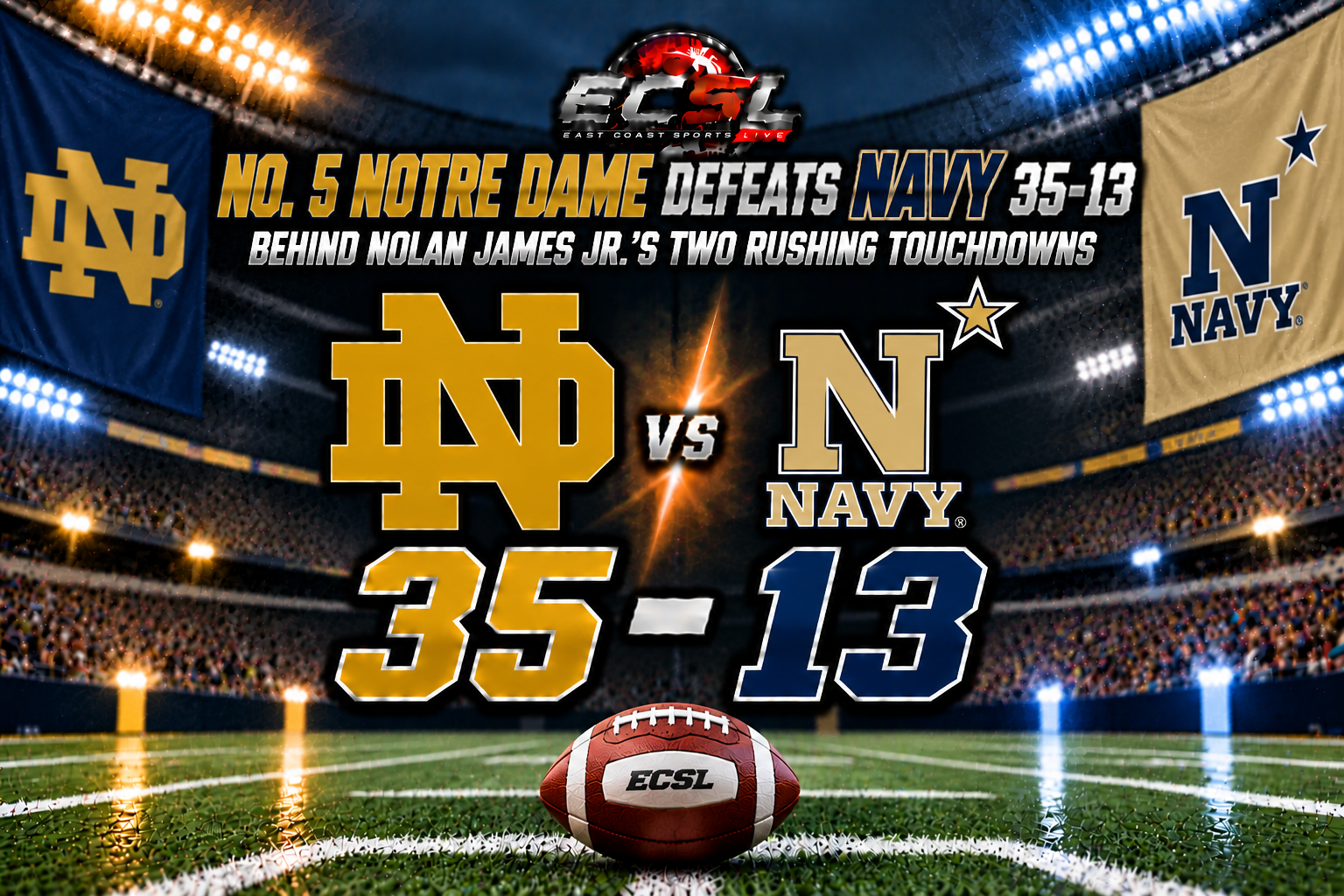
FOXBOROUGH, Mass. — No. 5 Notre Dame overcame a sluggish first half to defeat Navy 35-13 on Saturday, October 31, 2026, at Gillette Stadium, powered by two explosive rushing touchdowns from Nolan James Jr. and an impressive second-half defensive performance. James rushed for 107 yards on nine carries, scoring touchdowns from 52 and 23 yards. Quarterback CJ Carr added 210 passing yards and two touchdowns as the Fighting Irish scored 28 unanswered points after falling behind late in the second quarter. Notre Dame improved to 7-1, rebounding from its previous defeat against BYU and extending its winning streak over Navy to nine games. The Midshipmen dropped to 2-6. The victory also marked head coach Marcus Freeman's 50th career win at Notre Dame, setting the stage for a highly anticipated matchup against No. 1 Miami. Nolan James Jr. Sparks Notre Dame's Comeback James delivered the turning point when Notre Dame needed an offensive response. Trailing 13-7 with less than two minutes remaining before halftime, the Fighting Irish faced the possibility of entering the locker room behind a Navy team that had dominated possession. James changed that momentum with a 52-yard touchdown run, completing a five-play scoring drive that lasted just 50 seconds. The explosive play gave Notre Dame a 14-13 halftime advantage despite Navy controlling much of the opening two quarters. James continued his productive afternoon in the second half, scoring on a 23-yard run that extended the Fighting Irish's lead to 28-13. He finished with 107 rushing yards on only nine attempts, averaging nearly 12 yards per carry. His ability to generate explosive plays helped Notre Dame overcome Navy's deliberate offensive approach. Navy Controls Possession During First Half Navy entered the matchup looking to slow Notre Dame's offense through its option-based rushing attack. The Midshipmen executed that strategy effectively during the opening half, using lengthy possessions to limit the Fighting Irish's opportunities. Navy's first two drives combined for 30 plays, 110 yards and nearly 15 minutes of possession. However, both possessions ended with field goals rather than touchdowns. Notre Dame initially responded with a touchdown pass from Carr to Micah Gilbert, establishing a 7-3 advantage. The Fighting Irish then struggled on their next possession, going three-and-out after three consecutive incompletions. Navy capitalized by producing an 11-play, 63-yard touchdown drive. Quarterback Jackson Gutierrez finished the possession with a two-yard rushing touchdown, giving the Midshipmen a 13-7 lead with 1:52 remaining before halftime. Notre Dame had possessed the football for just 6:27 during the opening half, but James' long touchdown run restored its advantage before the break. CJ Carr Throws Two Touchdowns Against Navy Carr provided steady quarterback play despite Notre Dame's limited first-half possessions. The sophomore finished with 210 passing yards and two touchdowns, helping the Fighting Irish generate 426 total offensive yards. His first touchdown came on a completion to Gilbert during Notre Dame's opening scoring possession. Carr later connected with Jerome Bettis Jr. for a 31-yard touchdown during the second half. The scoring pass extended Notre Dame's advantage to 35-13 and effectively ended Navy's comeback hopes. Carr's ability to produce through the air complemented James' explosive rushing performance and gave Notre Dame a balanced offensive attack. The Fighting Irish surpassed 400 total yards for the fifth time this season. Notre Dame Takes Control After Halftime Notre Dame entered the second half holding a narrow one-point advantage but quickly established control. The Fighting Irish opened the third quarter with an 11-play, 78-yard touchdown drive. Running back Jonaz Walton finished the possession with a three-yard touchdown run, extending Notre Dame's lead to 21-13. After Navy failed to sustain its next possession, James broke free for his second touchdown, scoring from 23 yards to make it 28-13. Notre Dame's defense then stopped the Midshipmen on fourth down, giving Carr another opportunity to extend the lead. The quarterback connected with Bettis for a 31-yard touchdown, pushing the advantage to 35-13. Notre Dame scored touchdowns on its first three possessions of the second half, transforming a competitive matchup into a comfortable victory. Notre Dame Defense Shuts Out Navy in Second Half Notre Dame's defensive adjustments proved essential after Navy's productive opening half. The Midshipmen had successfully controlled possession through their rushing attack, forcing the Fighting Irish to defend lengthy drives. However, Notre Dame responded with a significantly stronger second-half performance. The Fighting Irish held Navy to just 56 total yards after halftime, preventing the Midshipmen from adding to their 13 first-half points. Notre Dame also forced a crucial fourth-down stop that helped create the final touchdown. Gutierrez finished with 110 rushing yards on 28 carries, becoming one of the few opposing quarterbacks to find sustained success against Notre Dame's rushing defense. The Fighting Irish entered the matchup allowing only 67.3 rushing yards per game, making Navy's early production particularly notable. Despite those initial struggles, Notre Dame's defense ultimately controlled the decisive stages. Marcus Freeman Earns 50th Victory at Notre Dame Saturday's result marked another milestone for Freeman. The Notre Dame head coach improved his career record with the Fighting Irish to 50-13, reaching 50 victories during his fifth season leading the program. Freeman emphasized the importance of maintaining composure and making defensive adjustments rather than abandoning the team's established approach. Notre Dame's second-half response reflected that philosophy. After struggling to contain Navy's offensive system during the opening half, the Fighting Irish simplified their defensive execution and prevented further scoring. The victory also helped Notre Dame regain momentum following its loss to BYU two weeks earlier. Notre Dame Prepares to Honor Lou Holtz Against Miami Notre Dame's upcoming matchup against No. 1 Miami will carry additional historical significance. The university announced plans to honor legendary former head coach Lou Holtz during the November 7 game at Notre Dame Stadium. Holtz coached the Fighting Irish from 1986 through 1996, compiling a 100-30-2 record and leading Notre Dame to the 1988 national championship. That championship season included a memorable 31-30 victory over No. 1 Miami, making the upcoming tribute especially meaningful. Former Notre Dame players, including Tony Rice, Byron Spruell and Ricky Watters, are expected to participate in the celebration. The university also plans special halftime recognition and commemorative merchandise supporting organizations associated with Holtz's legacy. What's Next for Notre Dame and Navy? Notre Dame returns home Saturday, November 7, to face No. 1 Miami in one of the most anticipated college football matchups of the season. The Hurricanes enter the contest undefeated at 8-0 after narrowly defeating North Carolina 38-35. For Notre Dame, the matchup presents an opportunity to strengthen its national championship credentials while honoring one of the program's most successful coaches. The Fighting Irish will need the defensive consistency demonstrated against Navy in the second half to challenge Miami's explosive offense. Saturday's 35-13 victory demonstrated Notre Dame's ability to recover from a difficult start, generate explosive rushing plays and make effective halftime adjustments. With James providing two rushing touchdowns, Carr delivering two scoring passes and the defense shutting out Navy after halftime, the Fighting Irish enter their showdown with Miami carrying renewed momentum.
football
By Amber Aniston • October 31, 2026
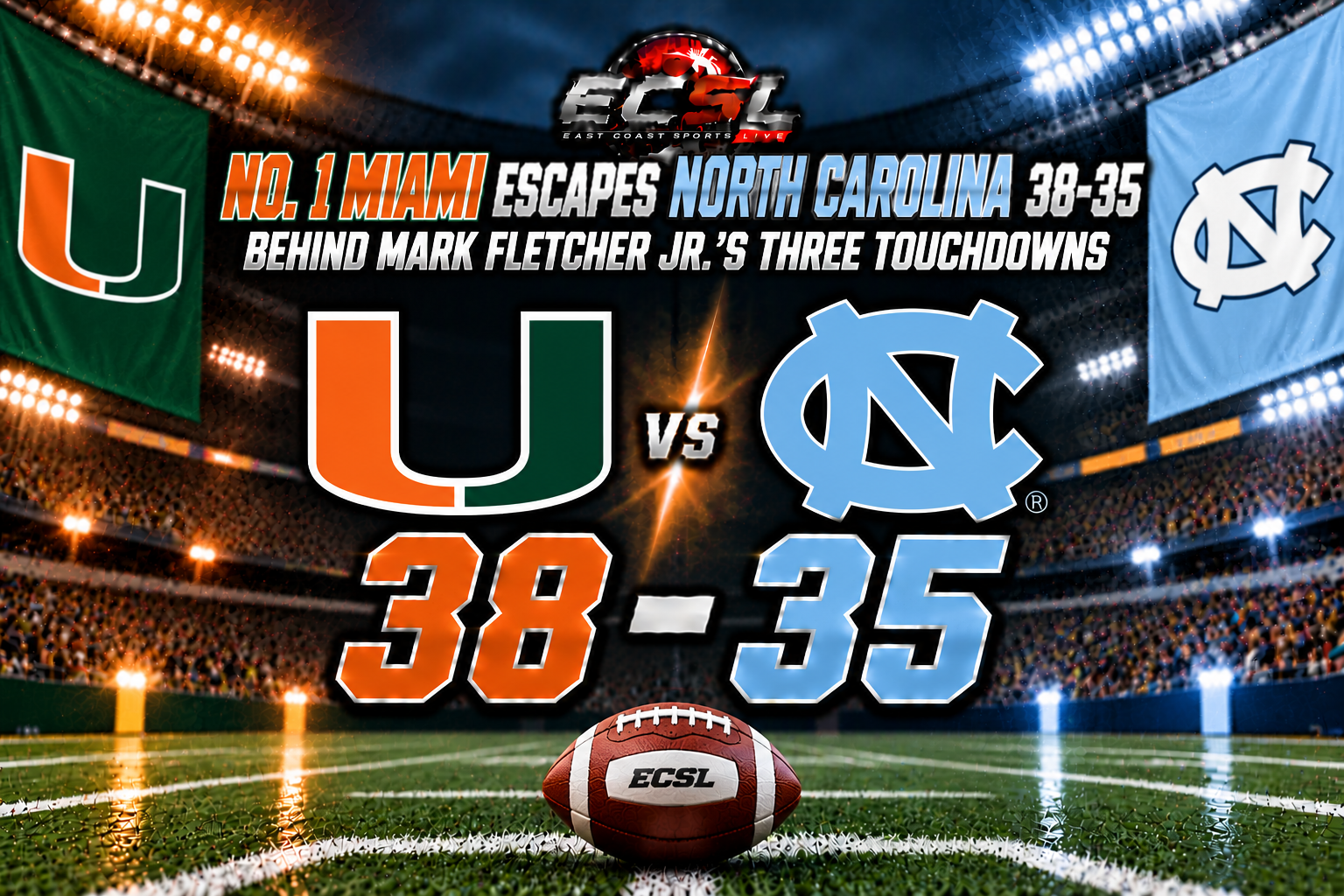
CHAPEL HILL, N.C. — No. 1 Miami survived a fourth-quarter scare Saturday night, October 31, defeating North Carolina 38-35 at Kenan Stadium behind three touchdowns from running back Mark Fletcher Jr. and a decisive defensive play from Marquise Lightfoot. Fletcher scored twice on the ground and once through the air, becoming Miami's career leader with 38 touchdowns from scrimmage. Quarterback Darian Mensah threw for 274 yards and three touchdowns, including the decisive nine-yard scoring pass to Malachi Toney. The Hurricanes improved to 8-0 overall and 6-0 in Atlantic Coast Conference play, while North Carolina fell to 4-4 and 2-3 in the ACC. Miami also snapped a five-game losing streak against the Tar Heels, earning its first victory in Chapel Hill since 2017. Mark Fletcher Jr. Makes Miami Football History Fletcher delivered a milestone performance in one of Miami's most challenging games of the season. The running back finished with 43 rushing yards on 13 carries, scoring two short rushing touchdowns while adding a 31-yard touchdown reception. His three scores increased his career total to 38 touchdowns from scrimmage, establishing a Miami program record. Fletcher also reached 35 career rushing touchdowns, tying Stephen McGuire for the school record. His first touchdown came during the second quarter when Mensah found him on a screen pass that developed into a 31-yard score. Fletcher later scored on two-yard runs during the third and fourth quarters, helping Miami respond whenever North Carolina threatened to take control. Darian Mensah and Malachi Toney Lead Miami's Passing Attack Mensah completed 22 of 29 passes for 274 yards and three touchdowns, maintaining his impressive efficiency throughout the contest. Toney caught seven passes for 75 yards and two touchdowns, providing Miami with a reliable target during critical situations. The duo connected on a two-yard touchdown during Miami's opening possession, completing a 13-play, 74-yard drive. Their second touchdown connection came late in the fourth quarter, following a crucial North Carolina turnover. Miami scored on six of its seven possessions, making the most of limited offensive opportunities against a Tar Heels team that controlled significant stretches of possession. North Carolina Challenges Miami Throughout First Half North Carolina refused to be intimidated by the nation's top-ranked team. After Miami opened with a touchdown, quarterback Billy Edwards Jr. answered with an eight-yard scoring pass to tight end Jelani Thurman. Mensah restored Miami's advantage with Fletcher's 31-yard touchdown reception, putting the Hurricanes ahead 14-7. However, Edwards found Thurman again for another eight-yard touchdown, tying the game at 14. Miami regained the lead just before halftime when Jake Weinberg converted a short field goal. The Hurricanes entered the locker room leading 17-14, but North Carolina had already demonstrated its ability to move the football against Miami's defense. Billy Edwards Jr. Gives Miami Defense Problems Edwards delivered his strongest statistical performance of the season, completing 28 of 34 passes for 341 yards and four touchdowns. The North Carolina quarterback repeatedly exploited openings in Miami's secondary, helping the Tar Heels sustain lengthy scoring drives. North Carolina converted eight of 11 third-down opportunities and both fourth-down attempts. The Tar Heels also punted only once throughout the game. Edwards opened the second half with another impressive possession, connecting with Jordan Shipp for a 16-yard touchdown. The score gave North Carolina its first lead at 21-17. Miami responded with Fletcher's first rushing touchdown, reclaiming a 24-21 advantage. However, North Carolina continued challenging the Hurricanes. Running back Demon June scored on a one-yard touchdown run early in the fourth quarter, putting the Tar Heels ahead 28-24. Fletcher's Fourth-Quarter Touchdown Restores Miami's Lead Facing a four-point deficit, Miami needed another offensive response. Mensah directed a nine-play, 75-yard possession, moving the Hurricanes deep into North Carolina territory. On fourth-and-one from the two-yard line, Fletcher powered into the end zone for his second rushing touchdown. The score gave Miami a 31-28 lead and tied McGuire's career rushing touchdown record. Despite regaining the advantage, Miami remained vulnerable against North Carolina's productive passing attack. The Hurricanes needed a defensive stop to protect their unbeaten season. Marquise Lightfoot Forces Game-Changing Fourth-Quarter Fumble Miami's most important defensive play arrived with 5:33 remaining. As Edwards attempted to extend another North Carolina possession, Lightfoot reached the quarterback and forced a fumble. Defensive lineman Justin Scott recovered the football at North Carolina's 37-yard line. The turnover gave Miami excellent field position and prevented the Tar Heels from threatening another lead change. Lightfoot finished with four tackles, two sacks and the forced fumble. Six plays after the recovery, Mensah connected with Toney for a nine-yard touchdown, extending Miami's advantage to 38-28. The scoring play ultimately provided the winning margin. North Carolina's Late Rally Falls Short North Carolina continued fighting despite trailing by 10 points. Edwards led another scoring possession, finding Trech Kekahuna for a 15-yard touchdown that reduced the deficit to 38-35. The Tar Heels attempted to recover an onside kick, but Miami retained possession following penalties that overturned North Carolina's apparent recoveries. The Hurricanes ran out the remaining clock, preserving their three-point victory. North Carolina finished with 341 passing yards and matched its season high with 35 points. However, the fourth-quarter fumble proved decisive in a game featuring limited possessions and repeated lead changes. Miami Remains Unbeaten Ahead of Notre Dame Showdown Saturday's victory kept Miami undefeated and strengthened its position atop the ACC standings. However, the Hurricanes' defensive struggles remain a concern. Miami allowed 35 points and struggled to stop North Carolina on third down, continuing a recent pattern of close games. Head coach Mario Cristobal acknowledged the need for improvement while emphasizing his team's ability to respond in difficult situations. The Hurricanes have now won 15 of their last 16 games dating back to the previous season. For North Carolina, the narrow defeat represented another competitive performance under head coach Bill Belichick, despite the Tar Heels falling short against the nation's top-ranked team. What's Next for Miami and North Carolina? Miami travels to South Bend for a highly anticipated Week 10 matchup against No. 5 Notre Dame. The contest renews a longstanding rivalry after Miami defeated the Fighting Irish 27-24 during the 2025 season opener. North Carolina visits UConn on Saturday, November 7, with kickoff scheduled for noon ET on CBS Sports Network. For Miami, Fletcher's historic three-touchdown performance, Mensah's efficient passing and Lightfoot's fourth-quarter strip sack combined to secure a dramatic 38-35 victory. The Hurricanes remain unbeaten, but their next challenge against Notre Dame will test their ability to deliver a more complete performance.
football
By Amber Aniston • October 29, 2026
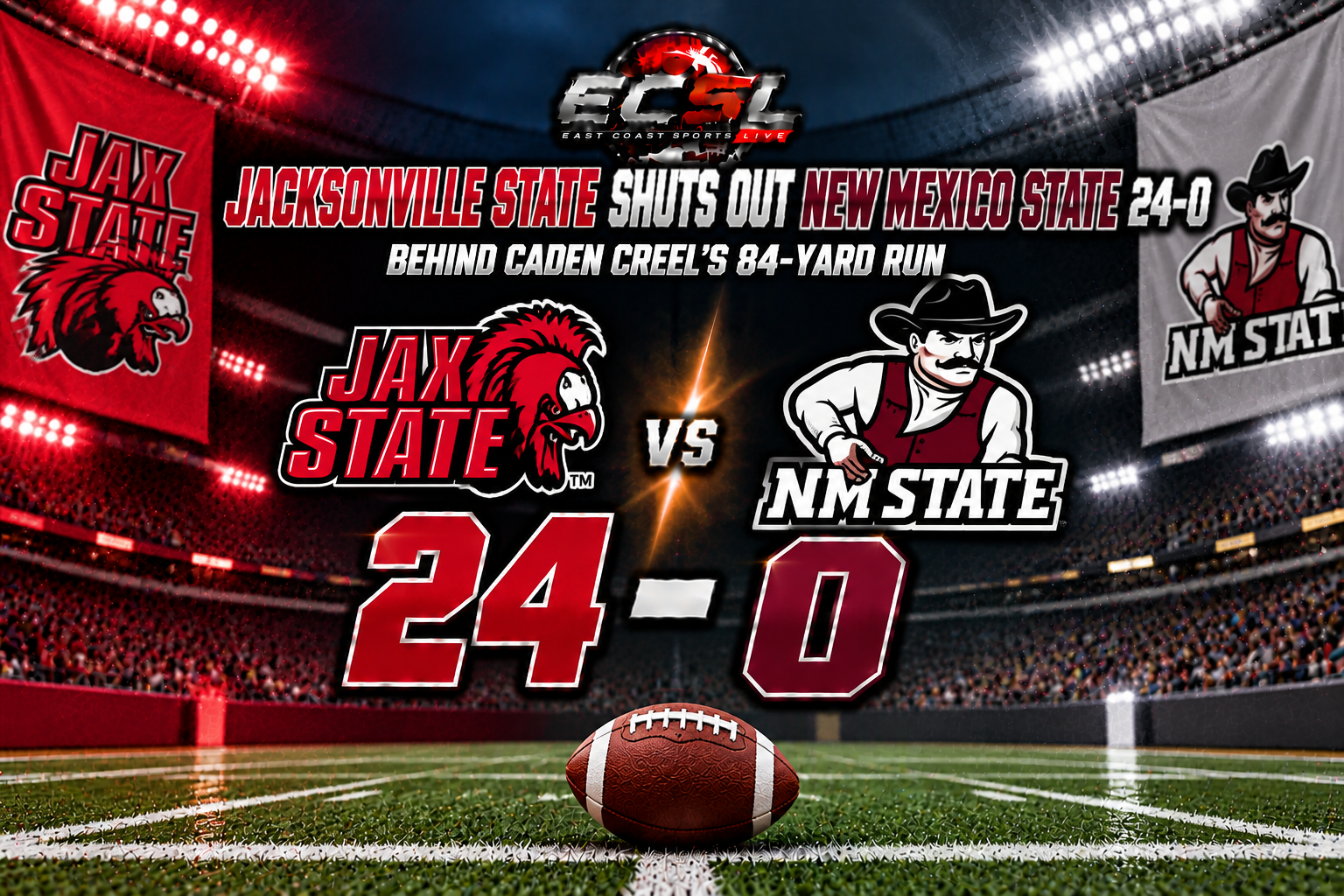
LAS CRUCES, N.M. — Jacksonville State continued its impressive run through Conference USA on Wednesday night, October 28, defeating New Mexico State 24-0 at Aggie Memorial Stadium behind a dominant defensive performance and an explosive 84-yard run from quarterback Caden Creel. The Gamecocks extended their winning streak to five games, improving to 6-2 overall and 4-0 in Conference USA play. New Mexico State dropped to 3-5 overall and 2-2 in conference competition. Creel scored Jacksonville State's opening touchdown and later produced the game's biggest offensive play, breaking free for an 84-yard run that set up a one-yard touchdown by Jalen Likley. Although New Mexico State rushed for 192 yards, the Aggies managed just 29 passing yards, threw a costly interception and missed two field goals. Jacksonville State capitalized on those mistakes to preserve its shutout and remain undefeated in conference competition. Caden Creel Leads Jacksonville State's Offensive Attack Creel provided the Gamecocks with the explosive plays necessary to overcome a determined New Mexico State defense. Jacksonville State's opening scoring possession covered 80 yards in 12 plays, ending with a short rushing touchdown from Creel. The score established an early advantage after New Mexico State failed to capitalize on its first possession. Creel's most important contribution came during the third quarter. With Jacksonville State leading 10-0, the quarterback broke free for an 84-yard run, moving the football to the New Mexico State one-yard line. Likley completed the possession with a short touchdown run, extending the Gamecocks' advantage to 17-0. The explosive play effectively changed the momentum of a game in which New Mexico State had opportunities to remain competitive. New Mexico State Wastes Promising Opening Drive New Mexico State initially appeared capable of challenging Jacksonville State. Defensive back Josiah Charles intercepted a deep pass from Creel at the Aggies' 10-yard line during the Gamecocks' opening possession. The turnover gave New Mexico State an opportunity to establish early momentum. The Aggies responded with an impressive 18-play, 78-yard drive, their longest possession of the season. Running backs James Jones and T.J. Washington Jr. combined for 66 rushing yards during the possession, repeatedly finding openings against Jacksonville State's defense. However, New Mexico State could not finish the drive. A 31-yard field-goal attempt missed, leaving the Aggies without points despite controlling the football for an extended period. Jacksonville State responded with its own lengthy possession, moving 80 yards in 12 plays before Creel scored the game's opening touchdown. The missed opportunity became an early indication of New Mexico State's offensive struggles. Jacksonville State Defense Controls the Game Jacksonville State's defense delivered the most important contribution to Wednesday's victory. Despite allowing New Mexico State to establish some success on the ground, the Gamecocks prevented the Aggies from scoring throughout the contest. New Mexico State finished with only 29 passing yards, severely limiting its ability to sustain a balanced offensive attack. The Gamecocks also capitalized on turnovers at critical moments. New Mexico State created opportunities through defensive interceptions but struggled to convert favorable field position into points. Jacksonville State's ability to protect its lead while forcing the Aggies into passing situations helped maintain control. The shutout represented another important defensive performance for a team competing near the top of the Conference USA standings. RJ Chapman's Interception Creates Major Opportunity One of New Mexico State's best opportunities arrived late in the third quarter. With Jacksonville State leading 10-0, safety RJ Chapman intercepted Creel on a fourth-down passing attempt. Chapman returned the interception 53 yards to Jacksonville State's 24-yard line, giving the Aggies excellent field position. A touchdown could have reduced the deficit to three points and changed the direction of the game. However, New Mexico State immediately surrendered the opportunity. Quarterback Adam Damante attempted a deep pass intended for A.J. Williams III, but Jacksonville State defensive back Marc Woods intercepted the throw. The turnover ended the Aggies' promising possession. Creel then delivered his 84-yard rushing play, setting up Likley's one-yard touchdown. Within a matter of plays, New Mexico State's opportunity to narrow the deficit became a 17-0 Jacksonville State advantage. Garrison Rippa Adds Third-Quarter Field Goal Jacksonville State maintained its offensive momentum after halftime. The Gamecocks opened the third quarter with a scoring possession that ended with a 49-yard field goal from Garrison Rippa. The successful kick extended Jacksonville State's advantage to 10-0. New Mexico State's defense continued producing important stops, including a fourth-down tackle by Nick Session and Gabe Peterson during the first half. However, the Aggies could not generate enough offensive production to take advantage of those defensive efforts. Jacksonville State eventually extended its lead to 17-0 following Likley's touchdown. The Gamecocks completed the scoring with a 29-yard touchdown pass late in the fourth quarter, establishing the final 24-0 margin. James Jones and T.J. Washington Jr. Lead Aggies' Rushing Attack New Mexico State received productive performances from its running backs despite the shutout. Jones rushed for 112 yards on 20 carries, averaging 5.6 yards per attempt. The performance marked his fifth 100-yard rushing game of the season. He became the first New Mexico State player to record five 100-yard rushing performances in one season since Jason Huntley accomplished the feat in 2019. Washington added a career-high 70 rushing yards on 10 attempts. Together, the two running backs accounted for 182 of New Mexico State's 192 rushing yards. Their production demonstrated that the Aggies could move the football effectively on the ground. However, the passing game's struggles prevented New Mexico State from maintaining consistent offensive drives. The Aggies also failed to capitalize on scoring opportunities, missing two field-goal attempts. New Mexico State's Offensive Struggles Continue Head coach Tony Sanchez expressed frustration with New Mexico State's execution following the defeat. The Aggies demonstrated defensive resilience, recording two interceptions and producing several important stops. Charles intercepted Creel during Jacksonville State's opening possession, while Chapman delivered another interception during the third quarter. New Mexico State's defense has now forced at least one turnover in 23 of its previous 24 games. However, those defensive contributions could not overcome the team's offensive problems. The Aggies struggled to generate passing yards, committed a costly turnover and failed to convert opportunities in Jacksonville State territory. Their inability to score despite productive rushing performances highlighted the challenges facing New Mexico State as the conference schedule continues. Jacksonville State Extends Winning Streak to Five Games Wednesday's victory strengthened Jacksonville State's position among Conference USA's leading teams. The Gamecocks improved to 4-0 in conference competition while extending their overall winning streak to five games.  Their ability to win despite committing two interceptions demonstrated the importance of defensive consistency and timely offensive execution. For New Mexico State, the defeat represented a missed opportunity to challenge one of the conference's strongest teams. The Aggies generated 192 rushing yards and forced two turnovers but could not translate those accomplishments into points. Jacksonville State's defense ultimately made the difference, securing a convincing road shutout. What's Next for Jacksonville State and New Mexico State? New Mexico State returns to action on Saturday, November 7, when it hosts Liberty at Aggie Memorial Stadium. Kickoff is scheduled for 6 p.m. MT, with coverage through ESPN Networks. Jacksonville State will look to maintain its undefeated Conference USA record as the regular season continues. For the Gamecocks, Creel's explosive 84-yard run, Likley's touchdown and a disciplined defensive effort combined to deliver a decisive victory. The 24-0 shutout extended Jacksonville State's winning streak and reinforced its position as a Conference USA contender.
More Posts