By Amber Aniston
•
September 12, 2026
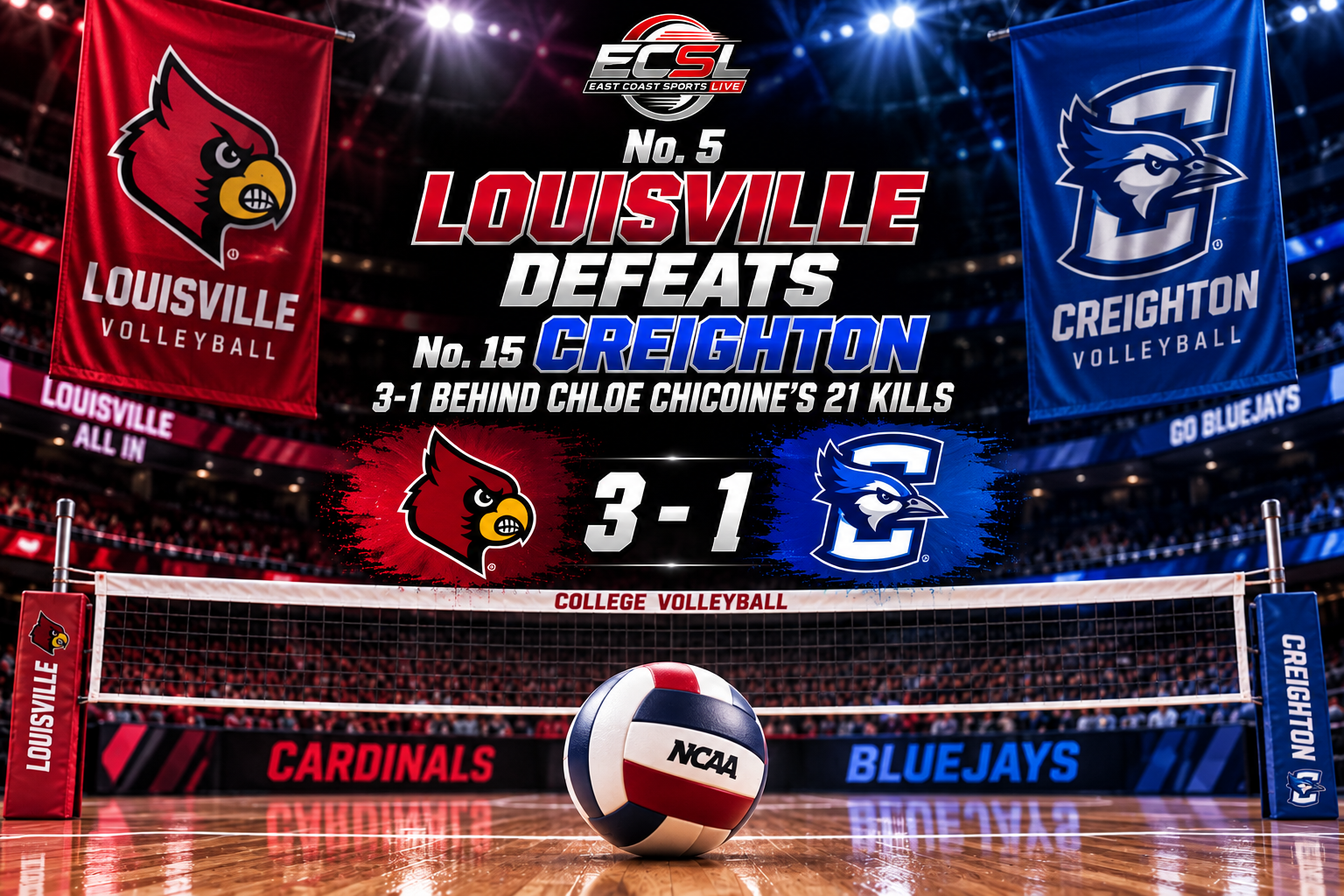
No. 5 Louisville continued its impressive start to the 2026 season Saturday afternoon, defeating No. 15 Creighton 3-1 (25-22, 27-25, 23-25, 25-16) at the Rice Invitational in Houston. The Cardinals improved to 8-1 and earned their fifth Top-20 victory of the season behind another standout performance from Chloe Chicoine, who recorded 21 kills and 13 digs for her third consecutive double-double . Kalyssa Blackshear added 18 kills without an attack error, while setter Nayelis Cabello finished with 52 assists and 12 digs. Creighton fell to 5-3 despite pushing Louisville deep into the second and third sets. Trinity Shadd-Ceres led the Bluejays with 17 kills and 14 digs. Louisville Establishes Early Control Louisville wasted little time putting pressure on Creighton. Blackshear delivered two early kills as the Cardinals jumped ahead 5-1 . After Creighton scored twice, Louisville responded with a 9-3 run that stretched its advantage to 14-6. The Cardinals spread the offense throughout the run, receiving kills from Cabello, Brooke Bultema, Chicoine, Blackshear and Addison Makun. Creighton refused to allow Louisville to cruise through the finish. The Bluejays fought off four set points and reduced the deficit to 24-22 , but Blackshear delivered the final kill to secure Louisville’s 25-22 opening-set victory . She finished the frame with six kills on .545 hitting. Creighton Pushes Louisville to the Limit in Second The second set became the most competitive frame of the afternoon. Creighton built a 9-6 advantage , its largest lead through the first two sets, before Louisville responded with five consecutive points to move ahead 11-9. The Bluejays recovered and held a 15-14 lead at the media timeout. From there, neither team managed to create meaningful separation. Chicoine became increasingly important late, recording four consecutive Louisville kills to help the Cardinals tie the score at 21-21. Creighton still found itself in position to win the set. The Bluejays led 23-21 and later held advantages at 24-23 and 25-24 , giving them multiple opportunities to even the match. Louisville denied every one. Cardinals Escape 27-25 With Three Straight Points Facing set point at 25-24, Louisville produced one of the most important sequences of the match. The Cardinals scored three consecutive points , with a solo block from Chloe Meester completing a 27-25 victory . The finish gave Louisville a commanding 2-0 match advantage despite Creighton having several opportunities to take the frame. Chicoine recorded eight kills in the second set alone, while Cabello distributed 17 assists. For Creighton, Shadd-Ceres had six kills and eight digs during the frame, and Ayden Ames added five kills. The Bluejays had come close, but they now needed three consecutive set victories to complete the comeback. Creighton Refuses to Fold Creighton responded with its strongest start of the match. Behind a four-point serving run from Ivy Leuck , the Bluejays raced to a 10-3 advantage in the third set. Louisville answered with a 7-2 run featuring two Blackshear kills and a Makun solo block, reducing Creighton’s advantage to 12-10. The Bluejays regained their composure. Creighton scored four of the next six points and entered the media timeout ahead 15-12. The margin eventually grew to 23-17 , putting the Bluejays within two points of extending the match. Louisville made one more push, using a 6-1 run to close within 24-23 . This time, Creighton finished. The Bluejays scored the final point for a 25-23 victory , cutting Louisville’s match advantage to 2-1. Chloe Chicoine Delivers Another Double-Double Chicoine was Louisville’s most productive attacker, finishing with 21 kills and a season-high 13 digs . It marked her third straight double-double. Her production became especially important during the tight second set and again when Louisville needed to regain control in the fourth. Blackshear gave the Cardinals an equally dangerous option on the opposite side. She finished with 18 kills on .486 hitting without committing an attack error and added three blocks. Meester provided 10 kills and three blocks, giving Louisville three players in double figures offensively. Louisville Pulls Away in Fourth Creighton entered the fourth hoping to carry over the momentum from its third-set victory. Louisville quickly disrupted that plan. An ace from Kamden Schrand helped the Cardinals build an early 6-2 advantage , forcing Creighton into a timeout. The Bluejays responded with four straight points to tie the score 6-6. Louisville then delivered the run that effectively decided the match. The Cardinals answered with a 9-2 surge , taking a 15-8 advantage into the media timeout. Creighton never recovered. Chicoine recorded seven kills in the fourth set , helping Louisville eventually stretch its advantage to 24-13. After Creighton saved three match points, Cabello and Bultema combined for the block that secured a 25-16 Louisville victory . Nayelis Cabello Directs Cardinals Offense Cabello finished with 52 assists and 12 digs , producing another Louisville double-double. She also recorded two kills, two blocks and an ace. Her distribution helped Louisville finish with 64 kills on .256 hitting . The .256 percentage ended a six-match streak in which the Cardinals had hit at least .300, but Louisville still produced enough offense to control three of the four sets. The Cardinals also finished with 69 digs, 10 blocks and five aces. Louisville Gets Contributions Across Defense Five Louisville players reached double figures in digs. Libero Payton Petersen led the Cardinals with 15 , followed by Chicoine with 13, Cabello with 12 and Schrand and Hannah Kenny with 11 apiece. At the net, Makun led Louisville with five blocks , while Bultema tied her season high with four. That defensive work helped hold Creighton to .169 hitting . The Bluejays finished with 50 kills, 72 digs, 11 blocks and four aces. Trinity Shadd-Ceres Reaches Creighton Milestone Shadd-Ceres led Creighton with 17 kills and 14 digs , recording her third double-double of the season. Her performance also produced an early milestone in her Bluejay career. Shadd-Ceres reached 100 kills in only her eighth match at Creighton , tying a program record originally established by JoDe Cieloha in 1994. Ames also delivered an efficient performance, recording 11 kills on .550 hitting with five blocks . Abbey Hayes finished with 10 kills, extending her streak of double-digit kill performances to four matches. Saige Damrow Extends 20-Dig Streak Creighton libero Saige Damrow recorded 25 digs , giving her at least 20 digs for the third consecutive match. She became the first Bluejay in four seasons to accomplish that feat. Leuck also produced a notable performance. After recording 53 aces while playing for Omaha from 2023-24, she collected the first three aces of her Creighton career against Louisville. Her 18 assists were also her most since joining the Bluejays. The game photo shown on page 5 of the uploaded source captures Creighton players gathering together on the court during the tournament in Houston. Louisville Adds Fifth Ranked Victory The result strengthened an already impressive Louisville résumé. The Cardinals earned their fifth Top-25 victory of the season and extended their winning streak to seven matches. Creighton dropped to 2-2 against ranked opponents this season. Both programs have established themselves as consistent national contenders. Louisville and Creighton are among only nine programs to reach the Sweet 16 in each of the past three seasons. Since 2018, Creighton ranks fourth nationally with 218 victories, while Louisville ranks sixth with 212. Saturday provided another high-level meeting between the two programs. Louisville Closes Rice Invitational Against Northern Iowa Louisville will complete its Rice Invitational schedule against Northern Iowa on Sunday at 1 p.m. ET in Houston. Creighton will finish the tournament against host Rice on Sunday at 2:30 p.m. The Bluejays challenged Louisville throughout Saturday’s match, particularly when they created multiple opportunities to win the second and then took the third. But the Cardinals repeatedly found the necessary response. Chicoine finished with 21 kills. Blackshear produced 18 without an attack error. Cabello distributed 52 assists. And after Creighton threatened to extend the match, Louisville dominated the fourth. The result was another ranked victory as No. 5 Louisville defeated No. 15 Creighton 3-1 in Houston .