Amber Aniston+ • October 12, 2025

No. 16 Notre Dame Dominates Second Half to Defeat NC State 36–7

Fighting Irish Win Fourth Straight Behind Carr’s Career Day 


SOUTH BEND, Ind. — The No. 16 Notre Dame Fighting Irish extended their winning streak to four games with a decisive 36–7 victory over the NC State Wolfpack on Saturday at Notre Dame Stadium. Despite a close first half that ended 10–7 in favor of the Irish, the home team erupted in the second half, scoring 26 unanswered points and shutting down one of the ACC’s top offenses. 


Quarterback C.J. Carr led the charge with a career-best performance, throwing for 342 yards and two touchdowns. His precision passing and command of the offense fueled a balanced attack that overwhelmed NC State’s defense. Wide receivers Will Pauling and K.K. Smith each found the end zone, while tight end Eli Raridon turned in his first career 100-yard game, catching seven passes for 109 yards. 


Running back Jeremiyah Love added 86 rushing yards and two touchdowns as the Irish improved to 4–2 on the season. Their defense, meanwhile, continued its dominant stretch, forcing four turnovers — including three interceptions — and recording a safety to cap off a second-half shutout. 


Early Battle: NC State Holds Strong 


Notre Dame opened the game with authority, driving 75 yards on its first possession. After several completions from Carr to Pauling, Love powered his way into the end zone from two yards out to give the Irish an early 7–0 lead. 


NC State, however, quickly showed it would not go quietly. The Wolfpack defense forced back-to-back punts and then capitalized on field position midway through the second quarter. Quarterback C.J. Bailey connected with wide receiver Terrell Anderson for a 45-yard touchdown strike, tying the game at 7–7. Anderson, who entered the game as NC State’s leading receiver, would later leave with an injury and not return. 


The Wolfpack defense followed with one of its best sequences of the afternoon, stopping Notre Dame on a fourth-down attempt deep in Irish territory. But the Irish regained momentum before halftime. With time winding down, Carr guided a quick drive featuring completions to Raridon and Malachi Fields, setting up kicker Noah Burnette for a 48-yard field goal that gave Notre Dame a 10–7 lead at the break. 


At halftime, NC State’s defense had held the Irish to just 59 rushing yards — tied for Notre Dame’s lowest first-half total this season — and looked poised to keep the game within reach. 


Second Half Surge: Notre Dame Pulls Away 


The tide turned completely in the third quarter. Notre Dame’s offense found its rhythm early, thanks to a well-timed fake punt that changed the game’s complexion. Facing fourth-and-two on their own 38-yard line, the Irish lined up to punt but shifted into a direct snap to backup quarterback Tyler Buchner, who powered forward for a first down. The successful trick play ignited the Notre Dame sideline and silenced the Wolfpack crowd. 


Moments later, Carr hit Smith on an 18-yard touchdown pass to extend the lead to 17–7. The Irish would never look back. 


On NC State’s next possession, pressure from Notre Dame’s defensive front forced Bailey into a hurried throw that was intercepted by safety Adon Shuler and returned deep into Wolfpack territory. Although the Irish offense couldn’t reach the end zone on that series, Burnette’s 34-yard field goal pushed the lead to 20–7. 


The Wolfpack offense unraveled from there. Bailey threw another interception on the following drive, this time to linebacker Kyngstonn Viliamu-Asa, setting up another short field for Notre Dame. Two plays later, Carr connected with Pauling for a 12-yard touchdown, making it 27–7 midway through the third quarter. 


As the Wolfpack continued to struggle with ball control, the Irish defense tightened its grip. Defensive lineman Boubacar Traore recorded two of Notre Dame’s four sacks, repeatedly collapsing the pocket and forcing errant throws. The relentless pressure culminated in a disastrous sequence for NC State — a fumble in the end zone recovered for a safety — giving Notre Dame a 29–7 advantage late in the third quarter. 


Fourth Quarter Control: Irish Seal the Win 


The Irish added one more touchdown in the fourth quarter to complete the rout. Following the safety, Carr found Raridon on a deep route to set up Love’s second rushing touchdown of the game from four yards out. That score capped a 26–0 second-half surge and showcased Notre Dame’s offensive depth. 


Defensively, the Irish closed the game in dominant fashion. Cornerback Karson Hobbs intercepted a desperation pass from Bailey in the red zone on NC State’s final drive, marking the team’s third pick of the day. From there, Notre Dame entered victory formation to close out the 36–7 win. 


The second-half dominance was reflected in the numbers: Notre Dame outgained NC State 277–75 after halftime and controlled possession for over 19 minutes. The Irish finished with 485 total yards of offense, their second-highest output of the season, while holding NC State to a season-low 233 yards. 


Defensive Prowess and Key Performances 


Notre Dame’s defense once again proved why it’s among the nation’s best. The unit allowed just three touchdowns in its last three games and has generated seven interceptions over that span. Linebackers Drayk Bowen and Tae Johnson led the team with seven tackles apiece, while the front line dominated the trenches, recording five tackles for loss and a safety. 


For NC State, it was a frustrating day offensively. Bailey completed 17 of 30 passes for 186 yards and one touchdown but was intercepted three times. Running back Hollywood Smothers — the ACC’s leading rusher entering the game — was held to just 46 yards on 12 carries. The Wolfpack, averaging over 440 yards per game coming in, were limited to barely half that production. 


NC State’s lone bright spot came from linebacker Caden Fordham, who led all players with 10 tackles and a sack. But the Wolfpack defense struggled to contain Notre Dame’s passing game, allowing multiple receivers to surpass 100 yards for the first time this season. 


The Turning Point 


The game’s pivotal moment came with the fake punt early in the third quarter. That gamble shifted momentum firmly in Notre Dame’s favor, sparking three straight scoring drives and breaking open what had been a tightly contested matchup. From that point on, the Wolfpack never recovered, as turnovers and injuries compounded their second-half collapse. 


Notre Dame’s ability to adjust offensively — spreading the field through Carr’s passing attack instead of relying solely on its running game — was another key factor. By the fourth quarter, the Wolfpack defense had little left, overwhelmed by tempo and precision passing. 


Looking Ahead 


The win improved Notre Dame’s record to 4–2 and strengthened its case to move up in the national rankings. The Irish will return home next weekend for a marquee matchup against Southern California, looking to continue their climb toward a potential New Year’s Six bowl appearance. 


NC State, now 4–3, will enter a much-needed bye week before traveling to Pittsburgh on October 25. The Wolfpack have lost three of their last four games, and head coach Dave Doeren’s group will look to regroup and refocus for the stretch run of conference play. 


For Notre Dame, the victory was a complete statement of balance and resilience. The Irish combined explosive offense, relentless defense, and sharp in-game adjustments to turn a narrow halftime lead into a commanding win. As October continues, the message from South Bend is clear — this team is playing its best football at the right time. 

VOLLEYBALL
By Amber Aniston • November 19, 2026
BERKELEY, Calif. — November 15, 2026 — California overcame a difficult opening set and a 2-1 match deficit to defeat Clemson 3-2 on Sunday at Haas Pavilion, earning an important Atlantic Coast Conference volleyball victory as the regular season approached its final stretch. The Golden Bears recovered from a 25-14 opening-set loss to win 14-25, 25-16, 23-25, 25-23, 15-7. The result improved California to 18-9 overall and 8-8 in ACC competition, while Clemson fell to 9-19 and 3-13 in conference play. Senior outside hitter Ashley Li led California with 16 kills and a .448 hitting percentage. Freshman Abby Zimmerman contributed 15 kills, including the Golden Bears' final five points of the fourth set and their first three points of the deciding fifth. Grace Agolli added 15 kills, while Cari Bohm finished with 11, giving California four players with double-digit kills. The victory came two days after the Golden Bears suffered a five-set defeat against Georgia Tech. This time, California controlled the deciding set and avoided another disappointing finish. With the NCAA Tournament approaching, the comeback provided a timely boost for a California team seeking to strengthen its postseason résumé. Ashley Li Leads California With 16 Kills and .448 Hitting Percentage Li delivered one of California's most efficient offensive performances of the season, recording a team-high 16 kills while hitting .448. Her production was particularly valuable because the Golden Bears struggled offensively during the opening set. California hit just .091 in the first frame as Clemson established early control. However, Li helped the Golden Bears recover by providing consistent attacking opportunities throughout the remaining sets. Her ability to convert scoring chances helped California maintain offensive balance when Clemson attempted to regain momentum. Li also contributed three service aces, adding another dimension to her performance. The senior's offensive efficiency was especially significant in a match where both teams experienced considerable momentum swings. Rather than relying exclusively on high-volume attacks, California benefited from Li's ability to produce points while limiting mistakes. Her performance also demonstrated the importance of experienced players during late-season conference matches. With postseason opportunities becoming increasingly important, Li's consistency provided California with a dependable offensive presence. Abby Zimmerman Delivers Decisive Fourth-Set Performance Although Li led California in total kills, Zimmerman produced the match's most consequential attacking sequence. The freshman outside hitter finished with 15 kills and played a central role in California's comeback. With the Golden Bears trailing 2-1 in the match, the fourth set became a must-win situation. Clemson remained competitive throughout the frame, preventing California from establishing a comfortable advantage. The Golden Bears eventually moved ahead 22-17, but the Tigers responded with a late scoring run. Clemson reduced the deficit to 24-23, placing California under pressure to finish the set. Zimmerman answered by providing California's final five points of the frame. Her attacking production helped the Golden Bears secure a 25-23 victory and force a deciding fifth set. The performance demonstrated Zimmerman's ability to deliver under pressure despite her freshman status. Rather than allowing Clemson's late comeback to disrupt California's rhythm, Zimmerman continued attacking aggressively and helped extend the match. Her fourth-set performance also established momentum that carried directly into the final frame. California Responds After Difficult Opening Set Clemson controlled the opening set with aggressive serving and efficient attacking. The Tigers used an extended scoring run to create separation and eventually secured a 25-14 victory. California struggled to establish offensive consistency, finishing the set with a .091 hitting percentage. Clemson, meanwhile, hit .353. The difference reflected the Tigers' ability to convert attacking opportunities while limiting California's scoring production. Clemson's serving pressure also disrupted the Golden Bears' offensive organization. Claire Luoma and Anika Groom contributed to the Tigers' strong serving performance, while Maddie Anspaugh, Brianna Washington and Talea Mitchell provided attacking support. The opening-set result placed California in an early deficit and created additional pressure following its previous loss to Georgia Tech. However, the Golden Bears responded with improved offensive execution during the second set. The comeback began with a more balanced attacking approach and stronger control of scoring opportunities. California Wins Second Set 25-16 Behind Balanced Offense The second set marked a significant change in California's performance. Both teams remained competitive through the early stages, reaching a 13-13 tie. California then produced one of its most important scoring runs of the match. The Golden Bears captured eight of the next 10 points, creating a substantial advantage. Li and Zimmerman helped drive the offensive improvement, while California's supporting attackers contributed additional scoring opportunities. The Golden Bears eventually secured a 25-16 victory, tying the match at one set apiece. The result demonstrated how quickly California could recover when its offense operated more efficiently. After struggling to generate consistent scoring opportunities in the opening frame, the Golden Bears began distributing attacks more effectively. That adjustment prevented Clemson from concentrating its defensive attention on a single hitter. The second-set victory also restored confidence after a difficult start. However, Clemson remained determined to challenge California and responded with another competitive performance in the third set. Clemson Takes Third Set 25-23 to Regain Match Lead The third set developed into one of the match's closest contests. Both teams exchanged scoring runs, with neither establishing sustained control. The frame featured 10 ties and six lead changes. California initially created a four-point advantage, but Clemson gradually reduced the deficit. The Tigers eventually tied the score at 15-15. Kennedy Wagner then delivered consecutive service aces, helping Clemson move ahead. Mitchell added important attacking and serving contributions during the closing stages. Her late kill and service ace helped the Tigers finish the set 25-23. The victory gave Clemson a 2-1 match advantage and placed California one set away from its third consecutive defeat. For Clemson, the third-set performance demonstrated its ability to recover from the disappointing second set. The Tigers improved their execution during important points and capitalized on California's inability to maintain its early advantage. However, Clemson still needed one additional set to secure the match. California responded with its strongest late-game execution of the evening. Zimmerman Helps California Survive Fourth Set 25-23 Facing elimination, California entered the fourth set needing a victory to keep the match alive. The Golden Bears initially appeared positioned to win comfortably after establishing a 22-17 advantage. However, Clemson refused to concede. Wagner contributed a kill, Washington delivered a solo block, and Katherine Sandt added another kill as the Tigers reduced California's lead.  Clemson eventually moved within one point at 24-23. The late comeback created a difficult situation for the Golden Bears, who had already experienced a disappointing five-set finish against Georgia Tech earlier in the weekend. Zimmerman became California's primary offensive answer. She accounted for the team's final five points of the fourth set, including the decisive point that secured the 25-23 victory. The result tied the match at two sets apiece. California's ability to finish the fourth set despite Clemson's comeback demonstrated improved composure in a high-pressure situation. It also gave the Golden Bears another opportunity to secure a five-set victory after falling short against Georgia Tech. California Controls Fifth Set 15-7 The deciding fifth set produced California's most convincing stretch of the match. Zimmerman scored the Golden Bears' first three points, immediately establishing offensive momentum. California extended its advantage to 5-0 before Clemson recorded its first point. The early scoring run placed the Tigers under considerable pressure in a set played to 15 points. Clemson attempted to recover behind attacking contributions from Lauren Schneider, Groom and Mitchell. The Tigers eventually reduced the deficit to 10-7, with Sandt providing assists during the comeback attempt. However, California prevented Clemson from moving any closer. The Golden Bears scored the final five points to secure a 15-7 victory. The result completed the 3-2 comeback and provided a significantly different ending from California's previous five-set match. Against Georgia Tech, the Golden Bears had allowed a decisive fifth-set scoring run. Against Clemson, they established the early advantage and finished with a strong closing sequence. The difference illustrated California's improved ability to execute during the most important moments of the match. Grace Agolli and Cari Bohm Strengthen California's Attack California's comeback depended on more than Li and Zimmerman. Agolli contributed 15 kills, matching Zimmerman's total and providing another consistent scoring option. Bohm added 11 kills, giving the Golden Bears four attackers with double-digit production. The balanced offense made California more difficult to defend. Rather than relying on one player to carry the attacking workload, the Golden Bears distributed opportunities across several positions. That approach became especially important after Clemson's strong opening set. As the match progressed, California found more ways to generate offense and prevent the Tigers from concentrating their defensive coverage. Agolli's production helped maintain pressure during the middle sets. Bohm's contribution provided additional scoring support as California attempted to overcome its early deficit. Together, the four attackers combined for 57 kills. Their collective performance demonstrated the offensive depth available to California as it approaches the final weeks of the regular season. Anna Flores Records 49 Assists and 17 Digs Freshman setter Anna Flores played an important role in organizing California's offensive recovery. Flores finished with 49 assists and 17 digs, recording another double-double. Her performance followed a 48-assist, 17-dig outing against Georgia Tech two days earlier. The consecutive performances highlighted her ability to manage a demanding offensive workload while contributing defensively. Against Clemson, Flores helped distribute attacking opportunities among Li, Zimmerman, Agolli and Bohm. That balance allowed California to generate offense from multiple positions. Her defensive contribution also helped the Golden Bears sustain rallies during the closely contested third and fourth sets. With California facing a must-win fourth set, Flores continued directing the offense toward reliable scoring options. Her ability to maintain offensive organization during pressure situations contributed to the Golden Bears' comeback. As a freshman, Flores' continued development provides California with an important foundation for future conference competition. Sophia Johnson Anchors California's Back-Row Defense Senior libero Sophia Johnson contributed 18 digs, leading California's defensive effort. Her performance helped the Golden Bears remain competitive during extended rallies and recover from Clemson's attacking pressure. Johnson's defensive consistency became particularly valuable during the fourth set, when Clemson attempted to complete its comeback. The Tigers generated several important attacking opportunities, but California continued producing defensive responses. Johnson's ability to keep rallies alive helped create additional scoring chances for the Golden Bears' attackers. Her contribution also complemented Flores' 17 digs. Together, the two players provided important back-row support during a match that required five sets to decide. Although California's offensive performances received much of the attention, its defensive effort played an equally important role in completing the comeback. Anika Groom Leads Clemson With 11 Kills Clemson received several notable individual performances despite the defeat. Groom led the Tigers with 11 kills. Her attacking contributions helped Clemson establish early momentum and remain competitive through the middle sets. Mitchell recorded 12.5 points and four blocks, providing an important presence at the net. Addi Rains led Clemson defensively with 19 digs. Sandt finished with 41 assists, directing the Tigers' offense throughout the five-set contest. Wagner also delivered important serving contributions, particularly during the third set. Her consecutive aces helped Clemson recover from a four-point deficit and eventually take a 2-1 match lead. The Tigers demonstrated that they could challenge California through aggressive serving, effective blocking and timely attacking. However, Clemson struggled to maintain that execution during the deciding set. After falling behind 5-0, the Tigers could not generate the sustained scoring run needed to complete the upset. California Rebounds From Georgia Tech Defeat California entered Sunday's matchup following a disappointing five-set loss to Georgia Tech. The Golden Bears had competed closely with the Yellow Jackets before allowing a decisive scoring run in the fifth set. Georgia Tech won the deciding frame 15-7. Zimmerman recorded a career-high 26 kills in that match, while Flores contributed 48 assists and 17 digs. Despite those performances, California could not finish the contest. The Clemson matchup presented a similar challenge. The Golden Bears again entered a deciding fifth set after four competitive frames. However, the outcome was reversed. California established an early 5-0 lead and eventually won 15-7. The identical fifth-set scorelines illustrated the contrast between the two matches. Against Georgia Tech, California struggled to respond after losing momentum. Against Clemson, the Golden Bears controlled the early stages and maintained their advantage. The improvement suggested that California had made meaningful adjustments in its late-match execution. California Reaches 18 Wins for First Time Since 2019 The victory improved California's record to 18-9 overall and 8-8 in ACC play. It also marked the program's first season with more than 16 victories since 2019. The milestone represented an important development for a team attempting to strengthen its postseason position. California entered the final stretch of the regular season with four matches remaining. According to California Athletics, all four remaining opponents held losing records at the time of the Clemson victory. That schedule provided the Golden Bears with opportunities to add victories before postseason selections. However, the team still needed to demonstrate consistent execution. The opening-set struggles against Clemson and the previous fifth-set collapse against Georgia Tech highlighted areas requiring improvement. California's ability to maintain offensive efficiency, reduce errors and finish close sets will be important during the remaining schedule. The Clemson victory provided a positive step, but the Golden Bears still had work to complete before the postseason. Clemson Looks to Finish Regular Season Strong The defeat dropped Clemson to 9-19 overall and 3-13 in ACC competition. Although the Tigers did not secure the victory, their performance demonstrated several encouraging qualities. Clemson dominated the opening set and recovered from a difficult second frame to win the third. The Tigers also challenged California late in the fourth set, nearly extending their advantage. However, the inability to finish the fourth set and the slow start in the fifth prevented Clemson from completing the upset. The Tigers will need more consistent offensive execution and stronger starts in decisive sets as they approach their remaining matches. Clemson's next two contests will come against Georgia Tech. The first matchup is scheduled for November 18 in Atlanta, followed by a home match on November 20. The second contest will also serve as Clemson's Senior Night at Jervey Gym. Those matches provide opportunities for the Tigers to respond to the California defeat and finish the regular season with improved performances. What's Next for California and Clemson? California will host Boston College on Friday at 7 p.m. as the Golden Bears continue their final regular-season stretch. The Bears will attempt to build on their 18th victory and improve their postseason résumé. Clemson travels to Atlanta to face Georgia Tech on November 18 before returning home for another matchup with the Yellow Jackets on November 20. For California, the 3-2 victory over Clemson represented more than a comeback from an early deficit. The Golden Bears demonstrated improved composure after trailing 2-1 and facing another potential five-set defeat. Li's 16 kills, Zimmerman's decisive late-match performance and the team's balanced offensive production provided the foundation for the victory. The deciding fifth set offered the clearest evidence of California's improvement. Rather than allowing Clemson to establish momentum, the Golden Bears opened with five consecutive points and finished with another five-point run. With postseason opportunities approaching, California will look to build on that performance and turn its late-season momentum into a stronger finish.
VOLLEYBALL
By Amber Aniston • November 18, 2026
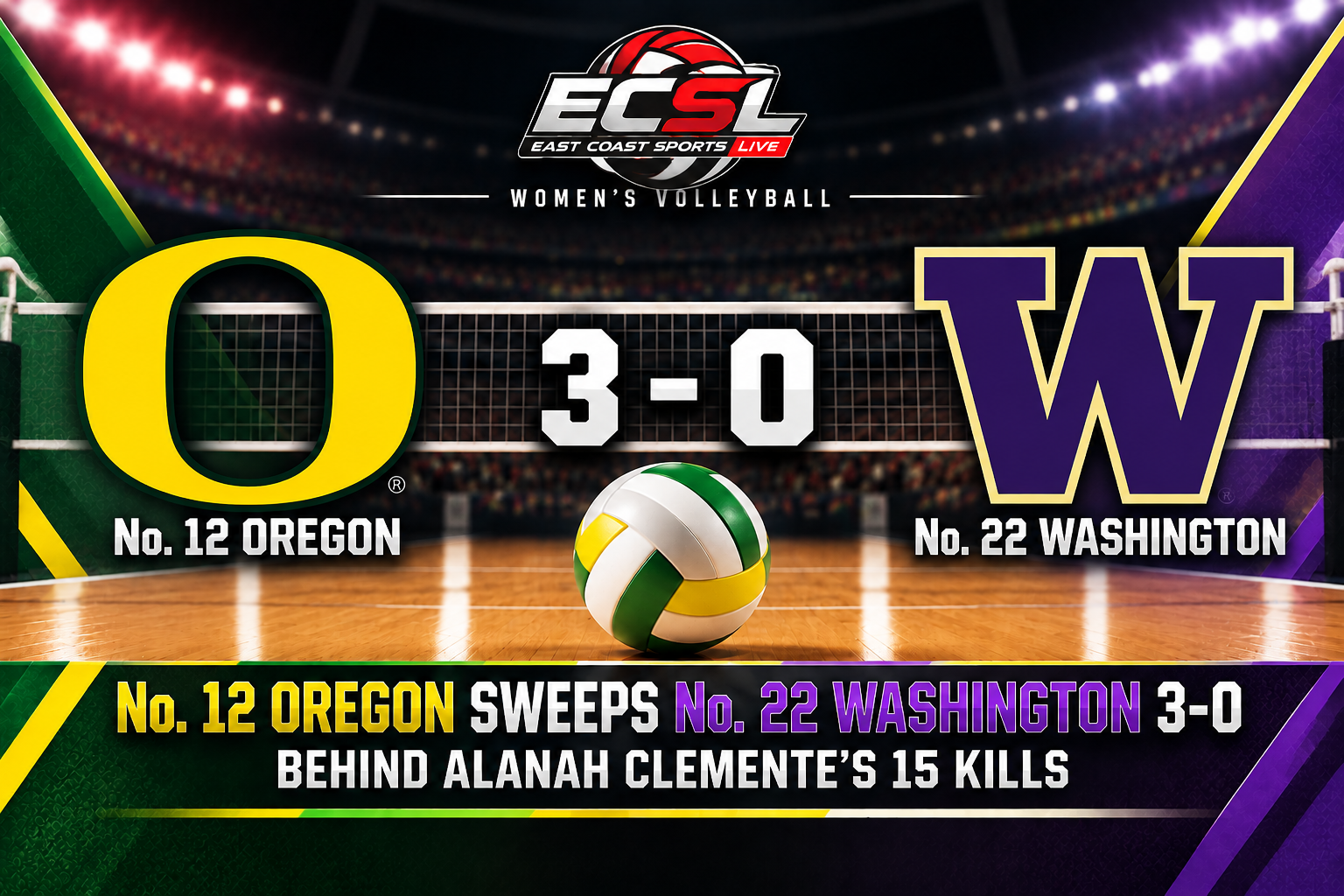
EUGENE, Ore. — November 17, 2026 — No. 12 Oregon closed its regular season with a hard-fought 3-0 victory over No. 22 Washington on Tuesday night at Matthew Knight Arena, overcoming two extended sets to secure its fourth consecutive win heading into the Big Ten Tournament. The Ducks prevailed 25-18, 29-27, 34-32 in a rivalry matchup that proved considerably closer than the final sweep suggested. Alanah Clemente led Oregon with 15 kills, while Valentina Vaulet contributed 12 and Sjakkie Donkers added 11. Setter Marina Crownover directed an efficient offensive performance as the Ducks combined balanced attacking with timely defensive plays. Washington challenged Oregon throughout the final two sets, repeatedly fighting off set and match points. However, the Huskies could not convert their opportunities to extend the contest. The victory strengthened Oregon's postseason position and provided momentum entering the conference tournament, where the Ducks will begin play in the quarterfinals. Oregon's Sweep Reveals More Than the Final Score A three-set victory typically suggests that one team controlled the match from beginning to end. Oregon's win over Washington told a different story. The Ducks captured the opening set by seven points but needed 29 points to win the second and 34 to finish the third. Washington pushed Oregon beyond regulation in both sets, forcing the Ducks to execute under pressure while protecting their advantage. The final two sets required a combined 122 points, demonstrating how closely the rivals competed despite the straight-set result. Oregon's ability to close those extended sets reflected its offensive balance and composure during critical possessions. The Ducks did not rely exclusively on one attacker. Instead, Clemente, Vaulet and Donkers consistently provided scoring options across the front row. That versatility became particularly important when Washington extended rallies and prevented Oregon from establishing comfortable leads. The victory also illustrated a valuable postseason quality: the ability to win close sets without allowing missed opportunities to disrupt the team's execution. Alanah Clemente Leads Oregon With 15 Kills Clemente delivered the Ducks' strongest individual attacking performance, finishing with a match-high 15 kills. Her production was especially important during the second set, when Washington repeatedly denied Oregon opportunities to finish. The Huskies erased late deficits and forced the Ducks to continue playing beyond the standard 25-point target. Clemente eventually supplied the decisive offense. With Oregon attempting to secure a two-set advantage, she recorded consecutive kills to finish the second set 29-27. Those plays prevented Washington from tying the match and gave the Ducks a commanding position entering the third. Clemente also contributed defensively, recording at least 10 digs to complete a double-double. Her ability to produce both kills and digs gave Oregon another reliable contributor during extended rallies. Rather than depending on high-volume attacking alone, Clemente demonstrated the value of maintaining offensive efficiency while contributing to the team's defensive structure. Her performance provided a strong conclusion to the regular season and reinforced her importance to Oregon's postseason attack. Marina Crownover Directs Oregon's Balanced Offense Oregon's offensive success depended heavily on the decisions of setter Marina Crownover. Crownover distributed opportunities among several attackers, allowing the Ducks to maintain pressure from multiple positions. Clemente led with 15 kills, Vaulet recorded 12 and Donkers finished with 11. The balanced production made it more difficult for Washington to concentrate its blocking assignments on one player. Oregon's official match account reported a .347 team hitting percentage, while Washington's account listed the Ducks at .357. Although the two sources differ slightly on the final figure, both show that Oregon attacked substantially more efficiently than Washington, which hit .220. Crownover also contributed defensively with at least 10 digs, completing a double-double. Her decision-making became especially important during the extended second and third sets. When Washington adjusted its blocking and challenged Oregon's attacking rhythm, Crownover continued finding opportunities for different hitters. The result was an offense capable of producing timely kills even when the Huskies extended rallies and created pressure. That offensive flexibility could become a significant advantage as Oregon prepares for stronger postseason competition. Oregon Wins Opening Set 25-18 After Washington Comeback Oregon began the match with an aggressive defensive approach. Freshman middle blocker Alaina Pollard contributed to two early blocks as the Ducks established a 6-1 lead. The opening stretch forced Washington to respond quickly and adjust its attacking approach. Clemente later extended Oregon's advantage to 10-4 with a kill. However, Washington gradually found its rhythm. The Huskies reduced the deficit and eventually moved ahead 16-15, threatening to reverse the momentum of the opening set. Oregon responded with five consecutive points behind the serving of Reese Sheppard. That run restored the Ducks' advantage and prevented Washington from building on its comeback. Dalia Virlan later delivered a kill that helped Oregon close the set with another strong scoring stretch. The Ducks finished with a 25-18 victory. Although Oregon won comfortably on the scoreboard, Washington's ability to recover from an early deficit foreshadowed the competitive sets that followed. The opening set also demonstrated Oregon's defensive potential, particularly through Pollard's blocking contributions. Clemente Delivers Consecutive Kills in 29-27 Second Set The second set developed into a much tighter contest. Neither team established a lead larger than two points through much of the early and middle portions. Both offenses exchanged scoring opportunities, while service and attacking errors prevented either side from maintaining extended momentum. Oregon eventually created separation with a three-point run that produced a 21-18 advantage. Washington responded and tied the score at 22-22. The Ducks then earned their first opportunity to finish the set, but the Huskies refused to concede. Washington saved multiple set points and forced Oregon to continue playing beyond 25. The extended finish tested both teams' ability to maintain offensive execution under pressure. Oregon repeatedly created opportunities to close the set, but Washington's defense and timely attacking kept the outcome uncertain. Clemente eventually ended the contest with back-to-back kills, securing a 29-27 victory. The result gave Oregon a 2-0 match advantage. For Washington, the narrow defeat represented a missed opportunity to change the direction of the match. The Huskies had demonstrated that they could compete with Oregon point for point, but they could not produce the final sequence needed to win. Washington Pushes Oregon to 34-32 in Third Set The third set produced the match's most dramatic finish. Washington continued challenging Oregon with aggressive attacking and sustained defensive effort. The Huskies established a 9-6 advantage during the early stages, forcing the Ducks to adjust their lineup and regain momentum. Oregon responded by inserting middle blocker Iva Šucurovic, whose contributions helped stabilize the team's performance. Šucurovic delivered timely kills and blocking support as the Ducks worked their way back into contention. Vaulet also became increasingly influential, providing important attacking production and serving pressure. Oregon eventually moved ahead 24-21 and appeared positioned to finish the match. Washington refused to surrender. The Huskies scored three consecutive points to tie the set at 24-24, extending the contest beyond regulation. Both teams subsequently earned opportunities to finish the set. Washington held set points at 26-25 and 27-26, but Oregon responded on each occasion. The Ducks also saw several match points erased as the Huskies continued producing timely plays. The contest eventually reached 33-32 in Oregon's favor. Crownover delivered a late kill, and Vaulet followed with a service ace to secure the 34-32 victory. The final point completed Oregon's sweep after one of the most competitive sets of its regular season. Valentina Vaulet Provides the Match-Winning Ace Vaulet's contribution extended beyond her 12 kills. The Oregon attacker delivered important points throughout the third set, helping the Ducks recover from Washington's early advantage. Her attacking production provided another dependable option when Clemente and Donkers faced defensive pressure. However, Vaulet's most significant contribution came at the end of the match. With Oregon leading 33-32, she delivered a service ace that ended the extended third set. The final serve completed a 34-32 victory and secured the Ducks' fourth consecutive win. Vaulet's ability to contribute through both attacking and serving demonstrated Oregon's offensive versatility. In closely contested matches, service pressure can become especially valuable because it creates scoring opportunities without requiring a full attacking sequence. Her match-winning ace provided an example of how individual execution can determine the outcome of an otherwise evenly contested set. Alaina Pollard Strengthens Oregon's Front-Row Defense Freshman middle blocker Alaina Pollard played an important role in Oregon's victory. Pollard finished with six kills and five blocks, contributing to both the Ducks' offensive production and defensive effectiveness. Her blocking presence was especially important during the opening set. Oregon used early blocks to establish a 6-1 lead and place immediate pressure on Washington's attackers. Pollard also provided efficient attacking opportunities throughout the match. Her ability to contribute without committing attacking errors, as reported in the Oregon student newspaper's coverage, demonstrated the value of controlled offensive execution. The freshman's performance added another dimension to Oregon's balanced lineup. With experienced attackers producing double-digit kills, Pollard's contributions in the middle helped prevent Washington from focusing exclusively on the Ducks' primary scoring options. Her continued development could provide Oregon with additional front-row flexibility during postseason competition. Washington's Addie Kanouff Delivers Career-Best Efficiency Despite the defeat, Washington received a strong performance from Addie Kanouff. The third-year player recorded a season-high 11 kills without committing an attacking error. Kanouff converted those opportunities on 16 attempts, producing a career-best .688 hitting percentage. Her efficient attacking helped Washington remain competitive during the extended second and third sets. Sammy Destler also contributed 11 kills and seven digs, sharing the team's lead in kills. Setter Andrea Fabikovicova finished with 35 assists, nine digs and four kills. Kaitlyn Nguyen added 12 digs and four assists. Washington's individual performances demonstrated that the Huskies possessed enough offensive talent to challenge Oregon. However, the team's overall attacking efficiency remained below that of the Ducks. The Huskies also struggled to convert late-set opportunities despite repeatedly forcing Oregon to play additional points. Kanouff's performance was a positive development entering the Big Ten Tournament, where Washington will need similar efficiency to advance. Oregon's Attacking Efficiency Makes the Difference The statistical comparison between the teams helps explain why Oregon secured the sweep despite Washington's resistance. Both programs finished with 53 kills. However, Oregon committed substantially fewer attacking errors. Washington's official match account reported that the Huskies committed twice as many attacking errors as the Ducks. The difference allowed Oregon to generate more effective offensive production even though both teams recorded the same number of kills. The Ducks also held advantages in several defensive and serving categories. Oregon recorded nine blocks compared with Washington's five. The Ducks finished with five service aces, while the Huskies recorded three. Oregon also collected 53 digs compared with Washington's 48. Those differences were particularly important during the second and third sets, when individual points carried greater significance. The match demonstrated that total kills alone do not determine offensive effectiveness. Limiting mistakes, maintaining blocking pressure and converting service opportunities can provide the margin needed to win close sets. Oregon succeeded in those areas often enough to secure the straight-set victory. Oregon Enters Big Ten Tournament With Four-Match Winning Streak The victory gave Oregon additional momentum heading into postseason competition. According to Oregon Athletics, the Ducks completed the regular season with a 23-4 overall record and a 14-3 mark in Big Ten play. The Ducks also finished with four consecutive victories. Oregon secured the No. 4 seed in the Big Ten Tournament and earned a double-bye into the quarterfinals. The tournament begins Friday in Fishers, Indiana, with Oregon scheduled to begin play Sunday. The Ducks will face an opponent determined by the earlier tournament rounds. Their regular-season performance also strengthened their position for the NCAA Tournament. Oregon entered the postseason in contention for a top-16 national seed, which would provide an opportunity to host the opening rounds. The possibility of earning an even higher seed adds significance to the team's Big Ten Tournament performance. For Oregon, the victory over Washington provided an encouraging final regular-season test. The Ducks demonstrated offensive balance, defensive resilience and an ability to finish difficult sets against a nationally ranked opponent. Those qualities will become increasingly important as the level of competition rises. Washington Prepares for Big Ten Tournament as No. 10 Seed Washington concluded the regular season with an 18-8 overall record and a 9-8 conference mark, according to Washington Athletics. The Huskies earned the No. 10 seed in the inaugural Big Ten Volleyball Championship. Washington will begin tournament play Friday against No. 15 seed Maryland. Although the loss to Oregon ended the regular season on a disappointing note, the Huskies demonstrated several encouraging qualities. Their ability to extend the second and third sets showed that they could compete with a nationally ranked opponent. Kanouff's efficient attacking performance provided another positive development. However, Washington must improve its ability to finish close sets. The Huskies created opportunities to win the third set but could not convert them. Reducing attacking errors and maintaining consistency during critical points will be important if Washington hopes to advance in the conference tournament. What's Next for Oregon and Washington? Oregon advances to the Big Ten Tournament quarterfinals on Sunday, with its opening match scheduled for 11 a.m. on Big Ten Network. The Ducks will attempt to extend their four-match winning streak and strengthen their NCAA Tournament seeding position. Washington begins its conference tournament campaign Friday against Maryland in Fishers, Indiana. The Huskies will look to turn their competitive performance against Oregon into a stronger postseason result. For Oregon, the 3-0 victory over Washington was more demanding than the final score suggested. Clemente's 15 kills, Vaulet's match-winning ace and Crownover's balanced distribution helped the Ducks overcome a determined rival. The extended second and third sets also provided valuable experience in high-pressure situations. As Oregon moves into postseason play, its ability to execute during those moments could prove just as important as its overall offensive production. The Ducks finished the regular season with momentum, but their next challenge will be translating that success into a deep postseason run.
East Coast Sports Live banner explaining what a redshirt freshman is and how new NCAA rules change it.
By Drew Rhoden • November 18, 2026
What a redshirt freshman is, how redshirt and medical redshirt rules work, and how the NCAA's 2026 age based eligibility model ends redshirting.
East Coast Sports Live banner for college football overtime rules explained.
By Amber Aniston • November 18, 2026
College football overtime rules explained: the coin toss, possessions from the 25, required two point tries, and the third overtime shootout.
East Coast Sports Live banner explaining the six volleyball positions and court zones.
By Amber Aniston • November 18, 2026
Volleyball positions explained: setter, outside hitter, opposite, middle blocker, libero, and defensive specialist, plus court zones and rotations.
East Coast Sports Live banner for a guide to high school football recruiting.
By Drew Rhoden • November 18, 2026
High school football recruiting explained: how college coaches find players, NCAA Division I eligibility rules, how to get recruited, and key mistakes.
Empty basketball arena with a single ball at center court after the season.
By Drew Rhoden • November 17, 2026
The Atlanta Dream roster after a Game 7 Finals loss: who is under contract, who is a free agent, and the storylines that will shape the 2027 season.
FOOTBALL
By Amber Aniston • November 15, 2026
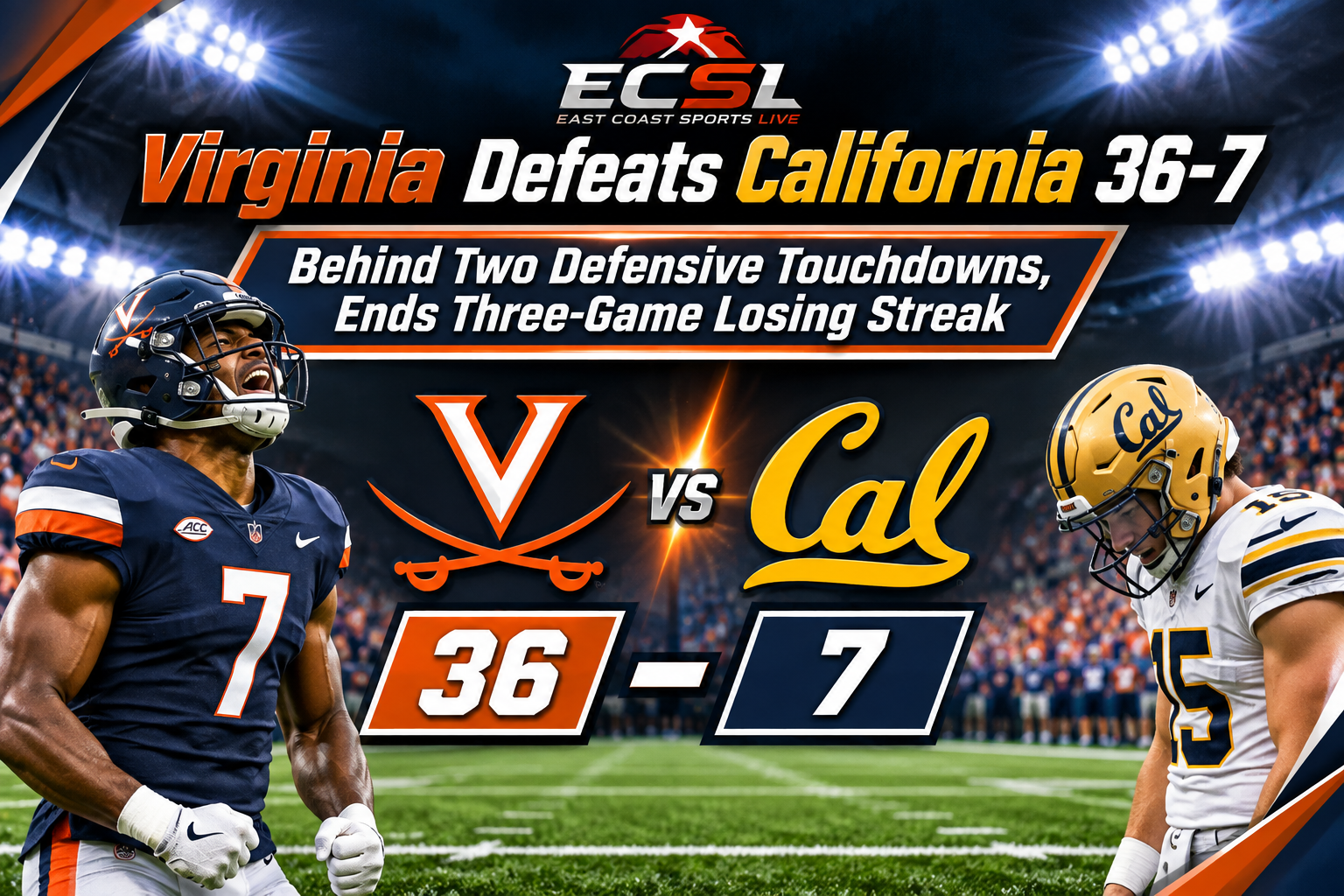
CHARLOTTESVILLE, Va. — November 14, 2026 — Virginia delivered a much-needed response to its recent struggles Saturday, defeating California 36-7 at Scott Stadium behind two interception returns for touchdowns and a dominant defensive performance. Brandyn Hillman and Kam Robinson supplied the game's defining moments, each scoring on an interception return as the Cavaliers ended a three-game losing streak and improved to 5-5 overall and 3-4 in Atlantic Coast Conference play. Virginia held California to just 201 yards of total offense, recorded four sacks and forced three turnovers. The Golden Bears, meanwhile, dropped their fourth consecutive game and fell to 3-7. The victory carried significant postseason implications for Virginia, which now needs one win in its final two regular-season games to become bowl eligible. More importantly, the Cavaliers demonstrated a level of defensive execution that had been missing during their recent losing streak, including a 51-7 defeat against Wake Forest on October 31. Brandyn Hillman's Interception Return Changes the Game Virginia's defense produced the afternoon's most consequential play late in the second quarter. With the Cavaliers leading 9-0, California advanced deep into Virginia territory and faced fourth-and-goal from the 4-yard line. Rather than attempting a conventional field goal, the Golden Bears called a fake field goal designed to surprise the Cavaliers' defense. The decision produced the opposite result. Virginia defensive back Brandyn Hillman intercepted a pass from Mason Mini near the goal line and raced the length of the field for a touchdown. The return, listed as 100 yards in the California Athletics account, extended Virginia's advantage to 16-0 with 2:02 remaining before halftime. The play transformed what could have been California's first scoring opportunity into another Virginia touchdown. Instead of narrowing the deficit, the Golden Bears surrendered seven points and faced a significantly more difficult comeback. Hillman's return also established a Virginia school record for the longest interception return, according to the Virginia Cavaliers analysis included in the source material. The defensive score illustrated the importance of preparation and recognition in special-teams situations. Virginia anticipated California's formation and responded decisively when the Golden Bears attempted the unexpected play. For the Cavaliers, the touchdown represented more than a momentum swing. It provided a scoring advantage that their offense did not have to generate through a traditional possession. Kam Robinson Adds Another Defensive Touchdown Hillman was not the only Virginia defender to turn an interception into points. Linebacker Kam Robinson delivered another decisive defensive score during the third quarter, effectively removing California's opportunity to build a sustained comeback. With Virginia leading 19-7, California quarterback Jaron-Keawe Sagapolutele attempted a short pass near the line of scrimmage. Robinson read the play, elevated to intercept the football and returned it 33 yards for a touchdown. The score increased Virginia's lead to 26-7 and placed additional pressure on a California offense that had already struggled to move the ball consistently. Robinson finished the game with 12 tackles, leading Virginia's defensive effort. His interception return was also the fourth touchdown of his college career on an interception, according to the Virginia Cavaliers analysis. Virginia's two defensive touchdowns marked the program's first game with multiple interception returns for scores since its 2003 matchup against Western Michigan. The accomplishment reflected an aggressive defensive approach that forced California into mistakes while limiting the Golden Bears' offensive opportunities. Together, Hillman and Robinson accounted for 14 of Virginia's 36 points. Their production was especially important because it allowed the Cavaliers to build a comfortable lead without relying entirely on their offense. Virginia Defense Holds California to 201 Total Yards Beyond the two interception touchdowns, Virginia's defense controlled much of the contest. The Cavaliers limited California to a season-low 201 total offensive yards and consistently disrupted the Golden Bears' passing attack. Virginia recorded four sacks and three interceptions, preventing California from developing the offensive rhythm needed to challenge the Cavaliers' lead. Robinson led the team with 12 tackles, while Montino Williams contributed another interception. The defensive performance was particularly notable considering Virginia's previous outing. Against Wake Forest on October 31, the Cavaliers surrendered 51 points in a lopsided defeat that extended their losing streak to three games. Following an open week, Virginia returned with improved defensive discipline and more effective execution. The Cavaliers did not eliminate every mistake, but they consistently created pressure and converted California's turnovers into scoring opportunities. For California, the inability to protect the football became one of the most significant factors in the loss. The Golden Bears surrendered three interceptions and failed to force a turnover themselves. That imbalance gave Virginia additional opportunities to control field position and build its lead. Although California's defense produced several stops, the offense's turnovers and inability to sustain drives made the overall matchup increasingly difficult. Beau Pribula Leads Virginia's Opening Touchdown Drive Virginia's offense established momentum immediately with an effective opening possession. Quarterback Beau Pribula directed a 13-play, 80-yard touchdown drive that gave the Cavaliers an early advantage. During the possession, Pribula completed five of eight passes for 51 yards. The drive ended with a 12-yard touchdown pass to Da'Shawn Martin, providing Virginia's first points of the afternoon. The opening series demonstrated the Cavaliers' ability to execute a methodical offensive approach rather than depending exclusively on explosive plays. Pribula finished the game completing 16 of 24 passes for 146 yards and one touchdown. He also led Virginia in rushing with 67 yards on seven carries, including a 43-yard run. The quarterback avoided turnovers and sacks during his three quarters of action, an important development for a team attempting to recover from several difficult performances. Pribula's efficiency allowed Virginia to maintain offensive stability while its defense generated the game's biggest plays. Although the Cavaliers did not produce overwhelming passing numbers, their offense provided enough scoring support to complement the defensive effort. California's Fake Field Goal Proves Costly California's unsuccessful fake field goal was arguably the game's most damaging decision. The Golden Bears had moved the football into scoring position while trailing 9-0 in the second quarter. At that stage, a successful scoring opportunity could have reduced Virginia's lead and given California momentum before halftime. Instead, Hillman's interception return increased the deficit to 16 points. The play demonstrated how quickly a high-risk decision can influence a football game when execution breaks down. California still managed to respond before halftime. Quarterback Jaron-Keawe Sagapolutele helped direct a nine-play, 60-yard touchdown drive. A 19-yard completion to Mark Hamper converted an important third-down opportunity and advanced the Golden Bears into Virginia territory. Later, a roughing-the-passer penalty gave California a first-and-goal opportunity at the 5-yard line. Running back Adam Mohammed finished the possession with a 5-yard touchdown run with 14 seconds remaining in the second quarter. The score reduced California's deficit to 16-7 at halftime. However, the Golden Bears could not build on that offensive success during the second half. Virginia's defensive pressure and Robinson's interception return prevented California from establishing the sustained production necessary for a comeback. California Struggles to Overcome Turnovers California entered the matchup hoping to reverse its recent struggles, but turnovers again complicated its efforts. The Golden Bears' offense had difficulty maintaining consistent drives against Virginia's defensive front. Sagapolutele faced pressure throughout the game, while the Cavaliers capitalized on passing mistakes. California receiver Mark Hamper provided one of the offense's more productive individual performances, finishing with six receptions for 66 yards. Mohammed accounted for the team's only touchdown. However, those contributions were not enough to overcome Virginia's defensive scoring. California's defense also experienced moments of success. Linebacker AJ Tuitele recorded a team-high and personal-best 10 tackles. The Golden Bears forced Virginia into several difficult offensive situations and prevented the Cavaliers from scoring touchdowns on every possession. Nevertheless, California could not recover from the combination of turnovers, defensive touchdowns and limited offensive yardage. The defeat highlighted the importance of complementary football, particularly when a team's offense and defense experience contrasting levels of success. California's defensive stops provided opportunities, but its offense could not consistently capitalize on them. Virginia's Offensive Penalties Remain a Concern Despite the convincing victory, Virginia still displayed areas requiring improvement. The Cavaliers committed eight penalties for 99 yards, according to the Virginia Cavaliers analysis. Several infractions interrupted offensive possessions, while defensive penalties contributed to California's only touchdown drive. The mistakes did not change the result against the Golden Bears, but they remain important as Virginia approaches its final two regular-season games. Against stronger offensive opponents, penalties that extend drives or eliminate scoring opportunities could carry greater consequences. Virginia's coaching staff will likely emphasize cleaner execution while attempting to maintain the defensive intensity displayed against California. The Cavaliers demonstrated that they can win with strong defensive contributions, but continued improvement on offense and special teams will be important if they hope to secure postseason eligibility. Virginia Ends Three-Game Losing Streak Saturday's result provided a significant change in direction for Virginia. The Cavaliers entered the matchup following three consecutive losses, including their 51-7 defeat against Wake Forest. That stretch raised questions about the team's consistency and ability to finish the season successfully. The victory over California did not erase those previous results, but it restored an important measure of momentum. Virginia improved to 5-5 overall, moving within one victory of the six-win threshold commonly associated with bowl eligibility. The Cavaliers also improved to 3-4 in ACC competition. The defensive performance offered a particularly encouraging development. By forcing three turnovers, recording four sacks and limiting California to 201 yards, Virginia showed it could control a game through defensive execution. The two interception touchdowns added an unusual scoring dimension that helped turn a competitive first half into a comfortable victory. The challenge now is sustaining that performance against the remaining opponents. What Virginia's Victory Means for Bowl Eligibility Virginia's 36-7 victory keeps its postseason hopes alive. With two regular-season games remaining, the Cavaliers need one additional victory to reach six wins. The team will have an opportunity to accomplish that goal when it hosts North Carolina in its next matchup. A victory would place Virginia in a stronger position to qualify for a postseason bowl game, subject to the applicable eligibility requirements and selection process. The California result also provides a useful example of the team's potential when its offense, defense and special teams contribute effectively. Pribula directed an efficient offensive performance, while Hillman and Robinson delivered defensive touchdowns that changed the game. However, Virginia must address its penalty problems and improve consistency if it hopes to finish the season successfully. The Cavaliers' ability to build on Saturday's defensive performance will be central to their postseason ambitions. California Turns Attention to Stanford Rivalry For California, the loss extended a difficult stretch of the 2026 season. The Golden Bears fell to 3-7 overall and suffered their fourth consecutive defeat. With the postseason no longer attainable through a conventional six-win finish, California's remaining games carry different significance. The Golden Bears will return home to face Stanford in the 129th Big Game. The rivalry provides California an opportunity to respond to its recent struggles and compete for the Stanford Axe. California head coach Tosh Lupoi emphasized the importance of the upcoming matchup in the team's postgame comments. The rivalry will be especially meaningful for California's senior players, including center Bastian Swinney, who has experienced multiple meetings between the programs. California will need improved ball security and more consistent offensive execution to compete effectively against Stanford. The Golden Bears cannot afford another performance defined by costly turnovers and limited offensive production. What's Next for Virginia and California? Virginia will host North Carolina in its next game, seeking the victory needed to reach six wins. The Cavaliers enter the matchup with renewed confidence following their strongest defensive scoring performance of the season. California returns home to face Stanford in the 129th Big Game, with kickoff scheduled for 4:30 p.m. on ACC Network, according to California Athletics. For Virginia, the most important takeaway from Saturday's victory was not simply the 29-point margin. The Cavaliers demonstrated how defensive preparation, turnover creation and efficient quarterback play can combine to produce a convincing result. Hillman's long interception return and Robinson's 33-yard defensive touchdown transformed the contest, while Pribula provided the offensive stability necessary to maintain control. After three consecutive losses, Virginia finally found a winning formula. Whether the Cavaliers can repeat that performance against North Carolina will determine if their late-season recovery leads to a postseason opportunity.
More Posts