
Amber Aniston+ • September 4, 2025

No. 11 SMU Powers Past Washington 3–1, Marks 250th Win at Moody

Mustangs Turn the Tide After Dropping the Opener 


SMU’s home opener doubled as a milestone night. The No. 11 Mustangs shrugged off a slow start and defeated Washington in four sets, 23–25, 25–22, 25–22, 25–19, to move to 3–0 and record the program’s 250th victory inside Moody Coliseum. The match had the tension and swings of a ranked-level duel: Washington’s physical pins landed early blows, but SMU’s balance, blocking, and late-set poise steadily seized control of the match and the narrative. 


Washington arrived intent on spoiling the celebration. The Huskies’ first-set efficiency forced SMU into chase mode and briefly quieted the building. From the second set on, however, the Mustangs made decisive adjustments—tightening first contact, setting quicker to the middle, and turning the match at the net. The result was a clean, fast-tempo offense that climbed all the way to .385 hitting on the night while limiting the visitors to extended sideout stretches. 


Livings, Jones, and Carlson Drive an Unstoppable Engine 


On a roster full of options, Jadyn Livings supplied the centerpiece performance: 18 kills at a crisp .371, plus nine digs and six blocks. Malaya Jones complemented her with 12 kills and a team-high 15 digs, underlining how often SMU’s outsides started and finished rallies. Averi Carlson conducted it all with 49 assists, guiding the Mustangs to their best attacking efficiency of the young season and sprinkling in seven digs for good measure. 


The lift in sideout speed was most obvious from set two onward. Carlson’s tempo to the pins widened gaps, Natalia Newsome’s slide and quicks forced Washington’s middle to stay honest, and the coverage around the attackers recycled tough balls that the Huskies had handled in the first frame. Every long exchange began to tilt SMU’s way, a sign that spacing, rhythm, and first-touch quality had all settled. 


The Net Belonged to the Mustangs 


If the offense supplied the spectacle, the block provided the separation. SMU finished with an 11–6 edge in total blocks and completely flipped the net-front story after the opener. Newsome led with seven stuffs, and Livings’ six made Washington think twice about attacking her lane. The effect was cumulative: deflections funneled balls to the floor defenders, transition opportunities multiplied, and the Huskies’ first-swing success from set one faded into grind-it-out points that favored the deeper side. 


Libero Jordyn Schilling steadied the back row with 13 digs, and freshman Maggie Croft delivered a momentum-jolting stretch in set three—back-to-back aces during a five-point run that swung the frame and, effectively, the night. Washington continued to land shots, but SMU’s block-touch-to-dig pipeline kept the Mustangs on the front foot in transition. 


How Each Set Was Won 


Set One (UW 25–23): Washington’s first-swing attack (.341) and a late three-point burst pushed the visitors to the finish line. SMU erased 22–20 with kills from Livings and Favor Anyanwu but couldn’t complete the steal. It was the Huskies’ best blocking set (3–1) and their cleanest sideout rhythm of the match. 


Set Two (SMU 25–22): The match pivoted here. SMU opened 9–5, weathered a Husky 6–1 push, then surged again with a 4–0 run fueled by Newsome’s quicks and a Livings termination. The Mustangs owned the net 6–1 in blocks in this frame alone, and their first-ball sideout rate spiked. 


Set Three (SMU 25–22): Washington’s 10–6 start didn’t hold. Croft’s serving run (two straight aces) keyed a five-point swing to 18–15, and Jones closed it down in the final rotations. SMU hit a blistering .526 in the set—its cleanest passing and sharpest spacing of the night. 


Set Four (SMU 25–19): An immediate 3–0 burst set the tone. Two separate 3–0 spurts later stretched the gap to 18–13, and the Huskies never clawed closer than four. Livings (six kills) and Jones (five) slammed the door while SMU posted .469 to finish. 


What the Numbers Say 


SMU out-hit Washington .385 to .239, out-blocked them 11–6, and out-dug them 49–39—a rare trifecta that reflects superiority in first contact, at the net, and in rally defense. The Mustangs’ attack rose steadily after set one, clearing .460 in each of the final three frames, the clearest indicator that the pass-set-hit rhythm settled and stayed. Washington, to its credit, kept pace into the late teens of each set, but SMU’s end-game organization—blocking matchups, serving targets, and transition spacing—was sharper when it mattered. 


Why This Win Matters 


Beyond the milestone tally at Moody, the performance reinforces who SMU intends to be this season: a top-tier side with multiple kill outlets, a setter capable of modulating tempo on the fly, and a front line that can win matches even when the serve-pass battle isn’t perfect. Beating a Pac-12 power by controlling the final three frames also builds confidence for the weekend’s quick turnaround and for the longer arc of conference play. Up next is Northern Iowa, another chance to refine the rotation while riding the momentum of a complete, problem-solving win. 


Bottom Line 


A first set that belonged to Washington turned into three sets of Mustang authority. Livings’ shot-making, Jones’ two-way impact, Carlson’s tempo, and Newsome’s wall at the net added up to a composed, professional home opener—and a fitting way to stamp victory No. 250 at Moody. 
East Coast Sports Live banner for a guide to high school football recruiting.
By Drew Rhoden • November 18, 2026
High school football recruiting explained: how college coaches find players, NCAA Division I eligibility rules, how to get recruited, and key mistakes.
Empty basketball arena with a single ball at center court after the season.
By Drew Rhoden • November 17, 2026
The Atlanta Dream roster after a Game 7 Finals loss: who is under contract, who is a free agent, and the storylines that will shape the 2027 season.
FOOTBALL
By Amber Aniston • November 15, 2026
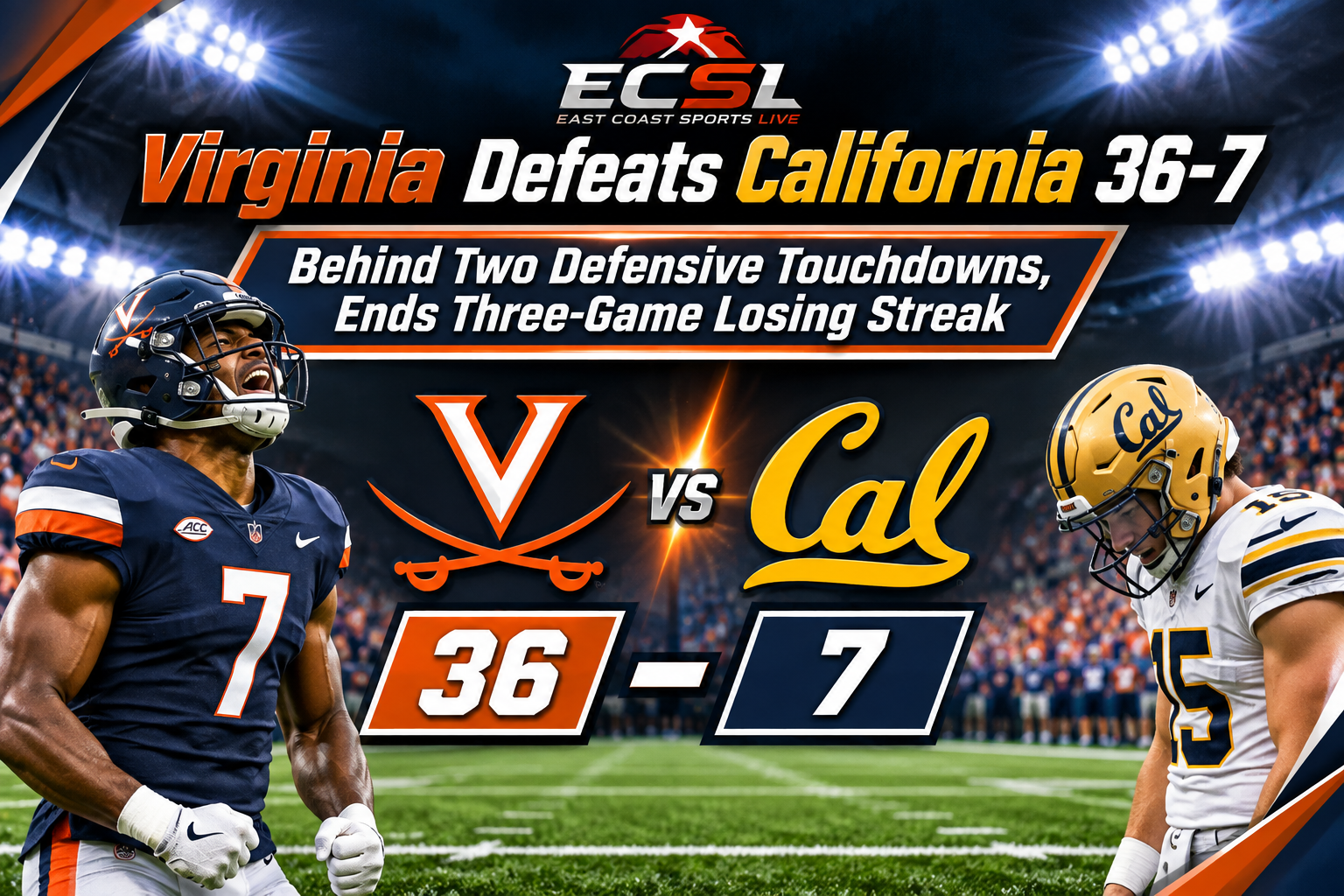
CHARLOTTESVILLE, Va. — November 14, 2026 — Virginia delivered a much-needed response to its recent struggles Saturday, defeating California 36-7 at Scott Stadium behind two interception returns for touchdowns and a dominant defensive performance. Brandyn Hillman and Kam Robinson supplied the game's defining moments, each scoring on an interception return as the Cavaliers ended a three-game losing streak and improved to 5-5 overall and 3-4 in Atlantic Coast Conference play. Virginia held California to just 201 yards of total offense, recorded four sacks and forced three turnovers. The Golden Bears, meanwhile, dropped their fourth consecutive game and fell to 3-7. The victory carried significant postseason implications for Virginia, which now needs one win in its final two regular-season games to become bowl eligible. More importantly, the Cavaliers demonstrated a level of defensive execution that had been missing during their recent losing streak, including a 51-7 defeat against Wake Forest on October 31. Brandyn Hillman's Interception Return Changes the Game Virginia's defense produced the afternoon's most consequential play late in the second quarter. With the Cavaliers leading 9-0, California advanced deep into Virginia territory and faced fourth-and-goal from the 4-yard line. Rather than attempting a conventional field goal, the Golden Bears called a fake field goal designed to surprise the Cavaliers' defense. The decision produced the opposite result. Virginia defensive back Brandyn Hillman intercepted a pass from Mason Mini near the goal line and raced the length of the field for a touchdown. The return, listed as 100 yards in the California Athletics account, extended Virginia's advantage to 16-0 with 2:02 remaining before halftime. The play transformed what could have been California's first scoring opportunity into another Virginia touchdown. Instead of narrowing the deficit, the Golden Bears surrendered seven points and faced a significantly more difficult comeback. Hillman's return also established a Virginia school record for the longest interception return, according to the Virginia Cavaliers analysis included in the source material. The defensive score illustrated the importance of preparation and recognition in special-teams situations. Virginia anticipated California's formation and responded decisively when the Golden Bears attempted the unexpected play. For the Cavaliers, the touchdown represented more than a momentum swing. It provided a scoring advantage that their offense did not have to generate through a traditional possession. Kam Robinson Adds Another Defensive Touchdown Hillman was not the only Virginia defender to turn an interception into points. Linebacker Kam Robinson delivered another decisive defensive score during the third quarter, effectively removing California's opportunity to build a sustained comeback. With Virginia leading 19-7, California quarterback Jaron-Keawe Sagapolutele attempted a short pass near the line of scrimmage. Robinson read the play, elevated to intercept the football and returned it 33 yards for a touchdown. The score increased Virginia's lead to 26-7 and placed additional pressure on a California offense that had already struggled to move the ball consistently. Robinson finished the game with 12 tackles, leading Virginia's defensive effort. His interception return was also the fourth touchdown of his college career on an interception, according to the Virginia Cavaliers analysis. Virginia's two defensive touchdowns marked the program's first game with multiple interception returns for scores since its 2003 matchup against Western Michigan. The accomplishment reflected an aggressive defensive approach that forced California into mistakes while limiting the Golden Bears' offensive opportunities. Together, Hillman and Robinson accounted for 14 of Virginia's 36 points. Their production was especially important because it allowed the Cavaliers to build a comfortable lead without relying entirely on their offense. Virginia Defense Holds California to 201 Total Yards Beyond the two interception touchdowns, Virginia's defense controlled much of the contest. The Cavaliers limited California to a season-low 201 total offensive yards and consistently disrupted the Golden Bears' passing attack. Virginia recorded four sacks and three interceptions, preventing California from developing the offensive rhythm needed to challenge the Cavaliers' lead. Robinson led the team with 12 tackles, while Montino Williams contributed another interception. The defensive performance was particularly notable considering Virginia's previous outing. Against Wake Forest on October 31, the Cavaliers surrendered 51 points in a lopsided defeat that extended their losing streak to three games. Following an open week, Virginia returned with improved defensive discipline and more effective execution. The Cavaliers did not eliminate every mistake, but they consistently created pressure and converted California's turnovers into scoring opportunities. For California, the inability to protect the football became one of the most significant factors in the loss. The Golden Bears surrendered three interceptions and failed to force a turnover themselves. That imbalance gave Virginia additional opportunities to control field position and build its lead. Although California's defense produced several stops, the offense's turnovers and inability to sustain drives made the overall matchup increasingly difficult. Beau Pribula Leads Virginia's Opening Touchdown Drive Virginia's offense established momentum immediately with an effective opening possession. Quarterback Beau Pribula directed a 13-play, 80-yard touchdown drive that gave the Cavaliers an early advantage. During the possession, Pribula completed five of eight passes for 51 yards. The drive ended with a 12-yard touchdown pass to Da'Shawn Martin, providing Virginia's first points of the afternoon. The opening series demonstrated the Cavaliers' ability to execute a methodical offensive approach rather than depending exclusively on explosive plays. Pribula finished the game completing 16 of 24 passes for 146 yards and one touchdown. He also led Virginia in rushing with 67 yards on seven carries, including a 43-yard run. The quarterback avoided turnovers and sacks during his three quarters of action, an important development for a team attempting to recover from several difficult performances. Pribula's efficiency allowed Virginia to maintain offensive stability while its defense generated the game's biggest plays. Although the Cavaliers did not produce overwhelming passing numbers, their offense provided enough scoring support to complement the defensive effort. California's Fake Field Goal Proves Costly California's unsuccessful fake field goal was arguably the game's most damaging decision. The Golden Bears had moved the football into scoring position while trailing 9-0 in the second quarter. At that stage, a successful scoring opportunity could have reduced Virginia's lead and given California momentum before halftime. Instead, Hillman's interception return increased the deficit to 16 points. The play demonstrated how quickly a high-risk decision can influence a football game when execution breaks down. California still managed to respond before halftime. Quarterback Jaron-Keawe Sagapolutele helped direct a nine-play, 60-yard touchdown drive. A 19-yard completion to Mark Hamper converted an important third-down opportunity and advanced the Golden Bears into Virginia territory. Later, a roughing-the-passer penalty gave California a first-and-goal opportunity at the 5-yard line. Running back Adam Mohammed finished the possession with a 5-yard touchdown run with 14 seconds remaining in the second quarter. The score reduced California's deficit to 16-7 at halftime. However, the Golden Bears could not build on that offensive success during the second half. Virginia's defensive pressure and Robinson's interception return prevented California from establishing the sustained production necessary for a comeback. California Struggles to Overcome Turnovers California entered the matchup hoping to reverse its recent struggles, but turnovers again complicated its efforts. The Golden Bears' offense had difficulty maintaining consistent drives against Virginia's defensive front. Sagapolutele faced pressure throughout the game, while the Cavaliers capitalized on passing mistakes. California receiver Mark Hamper provided one of the offense's more productive individual performances, finishing with six receptions for 66 yards. Mohammed accounted for the team's only touchdown. However, those contributions were not enough to overcome Virginia's defensive scoring. California's defense also experienced moments of success. Linebacker AJ Tuitele recorded a team-high and personal-best 10 tackles. The Golden Bears forced Virginia into several difficult offensive situations and prevented the Cavaliers from scoring touchdowns on every possession. Nevertheless, California could not recover from the combination of turnovers, defensive touchdowns and limited offensive yardage. The defeat highlighted the importance of complementary football, particularly when a team's offense and defense experience contrasting levels of success. California's defensive stops provided opportunities, but its offense could not consistently capitalize on them. Virginia's Offensive Penalties Remain a Concern Despite the convincing victory, Virginia still displayed areas requiring improvement. The Cavaliers committed eight penalties for 99 yards, according to the Virginia Cavaliers analysis. Several infractions interrupted offensive possessions, while defensive penalties contributed to California's only touchdown drive. The mistakes did not change the result against the Golden Bears, but they remain important as Virginia approaches its final two regular-season games. Against stronger offensive opponents, penalties that extend drives or eliminate scoring opportunities could carry greater consequences. Virginia's coaching staff will likely emphasize cleaner execution while attempting to maintain the defensive intensity displayed against California. The Cavaliers demonstrated that they can win with strong defensive contributions, but continued improvement on offense and special teams will be important if they hope to secure postseason eligibility. Virginia Ends Three-Game Losing Streak Saturday's result provided a significant change in direction for Virginia. The Cavaliers entered the matchup following three consecutive losses, including their 51-7 defeat against Wake Forest. That stretch raised questions about the team's consistency and ability to finish the season successfully. The victory over California did not erase those previous results, but it restored an important measure of momentum. Virginia improved to 5-5 overall, moving within one victory of the six-win threshold commonly associated with bowl eligibility. The Cavaliers also improved to 3-4 in ACC competition. The defensive performance offered a particularly encouraging development. By forcing three turnovers, recording four sacks and limiting California to 201 yards, Virginia showed it could control a game through defensive execution. The two interception touchdowns added an unusual scoring dimension that helped turn a competitive first half into a comfortable victory. The challenge now is sustaining that performance against the remaining opponents. What Virginia's Victory Means for Bowl Eligibility Virginia's 36-7 victory keeps its postseason hopes alive. With two regular-season games remaining, the Cavaliers need one additional victory to reach six wins. The team will have an opportunity to accomplish that goal when it hosts North Carolina in its next matchup. A victory would place Virginia in a stronger position to qualify for a postseason bowl game, subject to the applicable eligibility requirements and selection process. The California result also provides a useful example of the team's potential when its offense, defense and special teams contribute effectively. Pribula directed an efficient offensive performance, while Hillman and Robinson delivered defensive touchdowns that changed the game. However, Virginia must address its penalty problems and improve consistency if it hopes to finish the season successfully. The Cavaliers' ability to build on Saturday's defensive performance will be central to their postseason ambitions. California Turns Attention to Stanford Rivalry For California, the loss extended a difficult stretch of the 2026 season. The Golden Bears fell to 3-7 overall and suffered their fourth consecutive defeat. With the postseason no longer attainable through a conventional six-win finish, California's remaining games carry different significance. The Golden Bears will return home to face Stanford in the 129th Big Game. The rivalry provides California an opportunity to respond to its recent struggles and compete for the Stanford Axe. California head coach Tosh Lupoi emphasized the importance of the upcoming matchup in the team's postgame comments. The rivalry will be especially meaningful for California's senior players, including center Bastian Swinney, who has experienced multiple meetings between the programs. California will need improved ball security and more consistent offensive execution to compete effectively against Stanford. The Golden Bears cannot afford another performance defined by costly turnovers and limited offensive production. What's Next for Virginia and California? Virginia will host North Carolina in its next game, seeking the victory needed to reach six wins. The Cavaliers enter the matchup with renewed confidence following their strongest defensive scoring performance of the season. California returns home to face Stanford in the 129th Big Game, with kickoff scheduled for 4:30 p.m. on ACC Network, according to California Athletics. For Virginia, the most important takeaway from Saturday's victory was not simply the 29-point margin. The Cavaliers demonstrated how defensive preparation, turnover creation and efficient quarterback play can combine to produce a convincing result. Hillman's long interception return and Robinson's 33-yard defensive touchdown transformed the contest, while Pribula provided the offensive stability necessary to maintain control. After three consecutive losses, Virginia finally found a winning formula. Whether the Cavaliers can repeat that performance against North Carolina will determine if their late-season recovery leads to a postseason opportunity.
football
By Amber Aniston • November 15, 2026
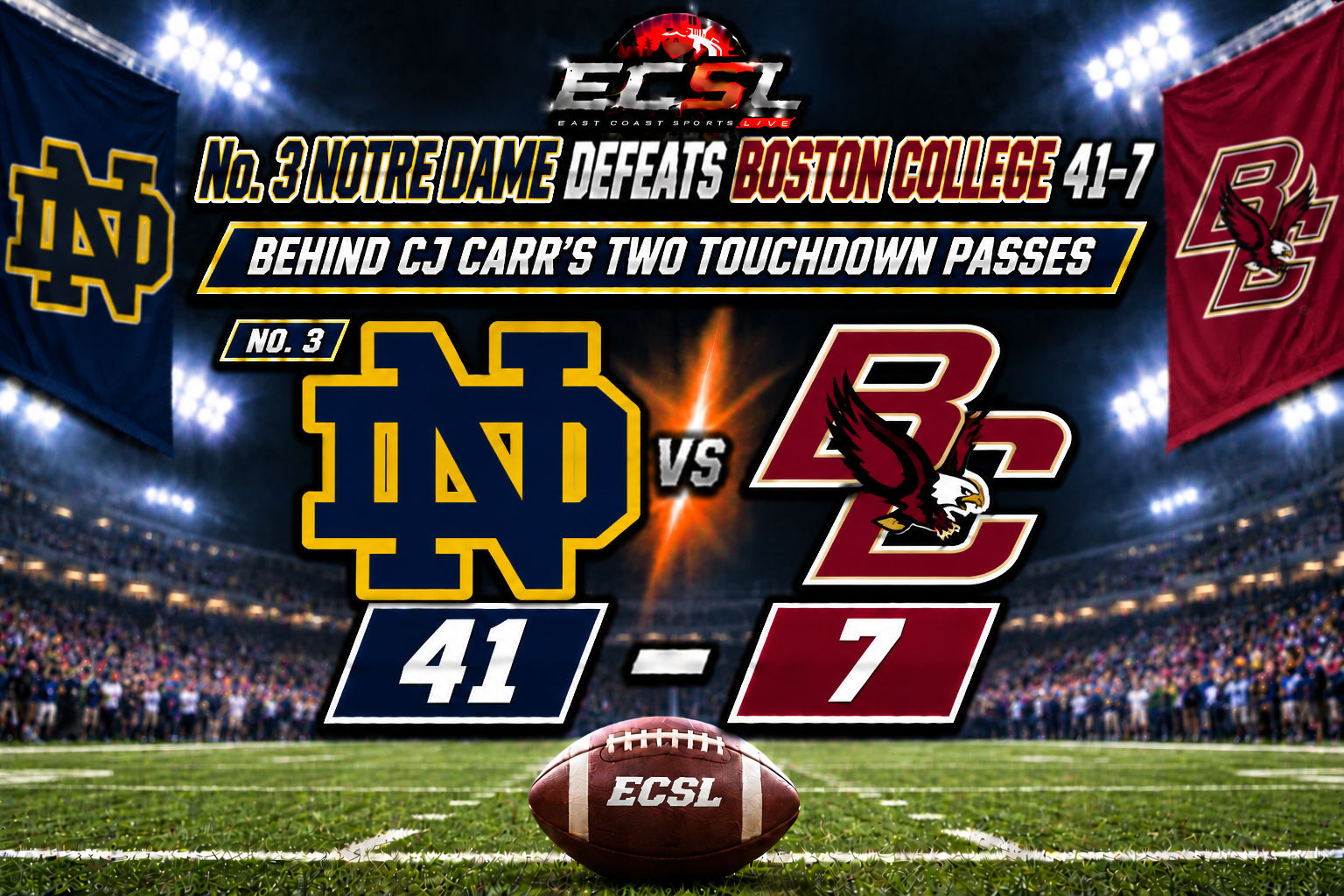
SOUTH BEND, Ind. — No. 3 Notre Dame avoided a potential letdown following its victory over top-ranked Miami, dominating Boston College 41-7 on Saturday, November 14, 2026, at Notre Dame Stadium. Quarterback CJ Carr completed 20 of 28 passes for 217 yards and two touchdowns, while freshman running back Jonaz Walton rushed for a career-high 141 yards and a touchdown. The Fighting Irish scored 31 unanswered points before halftime and held Boston College to just 136 total offensive yards. Notre Dame improved to 9-1 overall , maintaining momentum in the College Football Playoff race after defeating then-No. 1 Miami 31-24 the previous weekend. Boston College dropped to 4-6 after struggling to establish offensive consistency against Notre Dame's defense. CJ Carr Throws Two Touchdowns as Notre Dame Takes Control Carr helped Notre Dame establish control immediately, directing a productive opening possession. The Fighting Irish quarterback connected with wide receiver Micah Gilbert for a 26-yard touchdown , giving Notre Dame a 7-0 advantage. The touchdown marked Gilbert's sixth receiving score of the season and continued the offensive connection he established with Carr during the previous week's victory over Miami. Notre Dame scored touchdowns on three of its first four offensive possessions, preventing Boston College from developing momentum. Carr finished with 217 passing yards and two touchdowns despite throwing his second interception of the season. His performance demonstrated Notre Dame's offensive balance, as the Fighting Irish relied on both explosive passing plays and a physical rushing attack. Jonaz Walton Rushes for 141 Yards and a Touchdown Freshman running back Jonaz Walton delivered one of the most impressive performances of his young collegiate career. Walton rushed for 141 yards on 15 carries , averaging 9.4 yards per attempt. His performance included explosive runs of 50 and 28 yards, consistently challenging Boston College's defensive front. Walton also scored on a one-yard touchdown run during the second quarter, helping Notre Dame extend its advantage to 21-0. The freshman finished with more rushing yards individually than Boston College generated in total offense. His emergence provided Notre Dame with another reliable offensive weapon following the departures of Jeremiyah Love and Jadarian Price to the NFL. Running back Nolan James Jr. also contributed significantly, rushing for 73 yards and a touchdown . James scored on a powerful 10-yard run, breaking through Boston College defenders behind effective blocking from Notre Dame's offensive line. Together, Walton and James established the physical rushing attack that helped the Fighting Irish control the contest. Notre Dame Builds Commanding 31-0 Halftime Lead Notre Dame's offense and defense worked together to create a decisive first-half advantage. Following Carr's opening touchdown pass to Gilbert, James added his 10-yard rushing touchdown. Walton followed with a one-yard scoring run, extending Notre Dame's advantage to 21-0. The Fighting Irish defense then delivered one of the game's most important plays. Defensive lineman Boubacar Traore pressured Boston College quarterback Mason McKenzie and forced a fumble on a sack. Linebacker Jaylen Sneed recovered the loose football in the end zone for a one-yard defensive touchdown , increasing Notre Dame's lead to 28-0. The defensive score highlighted Notre Dame's aggressive approach and its ability to create scoring opportunities through turnovers. Kicker Spencer Porath added a field goal before halftime, establishing a 31-0 advantage . Notre Dame outscored Boston College 24-0 during the second quarter while holding the Eagles to minus-10 total offensive yards. The dominant opening half effectively decided the outcome before the teams returned from the locker rooms. Jaylen Sneed and Notre Dame Defense Shut Down Boston College Notre Dame's defense delivered one of its strongest performances of the season. The Fighting Irish limited Boston College to 136 total yards , preventing the Eagles from establishing a consistent rushing or passing attack. Linebackers Jaylen Sneed and Kyngstonn Viliamu-Asa played particularly important roles. Viliamu-Asa finished with seven tackles, including four stops against the run, while Sneed consistently pressured Boston College's offense. Sneed's fumble recovery touchdown provided another highlight for a defense that controlled the line of scrimmage. The linebacking unit continued performing effectively despite the absence of injured captain Drayk Bowen. Notre Dame's defensive pressure disrupted McKenzie's passing rhythm and forced Boston College into difficult situations throughout the afternoon. The Eagles struggled to sustain possessions, particularly during the second quarter when they finished with negative total yardage. Boston College Capitalizes on Carr's Third-Quarter Interception Boston College's only touchdown came after a Notre Dame turnover early in the second half. Defensive back K.P. Price intercepted Carr's pass, giving the Eagles possession at the Notre Dame 27-yard line. The interception ended Carr's streak of 190 consecutive pass attempts without throwing a pick. Price's takeaway marked his fourth interception of the season, helping Boston College increase its ACC-leading total to 13 interceptions . The Eagles quickly capitalized on the favorable field position. Running back Bo MacCormack III scored on a three-yard touchdown run , reducing Notre Dame's advantage to 31-7. However, the touchdown represented Boston College's only scoring possession of the afternoon. The Eagles were unable to build on the momentum as Notre Dame's defense regained control. Jordan Faison Scores as Notre Dame Extends Lead Notre Dame responded immediately following Boston College's touchdown. Carr directed another productive offensive possession, connecting with wide receiver Jordan Faison for a 13-yard touchdown pass . Faison secured the catch in the end zone, extending Notre Dame's advantage to 38-7. The scoring play demonstrated the Fighting Irish's ability to respond after committing a costly turnover. Notre Dame later added another field goal to establish the final 41-7 margin . The Fighting Irish generated approximately 500 total offensive yards, combining Carr's passing production with an effective rushing attack. Although Notre Dame's offense slowed during the final stages, its early dominance ensured a comfortable victory. Notre Dame Avoids Repeat of Historic 1993 Upset Saturday's matchup carried historical significance because of Notre Dame's victory over Miami the previous weekend. In 1993, Notre Dame defeated No. 1 Florida State before suffering a devastating home loss to Boston College the following week. The similarities created questions about whether the Fighting Irish could maintain their focus after another major victory over the nation's top-ranked team. However, head coach Marcus Freeman emphasized preparation and discipline throughout the week. Notre Dame responded with a commanding performance, scoring 31 points before halftime and preventing Boston College from mounting a serious challenge. The victory demonstrated the Fighting Irish's ability to maintain consistency following an emotionally significant win. Despite the comfortable margin, Notre Dame committed nine penalties for 66 yards , leaving areas for improvement. Carr's interception also provided a reminder that offensive execution remains important as the postseason approaches. Notre Dame Strengthens College Football Playoff Position The victory improved Notre Dame's record to 9-1 and reinforced its position among the leading College Football Playoff contenders. The Fighting Irish entered the matchup ranked No. 5 in the CFP rankings , despite holding the No. 3 designation in the national poll. Following the previous week's victory over Miami, Notre Dame needed another strong performance to maintain its postseason momentum. The Fighting Irish responded with a balanced offensive attack and dominant defensive execution. Walton's emergence as a productive running back provided additional depth, while Carr continued demonstrating his ability to lead the passing game. Notre Dame's defensive performance also highlighted the team's strength entering the final stretch of the regular season. For Boston College, the defeat represented another setback in its pursuit of bowl eligibility. The Eagles will need to win their remaining regular-season games to reach six victories. What's Next for Notre Dame and Boston College? Notre Dame remains at home to face SMU on Saturday, November 21 , in another important late-season matchup. The Fighting Irish will look to extend their winning streak and continue strengthening their College Football Playoff position. Boston College returns home to face Syracuse on Saturday, November 21 . The Eagles will attempt to recover from the defeat and keep their postseason hopes alive. For Notre Dame, Carr's two touchdown passes, Walton's 141 rushing yards and an outstanding defensive performance combined to produce a convincing victory. The 41-7 win over Boston College demonstrated the Fighting Irish's ability to maintain focus after a major victory while continuing their pursuit of a College Football Playoff berth.
football
By Amber Aniston • November 15, 2026
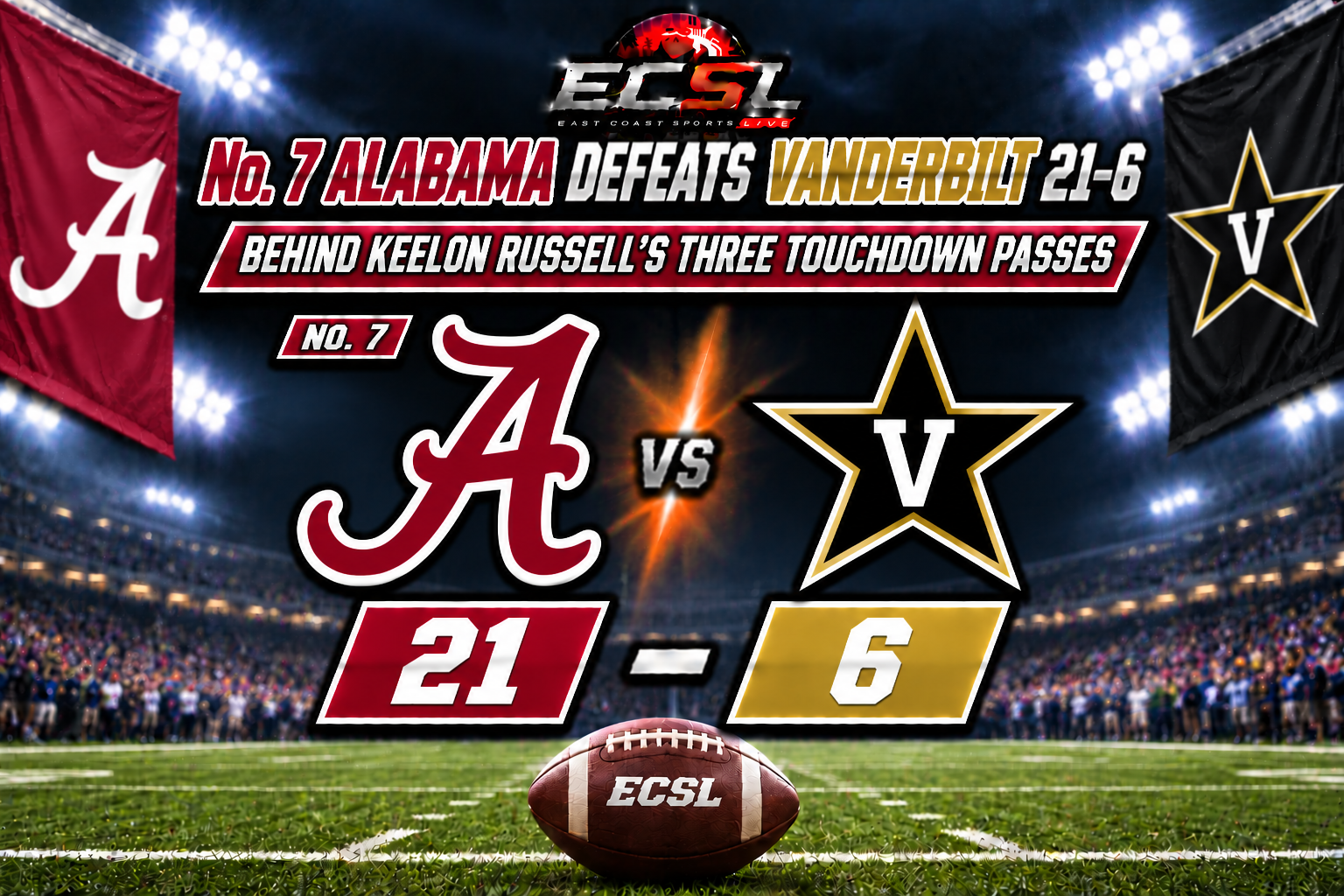
NASHVILLE, Tenn. — No. 7 Alabama overcame a sluggish offensive start to defeat Vanderbilt 21-6 on Saturday, November 14, 2026, at FirstBank Stadium, behind three touchdown passes from quarterback Keelon Russell and a dominant defensive performance. Russell, who entered the matchup with an ankle injury, completed 22 of 33 passes for 217 yards and three touchdowns. Wide receiver Lotzeir Brooks caught two second-half touchdown passes as the Crimson Tide pulled away from the Commodores. Alabama improved to 8-2 overall and 6-2 in Southeastern Conference play , strengthening its position in the College Football Playoff race despite an inconsistent offensive showing. Vanderbilt dropped to 4-6 overall and 1-6 in conference competition after struggling to capitalize on turnovers and scoring opportunities. Keelon Russell Throws Three Touchdowns Despite Ankle Injury Russell's availability remained uncertain throughout the week after an ankle injury limited his participation in practice. Alabama head coach Kalen DeBoer prepared backup quarterback Austin Mack to potentially start, but Russell recovered sufficiently to take the field. Despite being sacked three times and throwing an interception, Russell delivered the game's three touchdown passes. The quarterback completed 22 of 33 attempts for 217 yards , recording his sixth game this season with at least three passing touchdowns. His first scoring pass came during the final seconds of the opening half, connecting with tight end Marshall Pritchett for a nine-yard touchdown. Russell then found Brooks twice during the third quarter, turning a narrow halftime advantage into a comfortable lead. His performance demonstrated resilience despite limited preparation and persistent pressure from Vanderbilt's defense. Vanderbilt Takes Early Lead as Alabama Offense Struggles Neither team established consistent offensive momentum during the opening quarter. Alabama's first five possessions ended with three punts, a turnover on downs and an interception. Vanderbilt's defense disrupted Russell's passing rhythm while limiting the Crimson Tide's rushing attack. The Commodores created a major opportunity when Dontae Carter intercepted a pass that had been deflected into the air. The turnover gave Vanderbilt possession at Alabama's 17-yard line. However, the Commodores struggled to capitalize. A false-start penalty pushed Vanderbilt backward, and three consecutive negative-yardage plays forced a long field-goal attempt. Kicker Brock Taylor converted from 52 yards with 4:13 remaining in the second quarter , giving Vanderbilt a 3-0 advantage. The Commodores' inability to turn favorable field position into a touchdown proved costly. Marshall Pritchett Gives Alabama Halftime Lead Alabama finally established offensive momentum during its final possession of the first half. Russell directed a nine-play, 75-yard drive, moving the Crimson Tide into scoring position. With just six seconds remaining before halftime, Russell connected with Pritchett for a nine-yard touchdown pass . The score gave Alabama a 7-3 advantage entering the break. It marked the sixth time this season that the Crimson Tide scored during its final possession of the opening half. The touchdown also provided a critical momentum shift after Vanderbilt's defense had controlled much of the first two quarters. Alabama's defense had limited the Commodores to only 32 total offensive yards before halftime, preventing Vanderbilt from building a larger advantage. Lotzeir Brooks Scores Twice in Third Quarter Alabama carried its late first-half momentum into the third quarter. The Crimson Tide opened the second half with a six-play, 75-yard touchdown drive. Russell connected with Brooks on a 39-yard catch-and-run touchdown , extending Alabama's lead to 14-3 with 12:18 remaining in the quarter. Vanderbilt responded with another impressive field goal from Taylor. The Commodores moved 36 yards in eight plays before Taylor converted from 57 yards , reducing the deficit to 14-6. However, Alabama immediately answered through special teams. Freshman defensive back Dijon Lee Jr. returned the ensuing kickoff 83 yards , giving the Crimson Tide excellent field position. The return was Alabama's longest since Jameson Williams scored on a 100-yard kickoff return against Southern Mississippi in September 2021. Russell quickly capitalized, connecting with Brooks for a nine-yard touchdown pass. The score extended Alabama's advantage to 21-6 with 7:13 remaining in the third quarter . Brooks finished with five receptions for 62 yards and two touchdowns, recording his first multi-touchdown performance of the season. Alabama Defense Records Five Sacks and Limits Vanderbilt to Six Points While Russell and Brooks provided the scoring, Alabama's defense delivered the most consistent performance of the afternoon. The Crimson Tide held Vanderbilt to 235 total offensive yards , including just 12 rushing yards. Alabama also limited the Commodores to two successful third-down conversions on 15 attempts. The defensive front recorded five sacks, matching its season high. QB Reese led the Crimson Tide with eight tackles and one sack. Fatutoa Henry, Justin Hill, Yhonzae Pierre and Abduall Sanders Jr. also recorded sacks, giving Alabama five different defenders with a quarterback takedown. Hill contributed 1.5 tackles for loss, while Pierre added two quarterback hurries. The Crimson Tide forced five three-and-out possessions and stopped Vanderbilt on fourth down three times. Two of those fourth-down stops came during the Commodores' final possessions, preventing any possibility of a late comeback. The six points allowed represented Alabama's best defensive scoring performance of the season and its fewest points surrendered in an SEC game since shutting out Missouri in October 2024. Daniel Hill Leads Alabama Rushing Attack Running back Daniel Hill provided an important contribution to Alabama's offense, particularly while Russell managed his ankle injury. Hill rushed for 89 yards on 14 carries , averaging 6.4 yards per attempt. The performance represented a significant improvement after Hill had totaled just 85 rushing yards across Alabama's previous three games. His ability to generate positive yardage helped the Crimson Tide sustain possessions after struggling to establish the running game early. Alabama finished with 92 rushing yards as Vanderbilt's defensive front continued challenging the Crimson Tide. Wide receiver Ryan Coleman-Williams also delivered a productive performance, catching seven passes for 68 yards. Coleman-Williams surpassed 2,000 career receiving yards , moving into ninth place on Alabama's all-time receiving list with 2,051 yards. Despite those contributions, Alabama's offense finished with 309 total yards, leaving room for improvement entering the final stretch of the regular season. Vanderbilt's Penalties and Missed Opportunities Prove Costly Vanderbilt's defense created several opportunities to keep the Commodores competitive. Dontae Carter intercepted Russell, while Miles Capers forced a fumble that Talan Carter recovered. The Commodores also stopped Alabama on fourth down during the first half. However, Vanderbilt's offense struggled to convert those opportunities into points. The Commodores committed 14 penalties for 92 yards , including seven false starts and three holding penalties. Eleven of their penalties occurred on offense, repeatedly disrupting possessions and creating difficult down-and-distance situations. Vanderbilt also failed to capitalize on several drives into Alabama territory. Taylor, who became Vanderbilt's all-time leading scorer during the game, converted field goals from 52 and 57 yards. However, he missed a 50-yard attempt early in the fourth quarter. Vanderbilt head coach Clark Lea acknowledged his team's offensive struggles following the defeat. Although the Commodores held Alabama scoreless in the fourth quarter, they could not overcome their earlier mistakes. Alabama Strengthens College Football Playoff Position Saturday's victory improved Alabama's record to 8-2 and maintained its position among the leading College Football Playoff contenders. The Crimson Tide entered the matchup ranked No. 3 in the CFP rankings , despite carrying the No. 7 designation in the national poll used for the matchup. While the victory strengthened Alabama's postseason résumé, the offensive inconsistencies highlighted areas requiring improvement. The Crimson Tide struggled to generate rushing production, committed costly turnovers and failed to score during the fourth quarter. However, Alabama's defense demonstrated its ability to control an SEC opponent, while Russell delivered three touchdown passes despite limited preparation. The victory also improved Alabama's all-time record against Vanderbilt to 65-19-4 , including a 31-13-2 mark in Nashville. With two regular-season games remaining, Alabama will look to build on its defensive success while developing greater offensive consistency. What's Next for Alabama and Vanderbilt? Alabama returns home to face Chattanooga on Saturday, November 21 , at Saban Field at Bryant-Denny Stadium. Kickoff is scheduled for 1 p.m. CT , with coverage on SEC Network+. Vanderbilt travels to face Florida on Saturday, November 21 , seeking its fifth victory of the season. For Alabama, Russell's three touchdown passes, Brooks' two scoring receptions and a dominant defensive effort provided the foundation for another important SEC victory. The 21-6 win over Vanderbilt kept the Crimson Tide firmly in the College Football Playoff conversation while demonstrating the importance of defensive consistency during the final weeks of the regular season.
football
By Amber Aniston • November 15, 2026
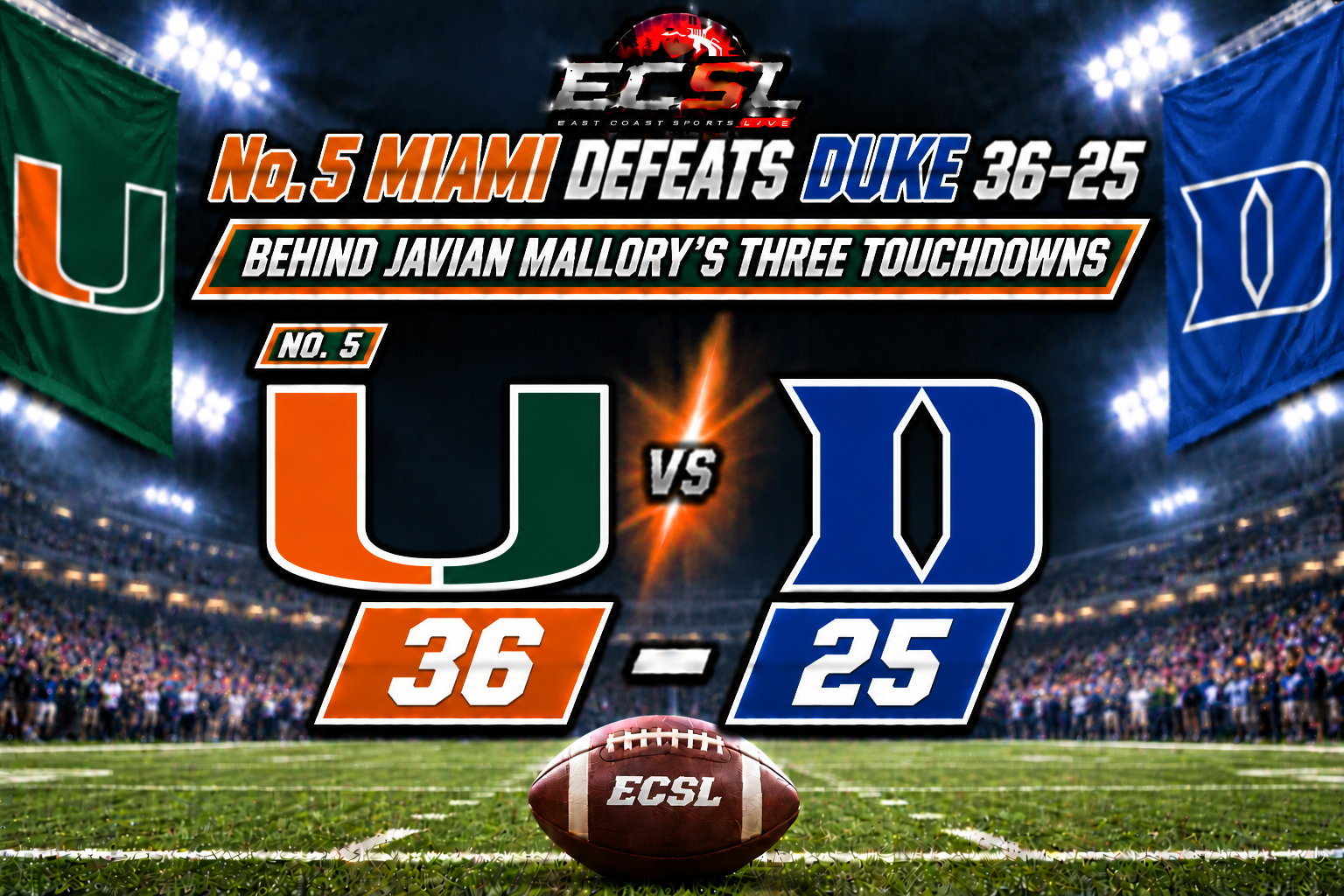
MIAMI GARDENS, Fla. — November 14, 2026 — No. 5 Miami moved closer to securing a place in the Atlantic Coast Conference (ACC) Championship Game with a 36-25 victory over Duke on Saturday at Hard Rock Stadium. Freshman running back Javian Mallory scored three touchdowns, while quarterback Darian Mensah threw for 382 yards against his former team to help the Hurricanes improve to 9-1 overall and remain unbeaten in conference play. Miami faced a persistent Duke team that remained within striking distance through three quarters. However, the Hurricanes pulled away in the fourth quarter behind Mallory's explosive rushing performance and a critical interception by defensive back Xavier Lucas. The victory extended Miami's conference record to 7-0 and marked its 11th consecutive ACC win, tying a school record. Javian Mallory Scores Three Touchdowns to Lead Miami Mallory delivered one of the most impactful performances of Miami's season, finishing with 150 yards from scrimmage and three touchdowns. The freshman recorded 71 rushing yards on 10 carries and added 79 receiving yards on three catches. His first touchdown came during the third quarter when Mensah connected with him on a 63-yard catch-and-run that extended Miami's lead to 22-10. Duke responded to narrow the deficit, but Mallory took control during the final quarter. He capped a 79-yard Miami possession with a 2-yard touchdown run, extending the Hurricanes' advantage to 29-17 with 8:06 remaining. Minutes later, Lucas intercepted Duke quarterback Walker Eget, giving Miami another opportunity to increase its lead. Mallory capitalized with a 39-yard touchdown run that pushed the score to 36-17 with 4:21 remaining. The three-touchdown performance made Mallory the first Miami freshman to score three touchdowns in a game since Mark Walton accomplished the feat against Georgia Tech on November 21, 2015. His combination of receiving ability, rushing explosiveness, and late-game production proved decisive against a Duke defense that had entered the matchup with an impressive recent stretch of touchdown prevention. Darian Mensah Throws for 382 Yards Against Former Team Miami quarterback Darian Mensah delivered an efficient performance against the program he previously led to an ACC championship. Mensah completed 30 of 41 passes for 382 yards and one touchdown, surpassing 3,000 passing yards for the season. The matchup carried additional significance because Mensah transferred to Miami after helping Duke capture the previous season's conference title. Despite the familiarity between the quarterback and his former teammates, Mensah consistently moved the Hurricanes' offense downfield. His connection with Mallory produced Miami's longest touchdown play of the afternoon, while his chemistry with receiver Cooper Barkate helped sustain several important possessions. Barkate, another former Duke player, recorded eight receptions for 134 yards, marking his first 100-yard receiving performance with Miami. The combination of Mensah's passing accuracy, Barkate's receiving production, and Mallory's versatility gave the Hurricanes multiple ways to attack Duke's defense. Miami finished with 36 points, the most Duke had allowed in a game during the 2026 season entering the matchup. Miami Takes a Narrow Lead Into Halftime The opening quarter ended without either team scoring, but both offenses found opportunities during the second period. Miami opened the scoring when kicker Jake Weinberg converted a 39-yard field goal early in the quarter. Duke responded with a 37-yard field goal from Gavin Strange to tie the game at 3-3. The Hurricanes then established their first touchdown drive of the afternoon. Running back Mark Fletcher Jr. scored on a 4-yard rush, putting Miami ahead 10-3 with 5:47 remaining before halftime. The touchdown carried historical significance for both programs. For Miami, it was Fletcher's 36th career rushing touchdown, moving him past Stephen McGuire for the most in school history. For Duke, it ended a defensive stretch of 13 consecutive quarters without allowing a touchdown. However, the Blue Devils answered quickly. Running back Nate Sheppard broke free for a 47-yard touchdown run, tying the score at 10-10. Miami regained the lead before halftime when Weinberg converted another field goal, sending the Hurricanes into the locker room ahead 13-10. Despite Miami's offensive production, Duke's defense kept the game competitive by limiting several scoring opportunities to field goals. Nate Sheppard Keeps Duke Competitive With Record-Setting Performance Although Miami ultimately secured the victory, Duke running back Nate Sheppard delivered one of the game's strongest individual performances. Sheppard rushed for 131 yards and two touchdowns on 16 carries while adding 93 receiving yards on 12 receptions. He also contributed 16 passing yards, accounting for 240 combined rushing, receiving, and passing yards. His two rushing touchdowns helped Duke remain competitive against a Miami defense that had been difficult to run against throughout the season. Sheppard's first touchdown came on a 47-yard run during the second quarter. He later added a 5-yard touchdown in the third quarter after another 47-yard rushing gain helped move Duke into scoring position. His rushing performance also established a Duke single-season record. Sheppard finished the afternoon with 1,320 rushing yards for the season, surpassing the previous program record held by Mataeo Durant. The sophomore became the first Duke player since Daniel Jones in 2018 to record two runs of at least 40 yards in an ACC game. Despite his production, the Blue Devils struggled to consistently contain Miami's passing attack and explosive plays. Duke quarterback Walker Eget completed 26 of 42 passes for 195 yards and one touchdown but threw a costly fourth-quarter interception. Miami Pulls Away With Two Fourth-Quarter Touchdowns The Hurricanes entered the fourth quarter leading 22-17 after Sheppard's second rushing touchdown brought Duke within five points. With the outcome still uncertain, Miami responded with one of its most important offensive possessions. Mensah directed a 79-yard drive that featured multiple completions to Barkate and concluded with Mallory's 2-yard rushing touchdown. The score gave Miami a 29-17 advantage. Duke attempted to respond, but Lucas intercepted Eget with 6:54 remaining, shifting momentum firmly toward the Hurricanes. Miami then assembled a five-play, 71-yard drive that ended with Mallory's 39-yard touchdown run. The two touchdowns came less than four minutes apart and effectively decided the contest. Duke added a late touchdown when Eget connected with tight end Jeremiah Hasley on a 1-yard pass, producing the final 36-25 score. Hasley's reception was his 10th career touchdown catch, placing him third among Duke tight ends in program history. Miami's fourth-quarter execution demonstrated its ability to finish a competitive conference matchup despite sustained pressure from the Blue Devils. Xavier Lucas and Miami Defense Deliver Key Stops Miami's defense faced challenges containing Sheppard, but several individual performances helped prevent Duke from completing a comeback. Lucas made the game's most consequential defensive play with his fourth-quarter interception. The takeaway gave Miami possession while protecting a two-score lead and directly preceded Mallory's final touchdown. Linebacker Mohamed Toure led the Hurricanes with 11 total tackles. Defensive backs Dylan Day and JJ Dunnigan each recorded six tackles, while Bryce Fitzgerald contributed three tackles and a pass breakup. Miami played without starting safety Zechariah Poyser, who had sustained an apparent shoulder injury during the previous week's loss to Notre Dame. The absence required adjustments in the Hurricanes' secondary, including moving Fitzgerald back to safety and returning Omar Thornton to a starting nickel cornerback role. Although Duke generated several explosive rushing plays, Miami's defense delivered enough stops and timely turnovers to preserve the victory. Mark Fletcher Jr. Breaks Miami Rushing Touchdown Record Fletcher's second-quarter touchdown provided another significant milestone for the Hurricanes. His 4-yard scoring run was the 36th rushing touchdown of his Miami career, establishing a new program record. Fletcher surpassed Stephen McGuire, with whom he had previously shared the school record. However, Fletcher did not receive a carry during the second half after experiencing a lower-body injury. Miami head coach Mario Cristobal did not express major concern about the injury following the game, although its longer-term implications were not established in the available reports. With Fletcher unavailable during the second half, Mallory assumed a larger role in Miami's offensive attack. The freshman responded with two fourth-quarter rushing touchdowns, reinforcing the Hurricanes' backfield depth during an important conference victory. Miami Moves Closer to ACC Championship Game The victory significantly strengthened Miami's position in the ACC championship race. At 9-1 overall and 7-0 in conference play, the Hurricanes remained undefeated against ACC opponents. Miami also tied its school record with 11 consecutive conference victories. The Hurricanes entered the weekend needing favorable results elsewhere in the conference standings or another victory to secure their championship game appearance. Wake Forest's victory over SMU improved Miami's position, but Louisville's 16-14 win over North Carolina prevented the Hurricanes from clinching immediately. Miami can secure its place in the December 5 ACC Championship Game in Charlotte with one additional conference victory against Virginia Tech or Boston College. A Louisville conference loss would also provide Miami a path to clinching. The Hurricanes' ability to finish the regular season strongly will determine whether they can compete for the conference championship while maintaining their position in the national postseason conversation. What's Next for Miami and Duke? Miami returns to Hard Rock Stadium on November 21 to face Virginia Tech. The Hurricanes will have an opportunity to clinch their ACC Championship Game berth while extending their conference winning streak. Duke, meanwhile, returns home to face Clemson on Friday. The Blue Devils will look to rebound after falling to 7-3 overall, with Sheppard's record-setting season remaining a major offensive strength. For Miami, the 36-25 victory represented more than another conference win. Mallory's three-touchdown performance, Mensah's 382 passing yards, and Lucas' timely interception demonstrated how the Hurricanes can rely on contributions across multiple positions when facing a competitive opponent. With the ACC Championship Game approaching, Miami now controls its opportunity to reach Charlotte and compete for the conference title.
FOOTBALL
By Amber Aniston • November 15, 2026
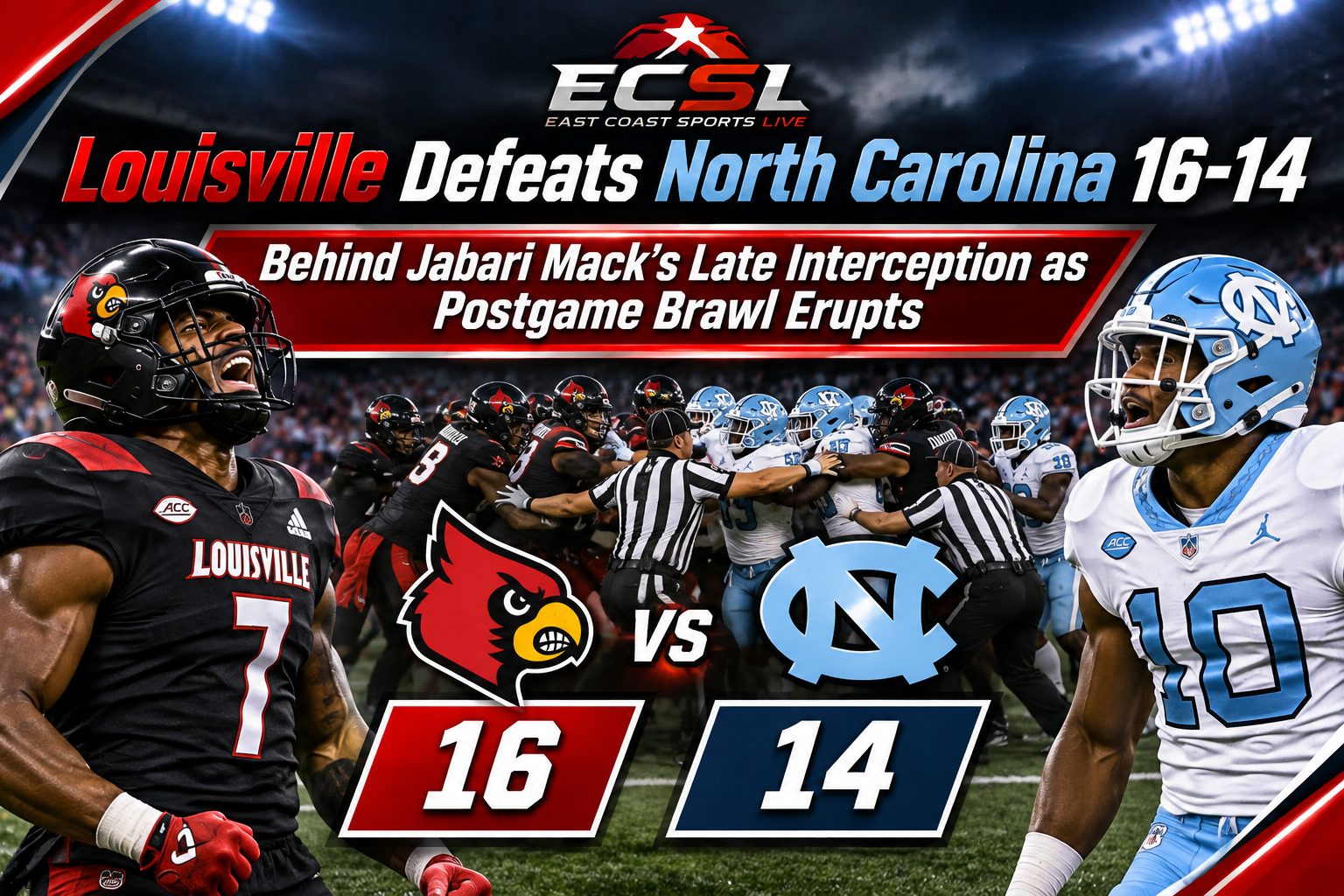
Louisville Defeats North Carolina 16-14 Behind Jabari Mack's Late Interception as Postgame Brawl Erupts CHAPEL HILL, N.C. — November 14, 2026 — Louisville survived a late comeback attempt by North Carolina, securing a 16-14 victory Saturday night at Kenan Stadium behind a decisive interception from defensive back Jabari Mack. The Cardinals relied on defensive pressure, timely turnovers and three field goals to extend their winning streak to five games. The victory improved Louisville's record to 7-3 overall and 6-2 in Atlantic Coast Conference play, keeping the team in contention for a spot in the ACC Championship Game. North Carolina nearly completed a fourth-quarter comeback after running back Benjamin Hall scored his second touchdown with 3:43 remaining. However, Mack intercepted a fourth-down pass from freshman quarterback Travis Burgess with less than a minute left, allowing Louisville to run out the clock. The tense finish was followed by a confrontation between players from both teams after the final kneeldown. Coaches and staff intervened as several separate altercations developed before order was restored. While the postgame incident drew attention, Louisville's defensive performance ultimately determined the outcome of a closely contested conference matchup. Jabari Mack's Late Interception Secures Louisville Victory With Louisville protecting a two-point lead, North Carolina regained possession at its own 30-yard line with 1:41 remaining. The Tar Heels needed to move into field-goal range to potentially win the game. Burgess, who had replaced injured starting quarterback Billy Edwards Jr. during the third quarter, attempted to lead the final possession. North Carolina eventually faced fourth-and-12 with its opportunity to extend the drive on the line. Burgess targeted wide receiver Jordan Shipp, who initially made contact with the football but could not secure the reception. The deflected pass reached Mack, who completed the interception and returned it 32 yards before sliding to end the play. With 58 seconds remaining, Louisville gained possession and was able to exhaust the remaining time. The interception capped a strong performance by Mack, who finished with seven tackles and one takeaway. His final defensive contribution prevented North Carolina from attempting a potential game-winning field goal and ensured Louisville's fifth consecutive victory. The play also demonstrated the Cardinals' ability to execute under pressure despite an offense that had struggled to generate consistent second-half production. Louisville and North Carolina Players Clash After Final Whistle The conclusion of the game was overshadowed by a physical confrontation involving players from both teams. After Louisville quarterback Lincoln Kienholz took the final kneeldown, North Carolina defensive tackle Xavier Lewis and Louisville offensive lineman Johnnie Brown III continued engaging physically. The confrontation escalated as additional players became involved. What began as pushing between individuals developed into multiple altercations, with groups of players gathering and some falling to the ground. Other confrontations occurred away from the initial group, including an additional gathering near an end zone. Coaches, staff members and other personnel moved onto the field to separate the players. North Carolina head coach Bill Belichick was among those who intervened to direct Tar Heels players away from the confrontation. Louisville head coach Jeff Brohm also expressed disappointment with the incident following the game. The teams were eventually separated, and the postgame proceedings continued. The available reports did not establish a definitive cause beyond the initial confrontation or confirm subsequent disciplinary decisions. Although the altercation occurred after Louisville had secured the victory, it became a prominent part of the game's conclusion. Louisville Defense Records Six Sacks and Two Takeaways Louisville's defense delivered the most important contributions in a game where offensive opportunities were limited. The Cardinals recorded six sacks, forced two turnovers and held North Carolina to 293 total offensive yards. Their defensive pressure disrupted the Tar Heels' passing attack and helped prevent North Carolina from establishing sustained momentum. Linebacker Stanquan Clark led Louisville with 10 tackles, including two tackles for loss and a sack. Koen Entringer added seven tackles, two sacks and a forced fumble. Entringer's forced fumble during the second quarter was particularly important because it created the opportunity for Louisville's only touchdown. Mack contributed seven tackles and the game-sealing interception. Together, those performances helped compensate for an offense that produced just 302 total yards. Louisville's defensive effectiveness was particularly evident during the second and third quarters, when North Carolina failed to score. The Cardinals also responded after Hall's late touchdown brought the Tar Heels within two points. Rather than allowing North Carolina to complete the comeback, Louisville generated the final takeaway necessary to secure the victory. Lincoln Kienholz Throws Touchdown Pass to Jaleel Skinner Louisville quarterback Lincoln Kienholz finished the game completing 23 of 31 passes for 154 yards and one touchdown. Although the Cardinals struggled to create explosive passing plays, Kienholz delivered an important scoring connection during the second quarter. Following a forced fumble by Entringer and a recovery by Joshua McDonald, Louisville took possession at the North Carolina 21-yard line. The favorable field position provided the Cardinals with an opportunity to take control. After three rushing plays, Kienholz connected with tight end Jaleel Skinner on a 3-yard touchdown pass. The score gave Louisville a 13-7 lead with 12:15 remaining before halftime. It would prove to be the Cardinals' only touchdown of the game. Kienholz managed the offense effectively enough to protect the advantage, but Louisville encountered difficulties sustaining drives during the second half. The Cardinals had entered the matchup averaging 43.5 points during their previous four victories. North Carolina's defense limited that production considerably, forcing Louisville to depend on field goals and defensive stops. Despite the offensive challenges, Kienholz avoided a late turnover and successfully completed the kneeldowns that secured the result. Carson Hilbert's Three Field Goals Prove Decisive Louisville kicker Carson Hilbert played an essential role in the two-point victory. Hilbert converted three field goals, accounting for nine of Louisville's 16 points. His first successful attempt came during the opening quarter, when he connected from 46 yards to give the Cardinals a 3-0 advantage. North Carolina responded with a touchdown, but Hilbert added a 32-yard field goal early in the second quarter to reduce the deficit to 7-6. Louisville then took the lead on Skinner's touchdown reception. The Cardinals carried a 13-7 advantage into halftime and maintained that margin through a scoreless third quarter. With 7:28 remaining in the fourth quarter, Hilbert converted a 36-yard field goal to extend Louisville's lead to 16-7. That kick ultimately supplied the winning margin. North Carolina scored again later in the quarter, but Louisville's three successful field goals ensured that the Tar Heels still needed another scoring possession to take the lead. In a defensive matchup decided by two points, Hilbert's consistency was a significant factor. Benjamin Hall Scores Both North Carolina Touchdowns North Carolina running back Benjamin Hall provided the Tar Heels' primary scoring production. Hall finished with 48 rushing yards on 10 carries and scored both of North Carolina's touchdowns. His first score came during the opening quarter on an 11-yard run that gave the Tar Heels a 7-3 lead. The touchdown capped a 12-play, 75-yard possession and briefly shifted momentum toward North Carolina. However, Louisville responded with 10 unanswered points during the second quarter. North Carolina then struggled to sustain offensive drives through much of the middle portion of the game. Hall eventually helped bring the Tar Heels back into contention during the fourth quarter. With North Carolina trailing 16-7, the offense assembled a nine-play, 75-yard touchdown drive. Hall finished the possession with a 6-yard run, cutting Louisville's advantage to 16-14 with 3:43 remaining. The score gave North Carolina an opportunity to complete a comeback if its defense could force another possession. The Tar Heels accomplished the first part of that objective by forcing Louisville to punt. However, the final offensive drive ended with Mack's interception. Hall's two-touchdown performance kept North Carolina competitive, but the Tar Heels could not produce the additional points needed to secure the victory. Billy Edwards Jr. Injury Forces North Carolina Quarterback Change North Carolina faced an additional challenge when starting quarterback Billy Edwards Jr. left the game during the third quarter. Edwards completed 10 of 14 passes for 120 yards before suffering an apparent upper-body injury following a sack. Louisville defender T.J. Capers was credited with the play that forced Edwards from the game. True freshman Travis Burgess entered as his replacement, making his first college appearance. Burgess completed six of 11 passes for 59 yards and one interception. He also contributed 35 rushing yards on eight carries, providing North Carolina with additional mobility at quarterback. The freshman helped direct the Tar Heels' late touchdown drive and kept the offense competitive during the fourth quarter. However, Louisville's defensive pressure complicated North Carolina's efforts to move the football consistently. The final interception came on a pass that reached Shipp but was not secured before Mack collected the deflection. Although the turnover ended North Carolina's comeback opportunity, Burgess' performance provided valuable experience in a difficult situation. The available sources did not establish a definitive recovery timeline for Edwards. North Carolina Defense Limits Louisville to 302 Yards While Louisville's defense received considerable attention, North Carolina also delivered a competitive defensive performance. The Tar Heels held the Cardinals to 302 total yards and just one touchdown. Louisville entered the matchup following four victories in which its offense had averaged 43.5 points. North Carolina significantly reduced that scoring production by limiting explosive plays and forcing the Cardinals to settle for field goals. Louisville running back Keyjuan Brown recorded 78 rushing yards on 11 carries, averaging 7.1 yards per attempt. Isaac Brown added 50 rushing yards on 12 carries. Receiver Lawayne McCoy led Louisville's passing attack with six receptions for 64 yards. Despite those contributions, the Cardinals struggled to maintain consistent offensive rhythm during the second half. North Carolina's defensive effort gave its offense an opportunity to win the game late. However, the Tar Heels' inability to capitalize on that opportunity ultimately determined the result. The matchup demonstrated how a strong defensive performance can still end in defeat when turnovers and missed offensive opportunities prevent a team from converting field position into points. Louisville Extends Winning Streak to Five Games Louisville's victory represented its fifth consecutive win, strengthening its position in the ACC standings. The Cardinals improved to 7-3 overall and 6-2 in conference competition. Their recent success had largely featured strong offensive production, including three victories by at least 24 points during the preceding four-game stretch. The North Carolina matchup required a different approach. Instead of relying on a high-scoring offense, Louisville depended on defensive pressure, field-goal accuracy and timely turnovers. The Cardinals demonstrated that they could win a closely contested conference game even when their offensive production fell below recent levels. That adaptability could prove important during the final weeks of the regular season. However, Louisville will need to improve offensive consistency and reduce penalties as it prepares for its remaining opponents. The victory also preserved the Cardinals' opportunity to compete for a place in the ACC Championship Game. ACC Championship Race Remains Competitive Louisville's win carried implications beyond the two teams involved. Entering the weekend, the Cardinals were the only ACC team with two conference losses still positioned within reach of the championship race. No. 5 Miami remained unbeaten in ACC play at 7-0, while No. 11 Wake Forest held a 6-1 conference record. A North Carolina victory over Louisville would have secured Miami's place in the conference championship game. Instead, Louisville's narrow win kept the Cardinals mathematically involved in the race. Miami still needed one victory in its final two games to clinch its championship appearance, while Wake Forest remained a strong contender. Louisville's path depended on winning its remaining conference matchup and receiving favorable results elsewhere. The Cardinals' immediate priority will be their upcoming game against Pittsburgh. A victory would strengthen their conference position while allowing them to finish ACC play with seven wins. Although Louisville does not fully control the championship race, its five-game winning streak has kept its postseason ambitions alive. North Carolina Remains One Win Away From Bowl Eligibility The defeat left North Carolina at 5-5 overall and 2-4 in ACC competition. The Tar Heels entered the matchup needing one victory to reach six wins and improve their bowl eligibility prospects. Their recent offensive production had been encouraging, with the team scoring at least 30 points in each of its previous three games. Louisville's defense interrupted that momentum. North Carolina managed only 14 points, its lowest scoring total of the season. The injury to Edwards further complicated the offense's ability to maintain consistency. Despite those challenges, the Tar Heels nearly completed a late comeback. Hall's second touchdown and the subsequent defensive stop gave North Carolina a final opportunity to win. However, Mack's interception ended that possibility. The Tar Heels now face additional pressure to secure a victory in their remaining regular-season games. Their next matchup against Virginia will be particularly important, as both programs enter the contest with five wins and an opportunity to move closer to postseason eligibility. What's Next for Louisville and North Carolina? Louisville returns home to face Pittsburgh on November 21 in its final ACC matchup of the regular season. The Cardinals will look to extend their winning streak to six games while maintaining their position in the conference championship race. North Carolina travels to Virginia on November 21 for a matchup between two teams seeking their sixth victory. The Tar Heels will need to improve offensive consistency and protect the football more effectively against a Virginia team coming off a 36-7 victory over California. For Louisville, the 16-14 victory over North Carolina demonstrated the value of defensive execution in a game where scoring opportunities were limited. Mack's late interception, Entringer's disruptive performance and Hilbert's three field goals provided the foundation for the Cardinals' fifth consecutive win. The postgame confrontation created an unfortunate conclusion to an otherwise competitive matchup, but the result remained significant for Louisville's conference ambitions. As the regular season approaches its final weeks, the Cardinals remain in the ACC championship conversation, while North Carolina continues searching for the victory needed to strengthen its postseason hopes.
football
By Amber Aniston • November 15, 2026
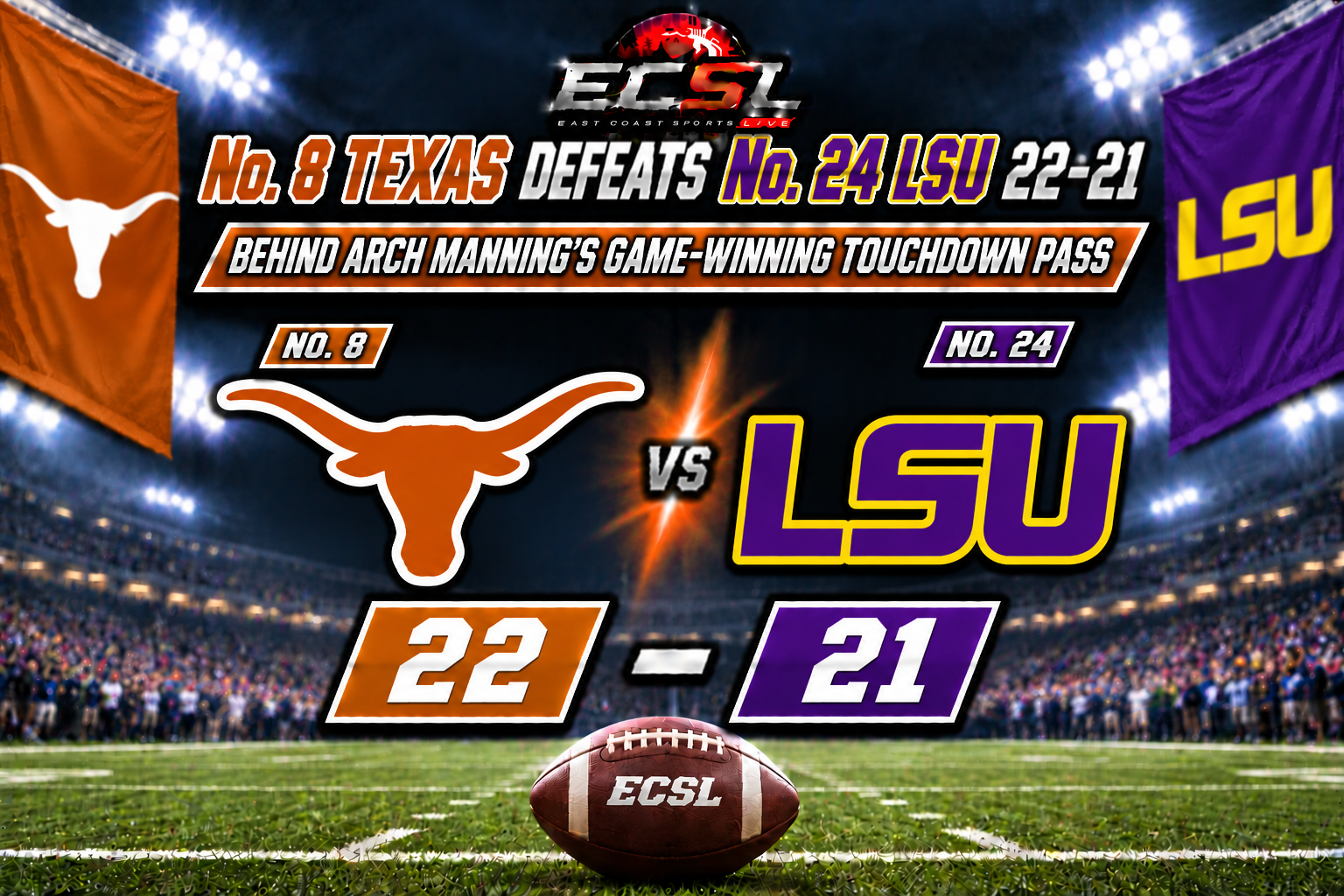
BATON ROUGE, La. — No. 8 Texas delivered one of the most dramatic finishes of the 2026 college football season Saturday night, November 14, defeating No. 24 LSU 22-21 at Tiger Stadium behind Arch Manning's game-winning touchdown pass with three seconds remaining. Manning connected with Raleek Brown for a four-yard touchdown, completing an 11-point second-half comeback in front of 102,321 fans. Despite throwing three interceptions, Manning delivered when Texas needed him most, leading a decisive 58-yard drive during the final two minutes. The Longhorns improved to 8-2 overall and 5-2 in Southeastern Conference play , strengthening their College Football Playoff position. LSU fell to 6-4 overall and 3-4 in conference competition after surrendering its 21-10 third-quarter advantage. Arch Manning Delivers Game-Winning Touchdown With Three Seconds Remaining Manning entered the final possession having endured one of his most challenging performances of the season. The Texas quarterback had thrown three interceptions and struggled to establish consistency against LSU's defense. However, trailing 21-16 with 2:19 remaining, Manning took possession at the Texas 42-yard line with an opportunity to complete the comeback. The sophomore quarterback responded with composure. Manning converted three critical third-down situations, including two with his legs, keeping the Longhorns' championship hopes alive. He completed six of eight passes for 51 yards during the decisive possession while adding 10 rushing yards. With the clock approaching its final seconds, Manning found Brown along the left sideline of the end zone for a four-yard touchdown . The scoring play gave Texas a 22-21 advantage with just three seconds remaining. The touchdown represented Texas' latest game-winning score in regulation since October 17, 1987, when Brett Stafford connected with Tony Jones as time expired against Arkansas. Manning finished 19 of 35 passing for 174 yards, one touchdown and three interceptions , while adding a rushing score. Although his overall statistics reflected an inconsistent performance, his execution during the final possession secured one of Texas' most important victories of the season. Texas Opens Scoring Before LSU Takes Control Texas established early momentum with an impressive opening possession. The Longhorns marched 75 yards on 11 plays , finishing the drive with Manning's one-yard rushing touchdown. The score gave Texas a 7-0 advantage. LSU responded behind quarterback Sam Leavitt, who connected with wide receiver Jackson Harris for a 10-yard touchdown pass . The scoring play tied the contest at 7-7. The Tigers continued attacking through the passing game during the second quarter. Leavitt found Harris again, this time for a nine-yard touchdown, giving LSU its first lead at 14-7. Texas responded with a 42-yard field goal from Gianni Spetic , reducing the deficit to 14-10. LSU threatened to extend its advantage before halftime, but the Longhorns' defense prevented another touchdown. Safety Jelani McDonald intercepted Leavitt in the end zone, preserving the four-point deficit. The Tigers also missed a 38-yard field-goal attempt during the closing stages of the opening half. LSU entered halftime leading 14-10 , having established offensive momentum but missed opportunities to create greater separation. Dilin Jones Extends LSU Lead With 44-Yard Touchdown LSU continued applying pressure during the third quarter. Running back Dilin Jones delivered the Tigers' most explosive offensive play, breaking through Texas' defense for a 44-yard rushing touchdown . The score extended LSU's advantage to 21-10 with 5:52 remaining in the third quarter . At that moment, the Tigers appeared positioned to secure a major victory over a nationally ranked SEC opponent. LSU had generated consistent offensive production and forced multiple turnovers against Manning. However, the Tigers struggled to sustain their offensive momentum during the final quarter. Texas' defense began controlling the line of scrimmage, while Spetic helped the Longhorns gradually reduce the deficit. Gianni Spetic Keeps Texas Within Striking Distance Texas relied on its kicking game to remain competitive during the second half. Spetic converted a 41-yard field goal late in the third quarter, cutting LSU's advantage to 21-13. The Longhorns continued generating defensive stops, creating another opportunity for their offense. Spetic then connected from 50 yards , reducing the deficit to 21-16. The kicker finished with three successful field goals, all from at least 40 yards. His consistency proved essential because Texas struggled to finish offensive possessions with touchdowns throughout much of the contest. The two second-half field goals positioned the Longhorns within one touchdown entering their final possession. Without Spetic's contributions, Manning's late scoring drive would not have been enough to secure the victory. Jelani McDonald Records Three Interceptions in Historic Performance Texas safety Jelani McDonald delivered one of the most impressive defensive performances of the season. McDonald intercepted three passes from LSU quarterback Sam Leavitt , becoming the first Texas player to record three interceptions in a single game since Aaron Humphrey accomplished the feat in 1997. His performance tied for the second-most interceptions in one game in program history. Only Bill Bradley, who recorded four interceptions against Texas A&M in 1968, has produced more. McDonald also finished with 11 tackles , matching linebacker Rasheem Biles for the team lead. Biles contributed two tackles for loss and two quarterback hits, applying consistent pressure on LSU's offense. The Longhorns recorded three sacks and forced three turnovers, helping overcome their offensive struggles. McDonald's interceptions repeatedly prevented LSU from extending its advantage and provided Texas with additional opportunities. Texas Defense Holds LSU to 22 Fourth-Quarter Yards The Longhorns' defensive performance became increasingly important as the game progressed. After allowing 21 points through three quarters, Texas shut out LSU during the fourth. The Longhorns limited the Tigers to just 22 total yards in the final quarter , forcing four consecutive punts. The defensive stops gave Manning multiple opportunities to lead a comeback. LSU finished with 366 total offensive yards compared with Texas' 273, but the Tigers struggled to capitalize on their statistical advantage. Leavitt passed for 244 yards and two touchdowns , both to Harris, but his three interceptions proved costly. The quarterback has now thrown 12 interceptions through 10 games this season. LSU's inability to generate sustained fourth-quarter possessions allowed Texas to control the closing stages. The Tigers also failed to score during the final period for the second consecutive week after experiencing similar offensive difficulties against Alabama. Arch Manning Continues Family's Tiger Stadium Legacy Saturday's comeback carried special significance for Manning, who grew up in Louisiana and attended LSU games during his childhood. His grandfather, Archie Manning, led Mississippi to a comeback victory at Tiger Stadium in 1968. His uncle, Eli Manning, accomplished a similar feat against LSU in 2001. Arch became the third generation of the Manning family to lead a dramatic comeback victory in Baton Rouge. Following the game, Manning celebrated with his parents, Cooper and Ellen, who watched the decisive touchdown from near the end zone. The quarterback embraced his father after the victory, creating an emotional moment following his challenging performance. Manning's ability to overcome three interceptions and deliver the winning touchdown reinforced his reputation as a resilient competitor. Texas head coach Steve Sarkisian praised Manning's toughness and determination after the game. The victory also represented a memorable homecoming for the quarterback, who grew up surrounded by LSU supporters. Texas Extends Winning Streak Against Ranked Opponents The victory carried significant postseason implications for Texas. The Longhorns entered the matchup ranked No. 6 in the College Football Playoff rankings , despite holding the No. 8 designation in the national poll. Texas secured its seventh consecutive victory over an AP Top 25 opponent , the longest active streak among Football Bowl Subdivision programs. The Longhorns improved to 5-0 against ranked opponents this season. Texas has also won 15 of its last 16 November games under Sarkisian, demonstrating consistent late-season performance. The victory strengthened the Longhorns' position in the College Football Playoff race despite their two losses. For LSU, the defeat represented another damaging setback. The Tigers entered ranked No. 21 in the CFP standings but dropped to 6-4 following their second consecutive loss. LSU's fourth defeat effectively ended its realistic hopes of reaching the College Football Playoff. The Tigers will now focus on finishing the regular season strongly and improving their postseason bowl positioning. What's Next for Texas and LSU? Texas returns home to face Arkansas on Saturday, November 21 , at Darrell K Royal–Texas Memorial Stadium. Kickoff is scheduled for 2:30 p.m. CT . The Longhorns will look to build on their dramatic comeback and continue strengthening their College Football Playoff résumé. LSU travels to face No. 9 Tennessee on Saturday, November 21 , seeking to recover from consecutive defeats. The Tigers will attempt to improve their offensive consistency and finish the regular season with momentum. For Texas, Manning's game-winning touchdown pass, McDonald's three interceptions and Spetic's three field goals combined to produce an unforgettable victory. The 22-21 comeback win over No. 24 LSU preserved the Longhorns' postseason ambitions and added another remarkable chapter to the Manning family's history at Tiger Stadium. 
More Posts